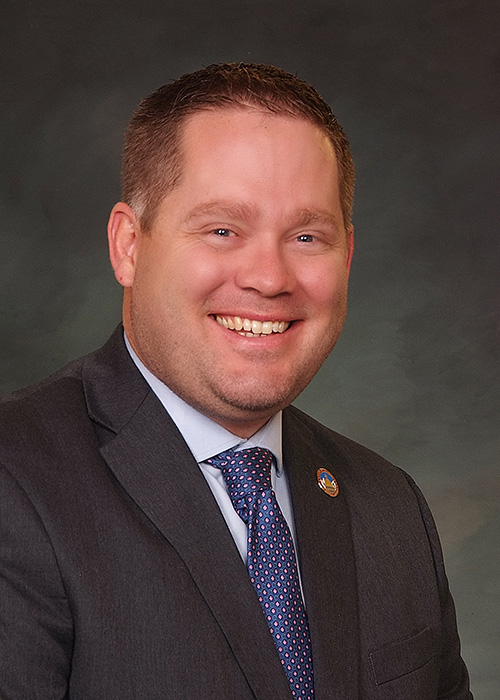
Photo of Kyle Mullica
D Colorado Senate · District 24 On the 2026 ballot

Sen. Kyle Mullica

Compare
Total votes
7,081
all sessions
Attendance
98%
143 missed
Near the chamber average
With party
97%
of cast votes
Lower than 78% of chamber peers
Bipartisan score
2%
crosses aisle rarely
Higher than 80% of chamber peers
Sponsored
475
bills & resolutions
Near the chamber average
Committees
7
assignments
475 bills and resolutions

Sponsored bills

Total
475
Primary
199
Co-sponsor
276
This page
475
matching current filters
Co-sponsor HJR 25-1007
Passed · Colorado House · Co-sponsor
Troy Jackson Memorial Highway

Maddy summaryThis bill (HJR 25-1007) is a commemorative resolution designating a specific segment of Interstate 25 in Colorado - southbound from mile marker 199.4 and northbound from mile marker 194.8 - as the "Firefighters Memorial Hwy in Memory of Chief Troy Jackson." It honors Troy Jackson, a 30-year firefighter with South Metro Fire Rescue who developed cancer prevention programs for first responders before passing in 2019. The resolution allows the Colorado Department of Transportation to accept donations for signage and coordinate with Arapahoe and Douglas counties for sign maintenance. As a naming resolution, it has no policy or funding changes beyond this memorial designation.

Passed Jan 31, 2025 1 co-sponsor
Co-sponsor SJR 25-004
Passed · Colorado Senate · Co-sponsor
Reproductive Rights and Justice Day

Maddy summarySJR 25-004 designates January 22 of each year as "Reproductive Rights and Justice Day" in Colorado. This symbolic resolution does not create new laws or policies but commemorates the anniversary of the Roe v. Wade decision (January 22, 1973) and acknowledges Colorado's legislative actions to protect reproductive rights, including the Reproductive Health Equity Act and the Safe Access to Protected Health Care Package. The designation serves as a formal observance without imposing legal obligations or altering existing rights.

Passed Jan 28, 2025 1 co-sponsor
Primary HB 25-1048
In committee · Colorado House · Lead sponsor
State Tax Expenditure & Grant Database

Legislative Oversight Committee Concerning Tax Policy. The bill creates an online database managed by the department of revenue that includes information on all qualifying state tax expenditures and state grant opportunities. A state grant opportunity is any grant funded by state money or administered by the state. A qualifying state tax expenditure is any state tax expenditure for which at least one of the following applies: A limited amount of dollars or credits is available; To qualify for the tax expenditure, a discretionary determination made by a state agency is necessary; or To qualify for the tax expenditure, a person must submit an application to and receive a certificate or other designation of approval from a state agency. The database must be created by December 31, 2026, and must be reviewed and updated on an annual basis. (Note: This summary applies to this bill as introduced.)

In committee Jan 27, 2025 0 co-sponsors
Co-sponsor HB 25-1045
In committee · Colorado House · Co-sponsor
Modify Long-Term Care Insurance Income Tax Credit

Legislative Oversight Committee Concerning Tax Policy. For income tax years commencing on or after January 1, 2025, the bill both: Increases the amount of federal taxable income a taxpayer may have and still qualify for the state income tax credit for purchasing long-term care insurance and annually adjusts that federal taxable income amount for inflation; and Doubles the amount of the credit a taxpayer may claim and, for income tax years commencing on or after January 1, 2026, annually adjusts the credit amount for inflation. (Note: This summary applies to this bill as introduced.)

In committee Jan 27, 2025 1 co-sponsor
Co-sponsor HJR 25-1005
Passed · Colorado House · Co-sponsor
Commemoration of Martin Luther King Jr. Day

Maddy summaryHJR 25-1005 is a ceremonial resolution encouraging Colorado communities to observe Martin Luther King Jr. Day on January 20, 2025 - the 41st anniversary of the state holiday. It does not create new laws or alter existing policies but urges cities, schools, counties, and local governments to hold commemorative events. The resolution honors Dr. King’s legacy, noting Colorado’s early adoption of the holiday in 1985 and its ongoing observance through events like the annual Marade. This is a non-binding call for community engagement, not a substantive legislative change.

Passed Jan 22, 2025 1 co-sponsor
Primary HB 24-1045
Signed into law · Colorado House · Lead sponsor
Treatment for Substance Use Disorders

The act prohibits an insurance carrier that provides coverage for a drug used to treat a substance use disorder under a health benefit plan from requiring prior authorization for the drug based solely on the dosage amount. The act requires an insurance carrier to reimburse a licensed pharmacist prescribing or administering medication-assisted treatment (MAT) pursuant to a collaborative pharmacy practice agreement (collaborative agreement) at a rate equal to the reimbursement rate for other health-care providers. The act amends the practice of pharmacy to include prescriptive authority for any FDA-approved product indicated for opioid use disorder in accordance with federal law, if authorized through a collaborative agreement. The act requires the state board of pharmacy, the Colorado medical board, and the state board of nursing to develop a protocol for pharmacists to prescribe, dispense, and administer certain FDA-approved products for MAT. The act requires reimbursement to pharmacies of an enhanced dispensing fee for administering injectable antagonist medication for MAT that aligns with the administration fee paid to a provider in a clinical setting. The act requires the medical assistance program to reimburse a pharmacist prescribing or administering medications for opioid use disorder pursuant to a collaborative agreement at a rate equal to the reimbursement rate for other providers. The act authorizes licensed clinical social workers, marriage and family therapists, and licensed professional counselors (professionals) within their scope of practice to provide clinical supervision to individuals seeking certification as addiction technicians and addiction specialists, and directs the state board of addiction counselors and the state board of human services, as applicable, to adopt rules relating to clinical supervision by these professionals. Further, a licensed addiction counselor is authorized to provide clinical supervision to individuals seeking licensure as marriage and family therapists or professional counselors if the licensed addiction counselor has met the education requirements for those professions, or the equivalent, as determined by the respective boards regulating those professions. The act expands the medication-assisted treatment expansion pilot program to include grants to provide training and ongoing support to pharmacies and pharmacists who are authorized to prescribe, dispense, and administer MAT pursuant to a collaborative agreement or drug therapy protocol to assist individuals with a substance use disorder. The act requires the department of health care policy and financing (HCPF) to seek federal authorization to provide MAT, case management services, and a 30-day supply of prescription medication to medicaid members upon release from jail or a juvenile institutional facility. The act adds substance use disorder treatment to the list of health-care or mental health-care services that are required to be reimbursed at the same rate for telemedicine as a comparable in-person service. The act requires HCPF to seek federal authorization to provide partial hospitalization for substance use disorder treatment with full federal financial participation. The act requires each managed care entity (MCE) that provides prescription drug benefits or methadone administration for the treatment of substance use disorders to: Set the reimbursement rate for take-home methadone treatment and office-administered methadone treatment at the same rate; and Not impose any prior authorization requirements on any prescription medication approved by the FDA for the treatment of substance use disorders, regardless of the dosage amount. The act requires the behavioral health administration (BHA) to collect data from each withdrawal management facility on the total number of individuals who were denied admittance or treatment for withdrawal management and the reason for the denial and to review and approve any admission criteria established by a withdrawal management facility. The act requires each MCE to disclose the aggregated average and lowest rates of reimbursement for a set of behavioral health services determined by HCPF and authorizes behavioral health providers to disclose reimbursement rates paid by an MCE to the behavioral health provider. Beginning in the 2024-25 state fiscal year, the act appropriates $150,000 from the general fund to the Colorado child abuse prevention trust fund (trust fund) for programs to reduce the occurrence of prenatal substance exposure. For the 2024-25 and 2025-26 state fiscal years, the act also annually appropriates $50,000 from the general fund to the trust fund to convene a stakeholder group to identify strategies to increase access to child care for families seeking substance use disorder treatment and recovery services. The act requires the BHA to contract with an independent third-party entity to provide services and supports to behavioral health providers seeking to become a behavioral health safety net provider with the goal of the provider becoming self-sustaining. The act creates the contingency management grant program in the BHA to provide grants to substance use disorder treatment programs that implement a contingency management program for individuals with a stimulant use disorder. The act authorizes the BHA to apply for federal funding for fetal alcohol spectrum disorder programs and to receive and disburse federal funds to public and private nonprofit organizations. The act extends the opioid and other substance use disorders study committee until September 1, 2026. The act appropriates money to implement the act. APPROVED by Governor June 6, 2024 PORTIONS EFFECTIVE August 7, 2024 PORTIONS EFFECTIVE July 1, 2025(Note: This summary applies to this bill as enacted.)


Signed into law Jun 6, 2024 0 co-sponsors
Primary HB 24-1327
Signed into law · Colorado House · Lead sponsor
Sunset Physical Therapists

The act continues the regulation of physical therapists and physical therapy assistants until September 1, 2035. The act also authorizes physical therapists to recommend and prescribe durable medical equipment to patients without a prescription from a physician. The act updates the definition of the practice of "physical therapy" to include wound debridement and also adds to the definition the ongoing review, integration, and understanding of a patient's or client's prescription and nonprescription medication regimen. The act also updates the titles and abbreviations that only a person licensed as a physical therapist or a physical therapy student may use. Currently, a physical therapist is authorized to perform wound debridement under the order of a physician or a physician's assistant. The act authorizes physical therapists to perform wound debridement under the order of an advanced practice nurse. The act clarifies that a physical therapist assistant may not perform sharp wound debridement, but may perform general wound care and nonsharp debridement. The act changes the term "foreign-trained" in reference to internationally educated applicants for licensure to instead describe an applicant who is educated by a program that is not accredited by the Commission on Accreditation in Physical Therapy Education or a comparable organization. APPROVED by Governor June 5, 2024 EFFECTIVE August 7, 2024(Note: This summary applies to this bill as enacted.)

Signed into law Jun 5, 2024 0 co-sponsors
Primary HB 24-1320
Signed into law · Colorado House · Lead sponsor
Educator Safety Task Force

The act creates the educator safety task force (task force) in the office of school safety (office) in the department of public safety (department). The task force consists of the following voting members: the director of the office, teachers, education support professionals, a school support professional, school administrators, a charter school teacher and a charter school administrator, a representative of an organization representing students and families from disproportionately impacted schools, a representative of a statewide organization that represents students with disabilities, an individual who works for a nonprofit that focuses on school safety, and a restorative justice professional. The task force members must be appointed by July 31, 2024. The task force also includes the following nonvoting members: the commissioner of education, a representative of the behavioral health administration, and a student who represents a community disproportionately impacted by school discipline. The task force shall convene no later than September 1, 2024, and shall meet at least 4 times in 2024 and at least 3 times in 2025 and may hold meetings with remote participation. On or before June 30, 2025, the act requires the task force to review, investigate, and make recommendations to the education committees of the house of representatives and the senate, the governor, the state board, the commissioner of education, and the department concerning: Any issue relating to the safety and well-being of public school staff, including laws or regulations that affect the safety and well-being of public school staff; The effects of the declining number of education professionals on student behaviors, as well as the impact of widespread staff shortages and the effects of class size and caseloads on disruptive learning environments; Incidents of aggressive student behaviors toward educators; The work and recommendations of existing education task forces; The impact of insufficient funding, lack of coordination of services between school and community, and the lack of wraparound services on learning environments; and The role that resource inequality may play in staff safety issues. The act appropriates $146,250 for the 2024-25 state fiscal year for administrative services related to the office from the general fund to the department to implement the act. APPROVED by Governor June 5, 2024 EFFECTIVE June 5, 2024(Note: This summary applies to this bill as enacted.)

Signed into law Jun 5, 2024 0 co-sponsors
Primary HB 24-1174
Signed into law · Colorado House · Lead sponsor
Concealed Carry Permits & Training

Under existing law, an applicant for a permit to carry a concealed handgun (permit) must demonstrate competence with a handgun. An applicant may demonstrate competence with a handgun in a number of ways, including by completing a training class offered by a certified instructor within 10 years before submitting an application for a permit. Pursuant to the act, beginning July 1, 2025, an applicant may demonstrate competence with a handgun by completing a training class only if the class satisfies the minimum standards for a training class, described below, and the applicant completes the class within one year before submitting an application for a permit. The act also allows a person to demonstrate competence with a handgun for the purpose of obtaining a permit by holding a current certification as a peace officer. An initial concealed handgun training class is a law enforcement training firearms safety course or a firearms safety course taught by an instructor verified by a county sheriff (verified instructor) that is held in person and includes instruction regarding: Knowledge and safe handling of firearms and ammunition; Safe storage of firearms and child safety; Safe shooting fundamentals; Federal and state laws pertaining to the lawful purchase, ownership, transportation, use, and possession of firearms; State law pertaining to the use of deadly force for self-defense; Best practices for safely interacting with law enforcement personnel who are responding to an emergency; and Techniques for avoiding a criminal attack and how to manage a violent confrontation, including conflict resolution and judgmental use of lethal force. A student must achieve a passing score on a written concealed handgun competency exam and in a live-fire exercise to complete an initial concealed handgun training class. An initial concealed handgun training class must provide at least 8 hours of instruction, including the live-fire exercise and written exam. Beginning July 1, 2025, the act requires an applicant to renew a permit to demonstrate competence with a handgun. A renewal applicant may demonstrate competence with a handgun through participation in organized shooting competitions, current military service, or current certification as a peace officer; by being a verified instructor for firearms safety courses; by showing honorable discharge from a branch of the United States armed forces or retirement from a Colorado law enforcement agency with pistol qualifications within 10 years prior to submitting a renewal form; or completing an initial concealed handgun training class or a concealed handgun refresher class (refresher class) within 6 months prior to submitting a renewal form. A refresher class must be held in person, be taught by a verified instructor, include instruction on changes to laws related to firearms, and require a passing score on a live-fire exercise and written exam. A refresher class must provide at least 2 hours of instruction, including the live-fire exercise and written exam. The act requires a county sheriff to verify as training instructors any person whose principal place to conduct firearms training is in the sheriff's county. To be a verified instructor, a person must hold a valid concealed carry permit and be certified as a firearms instructor by a law enforcement agency, college or university, nationally recognized organization that customarily offers firearms training, or firearms training school. Denial, suspension, or revocation of an instructor verification is subject to judicial review. It is a deceptive trade practice for a person to claim to be a verified instructor for a concealed handgun training class unless the person is verified as a firearms instructor by a county sheriff. The act prohibits a person from being issued a permit if the person was convicted of certain misdemeanor offenses within 5 years before submitting a permit application. APPROVED by Governor June 4, 2024 PORTIONS EFFECTIVE August 7, 2024 PORTIONS EFFECTIVE July 1, 2025(Note: This summary applies to this bill as enacted.)
Signed into law Jun 4, 2024 0 co-sponsors
Primary HB 24-1116
Signed into law · Colorado House · Lead sponsor
Extend Contaminated Land Income Tax Credit

The act extends for an additional 5 years the availability of the state income tax credit allowed to a taxpayer for an approved environmental remediation of contaminated property, through income tax years commencing prior to January 1, 2030. APPROVED by Governor June 4, 2024 EFFECTIVE August 7, 2024(Note: This summary applies to this bill as enacted.)

Signed into law Jun 4, 2024 0 co-sponsors
Showing 351 to 360 of 475 bills
Previous 1 … 35 36 37 … 48 Next