The act merges 2 existing medicaid waiver programs for children into one children's home- and community-based services waiver program, known as the children with complex health needs waiver program. The act relocates provisions to the new program due to the repeal of the 2 existing waiver programs. (Note: This summary applies to this bill as enacted.)
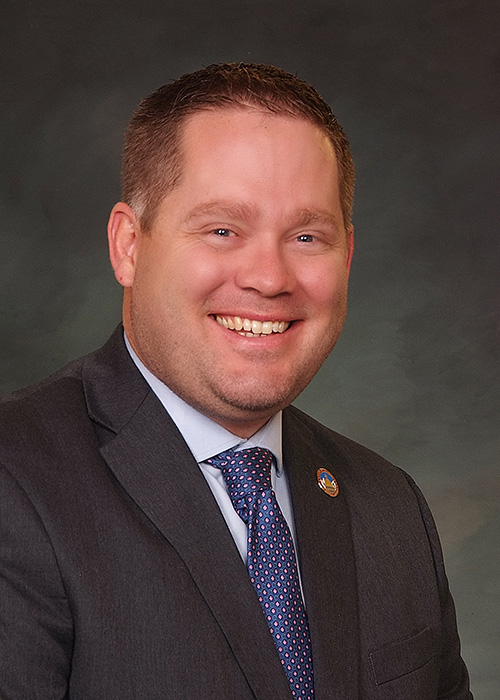
Sen. Kyle Mullica
Sponsored bills
The act designates the Agaricus julius mushroom, commonly known as the Emperor mushroom, as the state mushroom of the state of Colorado. (Note: This summary applies to this bill as enacted.)
The statutory definition of "clean energy" determines which energy projects are eligible for clean energy project financing at the county and city and county level. The statutory definition of "clean energy resource" determines which energy resources may be used by a qualifying retail utility to meet the 2050 clean energy target. The act updates the 2 statutory definitions to include nuclear energy; except that, for property valuations made for tax purposes, the act exempts from the definition of "clean energy resource" nuclear energy. (Note: This summary applies to this bill as enacted.)
The Colorado rangers law enforcement shared reserve, commonly known as the Colorado rangers (CLER), is a statewide law enforcement agency that has been established as a political subdivision of the state through the execution of an intergovernmental agreement for the public purpose of promoting the safety, security, and general welfare of all Coloradans by establishing a peace officers standards and training board (P.O.S.T. board) certified statewide shared peace officer reserve force. Sections 1 through 4 of the act update laws relating to civil defense workers and peace officers to clarify the status of the CLER as a governmental entity created by intergovernmental agreement rather than as a volunteer organization, as it was prior to 2018, the requirement that a Colorado ranger be a P.O.S.T. board certified peace officer, and the scope of a Colorado ranger's authority. Section 5: Authorizes the board of the CLER to establish policies to allow compensation to be paid to a Colorado ranger if the Colorado ranger: Is deployed as a peace officer to a jurisdiction for an extended period, as defined or described in the policies; or Is deployed as a peace officer outside the state as authorized by a specified interstate compact for any length of time; and Authorizes the CLER to accept gifts, grants, and donations.(Note: This summary applies to this bill as enacted.)
Under current law, every governing body of a municipality that has adopted and enforced a building code after July 1, 2023, is required to adopt and begin enforcing an energy code for residential buildings. The bill creates an exemption for municipalities with a population of less than 2,500 residents from having to adopt and enforce an energy code for residential buildings.(Note: This summary applies to the reengrossed version of this bill as introduced in the second house.)
Maddy summarySJR 25-013 is a symbolic resolution recognizing Thursday, March 20, 2025, as Nowruz Day in Colorado. It honors the ancient Persian New Year celebration observed by Iranian, Kurdish, Afghan, and Central Asian communities, acknowledging its cultural significance and the contributions of Colorado's Iranian-American residents. The resolution has no legal effect but formally extends recognition to the traditions of Nowruz, including its themes of renewal and community. It directly affects Colorado's Iranian-American community by affirming their cultural heritage through state acknowledgment.
Beginning July 1, 2025, the act increases by one the number of district court judges in the fourth, seventeenth, eighteenth, and twenty-third judicial districts and increases by one the number of county court judges in La Plata county. Beginning July 1, 2026, the act increases by one the number of district court judges in the fourth, seventh, thirteenth, seventeenth, eighteenth, and nineteenth judicial districts and increases by one the number of county court judges in Larimer county, Douglas county, Mesa county, and Eagle county. Current law requires district court judges regularly assigned to Arapahoe county to maintain offices within Arapahoe county. The act allows the district court judges assigned to Arapahoe county to maintain offices outside of the county seat. For the 2025-26 state fiscal year, the act appropriates $2,638,326 from the general fund to the judicial department to implement the increased number of judges and appropriates $621,337 from the general fund to the judicial department for use by the office of state public defender. (Note: This summary applies to this bill as enacted.)

Maddy summaryThis resolution (SJR 25-009) expresses Colorado's support for federal management of national public lands, including parks, forests, and monuments. It formally opposes efforts to sell, transfer, or dispose of these lands and urges Colorado's governor, attorney general, and congressional delegation to take action against such proposals. The resolution is non-binding but directs state officials to advocate for continued public stewardship by federal agencies like the National Park Service and Bureau of Land Management. It was passed by the Colorado Senate and referred to the House for consideration.
Under Colorado law, a person may file a claim with the division of parks and wildlife (division) for compensation for damages to property caused by wildlife, and the division must review and investigate that claim. The act requires that the personal information of a person, information related to site assessments received by the division through the claim procedures, and personal information associated with proactive nonlethal measures is kept confidential and not disclosed pursuant to the "Colorado Open Records Act". The act excludes from this prohibition: Information about nonlethal predator-livestock conflict minimization measures that does not reveal the identity of the person or the person's business; Nonidentifying information of county-level data highlighting the number or dollar amount of claims made to the division, the number of claims that were settled and the monetary amounts of those settlements, the number of claims that are pending at the time of a request for disclosure, and the number of claims that were denied and the reasons for denial; and Personal information that becomes public by the actions of the subject of the personal information or the subject's agent. The act prohibits bringing or maintaining a private action challenging the division's determination that a person or the person's agent has taken actions or made statements that led to the person's personal information becoming publicly known. (Note: This summary applies to this bill as enacted.)

The act clarifies that the health benefits coverage for the prevention of, screening for, and treatment of behavioral, mental health, and substance use disorders must be no less extensive than the coverage provided for any physical illness. The act requires that every health benefit plan provide coverage for medically necessary treatment of covered behavioral, mental health, and substance use disorder benefits, consistent with specified criteria. The act also specifies criteria to be used for conducting utilization review, service intensity, and the level of care for covered persons. In addition, the act prohibits: A health benefit plan from limiting coverage for chronic behavioral, mental health, or substance use disorders to short-term symptom reduction; and A health insurance carrier from reversing or altering a determination of medical necessity except in the case of fraud. The act requires carriers that provide benefits for mental health conditions or substance use disorders to offer meaningful benefits for mental health conditions and substance use disorders. The act describes how to determine whether the benefits provided are meaningful benefits. The commissioner of insurance is authorized to adopt rules to: Establish carrier utilization review compliance; Specify data testing requirements for plan design and application of parity compliance; Set standard definition for coverage requirements; Establish timelines for carriers to provide comparative analysis information to the division of insurance; and Establish time periods for visits with a provider for treatment of a behavioral, mental health, or substance use disorder after an initial visit with a provider.(Note: This summary applies to this bill as enacted.)