

Legislative Oversight Committee Concerning Tax Policy. Section 2 of the bill extends a refundable income tax credit (credit) that is available for the income tax years commencing on January 1, 2022, and January 1, 2024, so that the credit is also available for the income tax years commencing on January 1, 2025, and January 1, 2026. For each income tax year, the credit is for a qualifying senior, which means a resident individual who: Is 65 years of age or older at the end of the income tax year; Has federal adjusted gross income (AGI) that is less than or equal to $75,000 if filing a single return, or less than or equal to $125,000 if filing a joint return; and Has not claimed the senior property tax exemption for the property tax year that coincides with the income tax year. The amount of the credit for both the 2025 and 2026 income tax years is: $800 for a qualifying senior filing a single return with federal AGI that is $25,000 or less. For every $500 of federal AGI above $25,000, the amount of the credit is reduced by $8. $800 for 2 taxpayers filing a joint return with federal AGI that is $25,000 or less. For every $500 of federal AGI above $25,000, the amount of the credit is reduced by $4. $400 for each taxpayer, in the case of 2 taxpayers who share the same primary residence, and may legally file a joint return but actually file separate returns and both claim the credit. For every $500 of federal AGI above $25,000, the amount of the credit is reduced by $4. Notwithstanding the income-based reductions in the allowable credit amount, a taxpayer who also qualifies for a property tax and rent assistance grant or heat assistance grant during the calendar year 2025 or 2026 is eligible to receive the full amount of the credit. Section 1 requires the property tax administrator to provide reports from counties related to taxpayers who are eligible for and actually claim the homestead property tax exemption.(Note: This summary applies to this bill as introduced.)
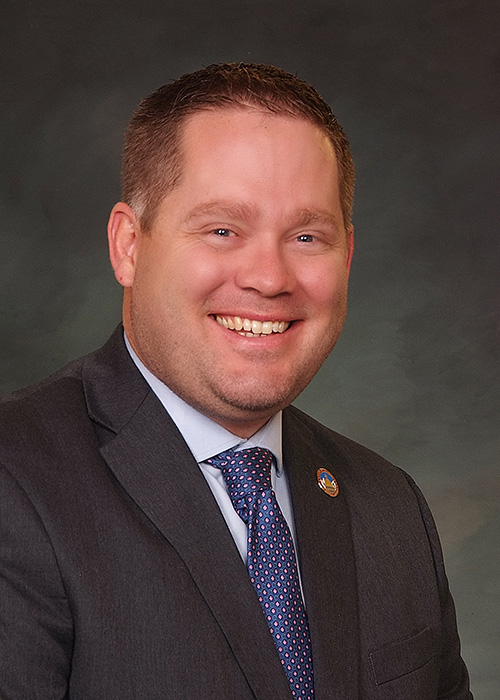
Sen. Kyle Mullica
Sponsored bills
Maddy summaryHJR 25-1028 designates Friday, April 25, 2025, as "Sportsmen's Day" in Colorado. This resolution aims to recognize the contributions of Colorado's sportsmen and women to conservation efforts and the state's economy. It also encourages members of the General Assembly to join the Colorado Legislative Sportsmen's Caucus and urges public and private institutions to work with the caucus.
Maddy summaryHouse Joint Resolution 25-1027 designates a specific portion of Colorado State Highway 1 in Larimer County, from East County Road 60 to Interstate 25, as the "Commissioner Lew Gaiter III Memorial Highway." It authorizes the Colorado Department of Transportation (CDOT) to accept donations for the initial placement of signs and to explore a cooperative agreement with Larimer County for sign maintenance.
Maddy summaryHouse Joint Resolution 25-1030 expresses the State of Colorado's strong opposition to the use of forced labor in the production of goods. The resolution states that Colorado will use its purchasing power to support businesses that ethically source or manufacture products without forced labor. It also encourages state and local economic development offices to attract businesses that avoid these labor practices. This joint resolution aims to influence state and local government purchasing decisions and promote ethical business standards.
Maddy summaryHJR 25-1026 designates Colorado State Highway 402, from United States Highway 287 to Interstate 25, as the "Rep. Hugh McKean Memorial Highway." It also authorizes the Colorado Department of Transportation (CDOT) to accept donations for the initial placement of signs and to explore agreements with Larimer County for sign maintenance.
Maddy summarySenate Resolution 25-012 commemorates Cinco de Mayo, recognizing its historical significance and its representation of pride, unity, and resilience for Mexican American, Hispano, Chicano, and Latino communities. The resolution pays tribute to the contributions and struggles of these communities in Colorado and affirms a commitment to combat discrimination.
The bill requires the Colorado energy office (office) to establish a state utility an on-bill repayment program to help finance certain gas and electric utilities' on-bill repayment programs (on-bill repayment program programs ), which are programs through which energy efficiency measures, electrification measures, and energy upgrades installed at utility customers' premises are financed through loans that and repaid by the customers repay through their monthly utility bill payments. The bill requires gas or electric investor-owned utilities that serve more than 500,000 customers to propose a plan to the public utilities commission for establishing or expanding an existing on-bill repayment program for the commission to review and approve, disapprove, or modify. The bill requires the state treasurer , on July 1, 2025, to make an 3 interest-free loan in the amount of $100 loans totaling $50 million from the unclaimed property trust fund to the state utility on-bill repayment program cash fund, which fund is created in the bill, to support the financing of the on-bill repayment programs. The office is required to pay back the loan by July 1, 2045 January 1, 2046 . As an alternative financing mechanism for the on-bill programs, the bill authorizes the department of the treasury to offer on-bill financing tax credits (tax credits) to insurance companies authorized to do business in Colorado, which insurance companies have premium tax liability owing to the state (qualified taxpayers). The tax credits will only be offered if the relevant quarterly state revenue forecast shows that the state's nonexempt revenue will be at least $50 million under the limit on state fiscal year spending authorized under section 20 of article X of the state constitution, as modified by Referendum C. The bill creates a building decarbonization enterprise (enterprise) to: Provide financing assistance, technical assistance, and other programmatic assistance to covered building owners to effectively and efficiently implement building decarbonization measures, including energy efficiency measures, electrification measures, and energy upgrades; and Provide technical assistance and other programmatic support to utilities that accept financing from the office for the purpose of establishing or expanding an on-bill program. The enterprise is authorized to impose and collect from covered building owners an annual building decarbonization fee and impose and collect from participating utilities an annual on-bill program administration fee to cover the enterprise's costs in providing financial, technical, and programmatic assistance to covered building owners and participating utilities. (Note: Italicized words indicate new material added to the original summary; dashes through words indicate deletions from the original summary.) (Note: This summary applies to the reengrossed version of this bill as introduced in the second house.)
A speech language pathology assistant (SLPA) is defined in the act as an individual who has a bachelor's degree or higher in speech-language pathology, communications disorders and speech sciences, or any other field that includes at least 24 semester hours in speech-language hearing sciences granted by an accredited institution of higher education. Only an individual who practices as an SLPA in accordance with statute or who is a school speech-language pathology assistant (school SLPA) authorized by the department of education may use the title "speech-language pathology assistant" or other terms that indicate that the individual is an SLPA or a school SLPA. An SLPA shall practice speech-language pathology only in collaboration with and under the direction and supervision of a certified speech-language pathologist (SLP). The act establishes requirements and guidelines for an SLP supervising an SLPA. The act prohibits an SLPA from engaging in certain speech-language pathology tasks, such as the diagnosis of patients and preparation of a treatment plan. An SLP may be disciplined for failing to properly direct and supervise an SLPA. The act repeals the regulation of SLPAs on September 1, 2033, subject to sunset review by the department of regulatory agencies. (Note: This summary applies to this bill as enacted.)
The act makes changes to the "Dental Practice Act" (act) by: Continuing the act for 9 years, until 2034; Updating and adding definitions; Changing the membership of the Colorado dental board (board); Adding to and updating the grounds for which the board may take disciplinary action against an applicant for licensure or a licensee; Allowing a licensee's submission to a mental or physical examination to satisfy the requirement to notify the board of a condition that may impair the licensee's ability to practice; Adding as exemptions to the act the volunteer practice of dental therapy and dental hygiene under specific conditions; Subjecting dentistry practiced by a professional service corporation to certain limits and requirements; Repealing exceptions that allow a dental therapist, dental hygienist, or dental assistant to perform certain dentistry practices and including additional tasks in the practice of dentistry; Clarifying that a dental assistant, dental hygienist, or dental therapist may perform tasks consistent with rules adopted by the board; Requiring a provider who performs itinerant surgery to develop and maintain protocols for emergency follow-up care; Clarifying the authority of a licensed dentist to prescribe orders electronically; Requiring a peer health assistance program selected as a designated provider for the dentist peer health assistance program to provide training to dentists who practice monitoring services; Authorizing a dentist to self-refer to participate in a peer health assistance program or be referred by the board; Removing a requirement that dental therapy education schools and programs must be accredited or approved by a specific entity; Requiring the board to adopt rules that allow for expedited, temporary licensure during a declared disaster emergency; Regulating anesthesia inspectors and requiring the board to design and implement expedited permitting of dentists with certain anesthesia or sedation training; Updating the business information a licensee must provide to the board and the circumstances under which providing the information is required; Repealing specific tasks that are currently authorized to be performed by a dental hygienist; Updating procedures for the construction of dental devices by an unlicensed technician; Updating the list of practices that are considered to be the practice of unsupervised dental hygiene; Repealing the specific dosages of certain drugs that a dental hygienist may prescribe; Authorizing the board to adopt rules that identify safe prescribing alternatives to silver diamine fluoride as a treatment for strengthening teeth and preventing tooth decay; Identifying tasks that constitute practicing supervised dental hygiene; Requiring a dental hygienist performing an interim therapeutic restoration to confirm a referral for follow-up care with a dentist; Limiting the number of dental hygienists or dental therapists that a dentist may supervise; and Authorizing a dental therapist to perform specific tasks.(Note: This summary applies to this bill as enacted.)
The act creates the "Know Your Health-Care Practitioner Act" that applies to certain health-care practitioners (practitioner) practicing in a health-care profession or occupation specified in the "Michael Skolnik Medical Transparency Act of 2010". The act does not apply to practitioners who work in a non-patient-care setting or do not have any direct patient care interactions, or when clinically not feasible. On and after June 1, 2026: In advertising health-care services using the practitioner's name, a practitioner must identify the type of state-issued license, certificate, or registration held by the practitioner and ensure that the advertisement is free from deceptive or misleading information; Except in certain circumstances, for practitioners providing services in a general hospital, urgent care center, ambulatory surgical center, or freestanding emergency department, the practitioner must affirmatively display an identification name tag or similar worn display that is visible during patient encounters. Except when emergent circumstances make it impracticable, while establishing a practitioner-patient relationship during the practitioner's first encounter with a patient, a practitioner must verbally communicate to the patient the practitioner's specific state-issued license, certificate, or registration or verbally identify themselves by a title or abbreviation authorized in statute to facilitate patient understanding. A practitioner does not have to display their name when interacting with a patient if the practitioner is concerned for their safety or if the patient is exhibiting signs of irrationality or violence. A practitioner may also use supplemental descriptors in advertising or identification, in the manner specified in the act. The director of the division of occupations and professions in the department of regulatory agencies may impose a fine of up to $500 if a practitioner violates the act. (Note: This summary applies to this bill as enacted.)