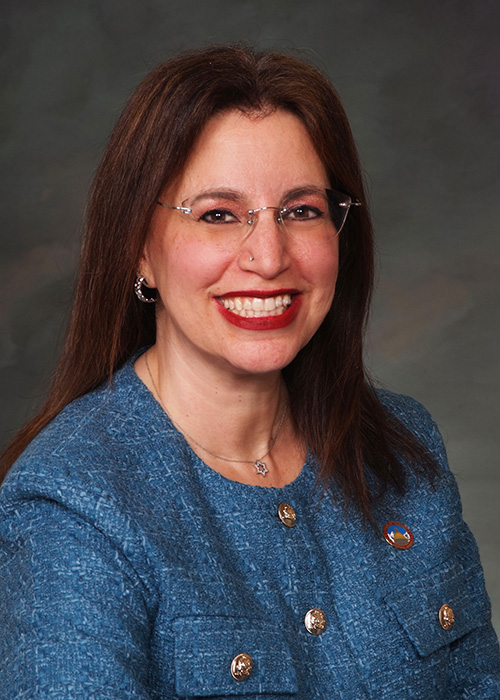
Photo of Dafna Michaelson Jenet
D Colorado Senate · District 21

Sen. Dafna Michaelson Jenet

Compare
Total votes
1,867
all sessions
Attendance
98%
39 missed
Higher than 97% of chamber peers
With party
99%
of cast votes
Higher than 97% of chamber peers
Bipartisan score
1%
crosses aisle rarely
Among the lowest in the chamber
Sponsored
421
bills & resolutions
Among the lowest in the chamber
Committees
0
assignments
421 bills and resolutions

Sponsored bills

Total
421
Primary
102
Co-sponsor
319
This page
421
matching current filters
Primary HB 24-1471
Signed into law · Colorado House · Lead sponsor
Electroconvulsive Treatment for Minors

Current law prohibits electroconvulsive treatment (ECT) from being performed on a minor under 16 years of age. The act authorizes ECT to be performed on a minor who is under 16 years of age only if: 2 individuals licensed to practice medicine in Colorado and specializing in psychiatry approve the ECT; Other less-invasive treatments have failed; ECT is medically necessary to treat life-threatening malignant catatonia; ECT is performed by at least one physician, or the physician's designee, who is trained and credentialed in ECT; and The minor's parent or guardian consents to ETC. APPROVED by Governor June 3, 2024 EFFECTIVE June 3, 2024(Note: This summary applies to this bill as enacted.)

Signed into law Jun 3, 2024 0 co-sponsors
Primary HB 24-1031
Signed into law · Colorado House · Lead sponsor
Accessibility for Persons in Child Welfare Matters

The act requires that certain services provided to children or their families comply with the provisions of Title VI of the federal "Civil Rights Act of 1964" if they are provided by a county department of human or social services (county department), city and county, or a private-entity contractor. Furthermore, the act requires that the county department, city and county, or private-entity contractor take reasonable steps to ensure meaningful language access to services in the person's primary language for a person with limited English proficiency, in a timely manner and without unreasonable delay. The act requires a court to provide language access, including translation and interpretation services, to a child, parent, guardian, custodian, or other party in a dependency and neglect case if the person requests language access or has limited English proficiency. The act requires that during a dispositional hearing concerning the best interests of a child, the court consider services and programs that provide the parent and child with language access and effective communication. The act appropriates $74,953 from the judicial stabilization cash fund to the judicial department to implement the act. APPROVED by Governor June 3, 2024 EFFECTIVE August 7, 2024(Note: This summary applies to this bill as enacted.)

Signed into law Jun 3, 2024 0 co-sponsors
Primary SB 24-124
Signed into law · Colorado Senate · Lead sponsor
Health-Care Coverage for Biomarker Testing

The act requires all large group health benefit plans to provide coverage for biomarker testing to guide treatment decisions if the testing is supported by medical and scientific evidence. The act defines "biomarker testing" as an analysis of a patient's tissue, blood, or other biospecimen for the presence of an indicator of normal biological processes, pathogenic processes, or pharmacologic responses to a specific therapeutic intervention. The required testing under the act does not include biomarker testing for screening purposes or direct-to-consumer genetic tests. The act requires the commissioner of insurance to implement biomarker testing coverage for all large employer health benefit plans issued or renewed on or after January 1, 2025. To the extent biomarker testing is not in addition to the benefits provided pursuant to the benchmark plan, all individual and small group health benefit plans must provide coverage for biomarker testing. Within 120 days after the act takes effect, the division of insurance (division) shall submit to the federal department of health and human services (HHS) its determination of whether biomarker testing is in addition to essential health benefits and would require state defrayal of costs pursuant to federal law. The division shall implement the requirement for coverage for biomarker testing for individual and small group health benefit plans within 12 months after the earlier of the division receiving confirmation from HHS that biomarker coverage does not require defrayal or more than 365 days passing since the division submitted its determination that defrayal was not necessary. Biomarker testing is subject to the health benefit plan's annual deductibles, copayment, or coinsurance but is not subject to any annual or lifetime maximum benefit limit. APPROVED by Governor June 3, 2024 EFFECTIVE June 3, 2024(Note: This summary applies to this bill as enacted.)

Signed into law Jun 3, 2024 0 co-sponsors
Primary SB 24-216
Signed into law · Colorado Senate · Lead sponsor
Standards for Decisions Regarding Library Resources

The board of trustees of a public library (board) is required to establish written policies for the acquisition, retention, display, and use of library resources and for the use of a public library facility. If a public library reconsiders library resources, the board is also required to establish a written policy for the reconsideration of a library resource. The board is required to comply with specified standards in establishing a policy for the acquisition, retention, display, use, and reconsideration of library resources and for the use of public library facilities. A public library may remove a library resource from its permanent collection only if the library resource has been reviewed in accordance with an established policy for the reconsideration of library resources that complies with the standards established in the act. These requirements do not apply to routine collection maintenance and deaccession in accordance with a public library's established collection development and maintenance policy. The board is required to make its policy for the reconsideration of library materials available to the public. Once a final determination has been made for a library resource that is the subject of a request for reconsideration, the board is required to make the determination available to the public. A request for reconsideration of a library resource is not a library user record and instead is an open record under the "Colorado Open Records Act". A librarian, media specialist, other employee, contractor, or volunteer (employee) at a public library is not subject to termination, demotion, discipline, or retaliation for refusing to remove a library resource before it has been reviewed in accordance with the public library's policy for the reconsideration of library resources or for making displays, acquisitions, or programming decisions that the employee believes, in good faith, are in accordance with the standards established in the act. APPROVED by Governor May 31, 2024 EFFECTIVE May 31, 2024(Note: This summary applies to this bill as enacted.)

Signed into law May 31, 2024 0 co-sponsors
Primary HB 24-1252
Signed into law · Colorado House · Lead sponsor
Sunset Suicide Prevention Commission

The suicide prevention commission (commission) created in the department of public health and environment is scheduled to repeal on September 1, 2024. The act continues the commission until September 1, 2034. The act also adjusts the appointments to the commission and limits the number of members from the current 26 to 22. APPROVED by Governor May 31, 2024 EFFECTIVE August 7, 2024(Note: This summary applies to this bill as enacted.)

Signed into law May 31, 2024 0 co-sponsors
Primary HB 24-1305
Signed into law · Colorado House · Lead sponsor
Changes for Concurrent Enrollment Students

The act expands the types of programs a pathways in technology early college high school (p-tech school) may focus on beyond science, technology, engineering, and mathematics. Under current law, the college opportunity fund program provides a stipend for eligible undergraduate students in Colorado. Generally, an eligible undergraduate student is ineligible to receive a stipend for more than 145 credit hours during the student's lifetime. The act makes an exception to this lifetime limitation for college-level credit hours earned while the eligible undergraduate student was enrolled in a concurrent enrollment program, the accelerating students through concurrent enrollment program, the teacher recruitment education and preparation program, or a p-tech school. APPROVED by Governor May 30, 2024 EFFECTIVE August 7, 2024(Note: This summary applies to this bill as enacted.)

Signed into law May 30, 2024 0 co-sponsors
Primary HB 24-1338
Signed into law · Colorado House · Lead sponsor
Cumulative Impacts & Environmental Justice

The environmental justice action task force was created in the department of public health and environment (CDPHE) to develop recommendations for measures to achieve environmental justice in the state. The task force completed its work and published a final report on November 14, 2022, which report included a recommendation for the development of environmental equity and cumulative impact analyses (EECIA) in the state. The act creates the office of environmental justice (office) in CDPHE and requires the office to oversee a process to develop at least 2 EECIAs for specific geographic locations in the state. Once an EECIA is developed, various state agencies will be able to rely on the EECIA in conducting cumulative impact analyses regarding certain activities that may result in pollution. The office must choose as locations for the EECIAs communities that are disproportionately impacted communities, with priority given to communities that have a heightened potential for widespread human exposure to environmental contaminants. After selecting a location for an EECIA, CDPHE must contract with an academic institution or other third party to develop an EECIA. In developing an EECIA, the applicable contractor must perform a scientifically rigorous analysis that includes most of the recommendations made by the environmental justice action task force. Within 9 months after completing the first EECIA, CDPHE is required to prepare a report, which includes identifying any recommendations or resources needed for implementing the findings of the EECIA. CDPHE must submit the report to certain legislative committees. On or before January 1, 2025, the division of administration (division) in CDPHE is required to hire a petroleum refinery regulation expert to examine whether a rule establishing petroleum refinery control regulations should be adopted by the air quality control commission and examine other regulatory or nonregulatory measures performed. After January 1, 2025, a petroleum refinery in the state must comply with certain monitoring requirements to provide real-time emissions monitoring data to the division. The division is required to establish a rapid response inspection team to respond quickly to air quality complaints received. Once the team is established, the team must develop processes and best practices for quickly responding to such complaints, engage in outreach to communities regarding events and conditions that lead to excess air pollution emissions in those communities, and track and report on the division's website the number of complaints filed and the formal action, if any, taken on each complaint. $1,829,087 is appropriated from the general fund to CDPHE for implementation of the act. Of the amount appropriated: $310,449 is reappropriated to the department of law to provide legal services to CDPHE; and Up to $959,310, if not expended before July 1, 2025, is further appropriated to the division through the 2028-29 state fiscal year for implementation of the act. APPROVED by Governor May 28, 2024 EFFECTIVE May 28, 2024(Note: This summary applies to this bill as enacted.)


Signed into law May 28, 2024 0 co-sponsors
Primary HB 24-1332
Signed into law · Colorado House · Lead sponsor
Sunset Continue Colorado Department of Early Childhood Executive Director Rule-Making

The act implements the recommendation of the department of regulatory agencies (department), as contained in the department's 2023 sunset review and report concerning the rule-making authority of the executive director of the department of early childhood (executive director). The act continues the executive director's rule-making authority for 7 years, until September 1, 2031. APPROVED by Governor May 24, 2024 EFFECTIVE August 7, 2024(Note: This summary applies to this bill as enacted.)
Signed into law May 24, 2024 0 co-sponsors
Primary SB 24-125
Signed into law · Colorado Senate · Lead sponsor
Interstate Compact for the Placement of Children

The act enacts the "Interstate Compact on Placement of Children" (compact). The purpose of the compact is to: Provide a process through which children subject to this compact are placed in safe and suitable homes in a timely manner; Facilitate ongoing supervision of a placement, the delivery of services, and communication between the states; Provide operating procedures that will ensure that children are placed in safe and suitable homes in a timely manner; Provide for promulgation and enforcement of administrative rules implementing the compact and regulating the covered activities of the member states; Provide for uniform data collection and information sharing between member states; Promote coordination between the compact, the interstate compact for juveniles, the interstate compact on adoption and medical assistance, and other compacts affecting the placement of children and provision of services to children otherwise subject to this compact; Provide for a state's continuing legal jurisdiction and responsibility for placement and care of a child that it would have had if the placement were intrastate; and Provide for the promulgation of guidelines, in collaboration with Indian tribes, for interstate cases involving Indian children as is or may be permitted by federal law. After the act takes effect, and subject to available appropriations, the executive director of the department of human services (executive director) shall convene a working group to review the proposal for enactment of the revised interstate compact on placement of children, and conclude one year later unless amended. The working group shall review and make recommendations, according to a time frame determined by the working group, to Colorado's commissioner to the compact on the following issues: Evaluating the current compact process for children and families; Determining the status of Colorado's implementation of the national electronic interstate compact enterprise requirements and what effect the implementation of these requirements may have on Colorado; Improving the use of cross-border agreements; Identifying any barriers to placing children in residential treatment facilities out of state and options for addressing barriers within existing law; Identifying and prioritizing any alternative efforts being made to address interstate placement issues at the national level; and Identifying language and processes to improve interstate placements. The compact takes effect after the executive director provides notice to the revisor of statutes that the thirty-fifth state has enacted the compact. APPROVED by Governor May 24, 2024 EFFECTIVE August 7, 2024(Note: This summary applies to this bill as enacted.)

Signed into law May 24, 2024 0 co-sponsors
Primary SB 24-115
Signed into law · Colorado Senate · Lead sponsor
Mental Health Professionals Practice Requirements

The act removes the requirement that a mental health professional provide each client with an explanation of the levels of regulation and the differences between licensure, registration, and certification of mental health professionals. The act removes the requirement for an individual to take and pass the board of social work examiners' masters examination in order to obtain a licensed social worker license. In order for an individual to obtain a registration as a psychologist candidate (PSYC), a clinical social worker candidate (SWC), a marriage and family therapist candidate (MFTC), a licensed professional counselor candidate (LPCC), or an addiction counselor candidate (ADDC), the act requires the individual to pass the Colorado jurisprudence examination. The act authorizes PSYCs, SWCs, MFTCs, LPCCs, and ADDCs to renew their candidate registrations if they are unable to complete all the post-degree licensure requirements within the 3-year time frame that a registration is valid and allows candidates whose registrations have expired to reapply for the registration. The act requires certain mental health professionals, prior to a renewal of a license or registration, to complete continuing professional development and educational hours. On or before December 31, 2024,the state board of psychologist examiners, the state board of social work examiners, the state board of marriage and family therapist examiners, the state board of licensed professional counselor examiners, and the state board of addiction counselor examiners are required to begin the rule-making process to align their respective rules with their respective practice acts. APPROVED by Governor May 22, 2024 EFFECTIVE August 7, 2024(Note: This summary applies to this bill as enacted.)

Signed into law May 22, 2024 0 co-sponsors
Showing 391 to 400 of 421 bills
Previous 1 … 39 40 41 … 43 Next