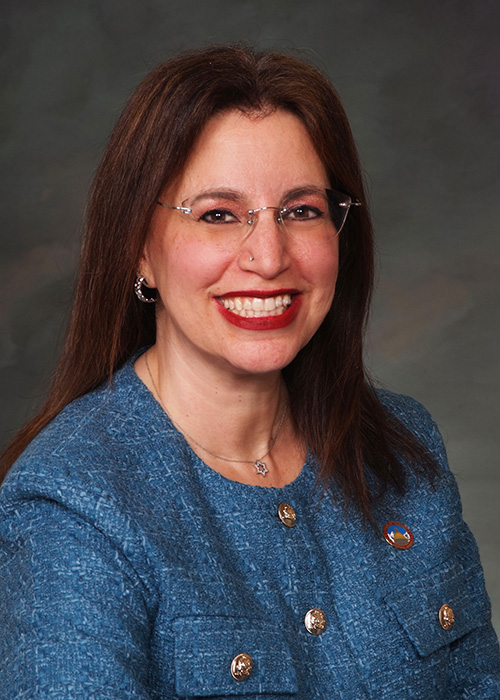
Photo of Dafna Michaelson Jenet
D Colorado Senate · District 21

Sen. Dafna Michaelson Jenet

Compare
Total votes
1,867
all sessions
Attendance
98%
39 missed
Higher than 97% of chamber peers
With party
99%
of cast votes
Higher than 97% of chamber peers
Bipartisan score
1%
crosses aisle rarely
Among the lowest in the chamber
Sponsored
421
bills & resolutions
Among the lowest in the chamber
Committees
0
assignments
421 bills and resolutions

Sponsored bills

Total
421
Primary
102
Co-sponsor
319
This page
421
matching current filters
Co-sponsor SB 25-298
Signed into law · Colorado Senate · Co-sponsor
Remove Term Homosexuality from Criminal Code

The act removes the term "homosexuality" from the definition of sexual conduct in the sexually explicit materials harmful to children part of the "Colorado Criminal Code". (Note: This summary applies to this bill as enacted.)

Signed into law May 30, 2025 1 co-sponsor
Primary HB 25-1186
Signed into law · Colorado House · Lead sponsor
Work-Based Learning Experiences in Higher Education

The act creates the work-based learning consortium pilot program (pilot program) in the department of higher education (department). The purpose of the 3-year pilot program is to: Demonstrate the value of work-based learning in postsecondary curricula by studying the impact of industry-sponsored projects on course objectives and learning outcomes; Promote the adoption of work-based learning in higher education by working with faculty at institutions of higher education (institutions) that participate in the pilot program (participating institutions) to embed project-based learning opportunities into credit-bearing programs; Provide broader access to collegiate work-based learning for students; Measure the impact of work-based learning on participating students; and Learn how institutions can increase the value of postsecondary education through career exposure and preparedness. Pending the receipt of sufficient funds, the department shall convene a consortium (consortium) of representatives from participating institutions, the commission on higher education (commission), the department of labor and employment, the department of education, and a subject matter expert with experience implementing work-based learning. The consortium shall: Work with each participating institution's faculty to embed industry-sponsored projects in course curriculum that meet the work-based learning quality standards; Work with the department to determine the impact of industry-sponsored projects; Work with a third-party platform to connect faculty from participating institutions to employers for the purpose of developing high-quality, project-based learning opportunities for classroom instruction; Advise the commission on strategies to improve student access to high-quality, work-based learning opportunities for students based on participating faculty members' experience embedding industry-sponsored projects into curriculum; Develop best practices for institutions to expand access to work-based learning in the classroom through industry-sponsored projects; and Develop findings and recommendations. Subject to available appropriations, at the end of the pilot program, the act requires the consortium to complete and submit a report to the education committees of the house of representatives and the senate, or their successor committees. The report must include: A description of the consortium's findings and recommendations; Details on the consortium's impacts on participating institutions and the effects of creating additional work-based learning activities on students, faculty, and employers; and Recommendations for statutory changes, financial resources, department policy changes, and policy changes in institutions that are necessary to improve successful work-based learning opportunities for students in institutions. The department may seek, accept, and expend gifts, grants, or donations from private or public sources for the pilot program. The department shall transmit all gifts, grants, or donations to the state treasurer, who shall credit the money to the higher education work-based learning consortium fund (fund). If, by June 30, 2028, the money in the fund has never reached or exceeded $2 million dollars, the state treasurer shall return each grantor's or donor's gift, grant, or donation. On or before November 1, 2026, the commission shall recommend a list of terms used by institutions related to work-based learning to the Colorado workforce development council for inclusion in the talent development glossary (glossary). The purpose of the list of terms is to: Augment the glossary so that collegiate work-based learning activities are accurately reflected in statewide efforts to promote work-based learning; and Demonstrate to institutions relevant opportunities to participate in statewide efforts to promote work-based learning. On or before July 1, 2026, the commission shall work with institutions, the Colorado workforce development council, the department of education, the consortium, nonprofit organizations, industry associations, and businesses to develop recommendations on how to best embed work-based learning opportunities into current degree pathways. On or before December 31, 2026, the department shall work with institutions to identify which work-based learning activities are measurable and how to best report work-based learning activities. Institutions that are eligible for the work-study program may use work-study program money to cover the costs of work-based learning credits for students who are required to complete credit-bearing work-based learning requirements to graduate from an institution. The office of economic development (office) administers the universal high school scholarship program (program). The act allows the office to spend unexpended or unencumbered money appropriated in the 2023-24 state fiscal year through the 2025-26 state fiscal year without further appropriation. The act requires that expenditures for the administrative costs of the program not exceed $1.5 million. The act extends the date for the state treasurer to transfer all unexpended and unencumbered money in the universal high school scholarship cash fund from December 30, 2026, to June 30, 2027. (Note: This summary applies to this bill as enacted.)


Signed into law May 30, 2025 0 co-sponsors
Co-sponsor HB 25-1301
Signed into law · Colorado House · Co-sponsor
Authorizing Voice Court Reporter to Give Oath

Current law does not allow a voice court reporter to administer an oath or affirmation. The act adds voice reporters to the list of professionals who may administer an oath or affirmation. (Note: This summary applies to this bill as enacted.)
Signed into law May 30, 2025 1 co-sponsor
Co-sponsor SB 25-158
Signed into law · Colorado Senate · Co-sponsor
State Agency Procurement & Disposal Certain Items

The act creates state procurement practices for firearms and items regulated pursuant to the federal "National Firearms Act" ("NFA"). The act applies to all contracts the state sources, enters into, awards, amends, renews, or extends on or after January 1, 2026, for procuring firearms or items regulated pursuant to the "NFA". During a governmental body's contracting process, sourcing method process, or upon request during the term of a contract, a contractor or bidder shall comply with certain requirements, make certain disclosures, and provide certain documentation to confirm that the contractor or bidder engages in safe business practices. The attorney general may assist the department of personnel (department) in developing processes and procedures to implement the procurement practices. The department may adopt rules to implement this act. (Note: This summary applies to this bill as enacted.)

Signed into law May 30, 2025 1 co-sponsor
Co-sponsor SB 25-228
Signed into law · Colorado Senate · Co-sponsor
Enterprise Disability Buy-in Premiums

Under current law, there are 2 programs available to low-income individuals to buy in to the state medical assistance program: One for adults with disabilities and one for children with disabilities (medicaid buy-in programs). Individuals who participate in either program pay a premium based on their family income. The premiums are credited to the medicaid buy-in cash fund. The premiums credited to the medicaid buy-in cash fund are used to offset the costs of providing the medicaid buy-in programs. The costs of providing the medicaid buy-in programs are also offset by the money in the healthcare affordability and sustainability fee cash fund in the Colorado healthcare affordability and sustainability enterprise (CHASE) within the department of health care policy and financing (HCPF). The act repeals the existing medicaid buy-in cash fund and creates the healthcare affordability and sustainability medicaid buy-in cash fund (buy-in cash fund) within CHASE and directs that individuals who participate in the existing medicaid buy-in programs pay their premiums into the buy-in cash fund. The act creates a medicaid buy-in enterprise support board within CHASE to support the existing enterprise with the implementation of the medicaid buy-in program, including consulting with HCPF and the state medical services board on the amount of the premiums for and other components of the medicaid buy-in programs. Because CHASE is an enterprise for purposes of the Taxpayer's Act of Rights, its revenue does not count against the state fiscal year spending limit. For the 2025-26 state fiscal year, $6,660,761 is appropriated from the buy-in cash fund to HCPF for medical and long-term care services for medicaid-eligible individuals. The act also decreases in a corresponding amount an appropriation to HCPF from the existing Medicaid buy-in cash fund and adjusts similar appropriations to HCPF for the 2024-25 state fiscal year. (Note: This summary applies to this bill as enacted.)

Signed into law May 30, 2025 1 co-sponsor
Co-sponsor SB 25-292
Signed into law · Colorado Senate · Co-sponsor
Workforce Capacity Center

The act requires the department of health care policy and financing (state department), in collaboration with the behavioral health administration, to establish the workforce capacity center to train providers in evidence-based or supported models as part of the system of care for children and youth. The act requires the state department to include updates on and milestones achieved by the workforce capacity center and information about trainings and certifications by the workforce capacity center in its quarterly report to the joint budget committee. The act repeals the workforce capacity center, effective July 1, 2027. (Note: This summary applies to this bill as enacted.)

Signed into law May 30, 2025 1 co-sponsor
Co-sponsor SB 25-278
Signed into law · Colorado Senate · Co-sponsor
Epinephrine Administration in Schools

The act changes the term "epinephrine auto-injector" to "emergency-use epinephrine" in order to encompass alternatives to injecting epinephrine as a means to treat anaphylaxis in school settings. (Note: This summary applies to this bill as enacted.)

Signed into law May 30, 2025 1 co-sponsor
Co-sponsor SB 25-118
Signed into law · Colorado Senate · Co-sponsor
Health Insurance Prenatal Care No Cost Sharing

The act requires that, for health insurance policies providing maternity coverage, policies issued or renewed on or after January 1, 2027, must include prenatal care coverage without cost sharing for up to 3 office visits. (Note: This summary applies to this bill as enacted.)

Signed into law May 29, 2025 1 co-sponsor
Co-sponsor SB 25-186
Signed into law · Colorado Senate · Co-sponsor
Sunset Workers' Compensation Providers Accreditation Program

The act implements the recommendations of the department of regulatory agencies in its 2024 sunset review of the workers' compensation accreditation of health-care providers program (program), including extending the program for 11 years to September 1, 2036, and authorizing any health-care professional regulated by the division of professions and occupations and listed in the utilization standards established by the director of the division of workers' compensation (division) who provides treatment in the workers' compensation system to obtain level I accreditation from the division. (Note: This summary applies to this bill as enacted.)

Signed into law May 29, 2025 1 co-sponsor
Co-sponsor HB 25-1088
Vetoed · Colorado House · Co-sponsor
Costs for Ground Ambulance Services

For ground ambulance services (ambulance services), the act: Allows a political subdivision or an ambulance service providing ambulance services on behalf of the political subdivision to submit to the division of insurance (division) the established rates for the ambulance services, if the rates meet specified conditions; Requires the division to publish reimbursement rates on the division's public-facing website; Establishes reimbursement rates for ambulance services that are out of network; and Prohibits an out-of-network ambulance service from billing an individual covered under a health insurance coverage plan (covered person) any outstanding balance for a covered service not paid for by an insurance carrier, except for any coinsurance, deductible, or copayment amount required to be paid by the covered person. If a covered person makes a payment for an out-of-network ambulance service, the payment must be applied to the covered person's in-network deductibles and in-network out-of-pocket maximum amounts. For the 2025-26 state fiscal year, $38,149 is appropriated from the division of insurance cash fund to the department of regulatory agencies for use by the division to implement the act. VETOED by Governor 5/29/2025(Note: This summary applies to this bill as enacted.)

Vetoed May 29, 2025 1 co-sponsor
Showing 121 to 130 of 421 bills
Previous 1 … 12 13 14 … 43 Next