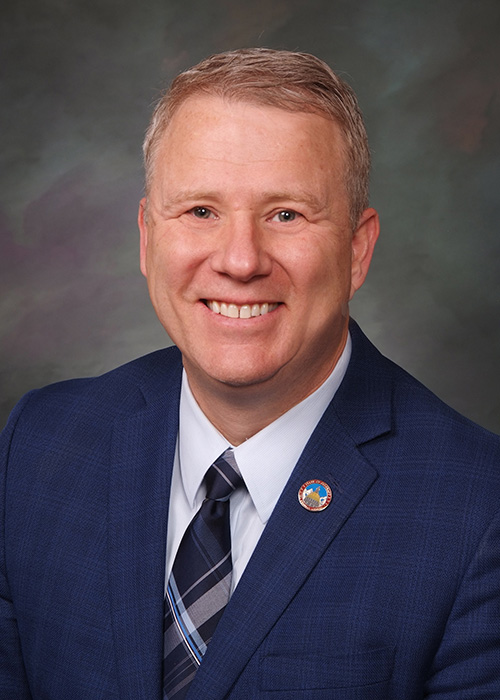
Photo of Chris Kolker
D Colorado Senate · District 16

Sen. Chris Kolker

Compare
Total votes
4,873
all sessions
Attendance
91%
421 missed
Near the chamber average
With party
98%
of cast votes
Near the chamber average
Bipartisan score
1%
crosses aisle rarely
Near the chamber average
Sponsored
445
bills & resolutions
Near the chamber average
Committees
4
assignments
445 bills and resolutions

Sponsored bills

Total
445
Primary
136
Co-sponsor
309
This page
445
matching current filters
Primary HB 22-1001
Signed into law · Colorado House · Lead sponsor
Reduce Fees For Bus Filings

The act requires the state treasurer to transfer $8,435,000 from the general fund to the department of state cash fund on July 1, 2022, for use by the department of state to offset the costs of reducing certain of the secretary of state's business-related fees during state fiscal year 2022-23. (Note: This summary applies to this bill as enacted.)

Signed into law May 16, 2022 0 co-sponsors
Primary HB 22-1004
Signed into law · Colorado House · Lead sponsor
Driver License Fee Reduction

The act requires the state treasurer to transfer $3,900,000 from the general fund to the Colorado DRIVES vehicle services account in the highway users tax fund. This transfer allows the department to maintain the current driver license fee while supporting the solvency of the fund. (Note: This summary applies to this bill as enacted.)

Signed into law May 16, 2022 0 co-sponsors
Primary SB 22-124
Signed into law · Colorado Senate · Lead sponsor
SALT Parity Act

The "SALT Parity Act" was enacted in 2021 and, for income tax years commencing on or after January 1, 2022, it allowed pass-through entities to elect to pay state income tax at the entity level, which allows the entity to claim an unlimited deduction at the federal level for state and local taxes paid. While this election reduces federal taxable income for the pass-through entity, it does not reduce or increase Colorado taxable income under current law based on additions and subtractions (deductions) to the state income tax. The act converts the state income tax deductions created to keep state revenue neutrality into a tax credit and makes provisions of the "SALT Parity Act" retroactive to January 1, 2018. An S corporation or a partnership must make the retroactive election on or after September 1, 2023, but before July 1, 2024, in a composite amended tax return for all of the years for which the election is made that is filed on behalf of the S corporation or partnership and the electing pass-through entity owners. (Note: This summary applies to this bill as enacted.)

Signed into law May 16, 2022 0 co-sponsors
Primary SB 22-006
Signed into law · Colorado Senate · Lead sponsor
Sales Tax Assistance For Small Bus

The act permits a retailer with total taxable sales in the amount of $100,000 or less for any filing period to retain 5.3% of the sales tax reported as compensation for the retailer's expenses incurred in collecting and remitting the tax (vendor fee) for sales made in 2023, rather than retaining a 4% vendor fee, which is what current law allows. The act also clarifies that the calculation of the amount that is credited to the housing development grant fund is only based on the changes to the vendor fee from House Bill 19-1245, and not on any subsequent modifications, including the changes made in the act. The act allows the executive director of the department of revenue to deduct processing costs from the electronic payment of taxes and fees in lieu of imposing a convenience fee. (Note: This summary applies to this bill as enacted.)

Signed into law May 16, 2022 0 co-sponsors
Primary HB 22-1416
Signed into law · Colorado House · Lead sponsor
Property Tax Administrative Procedures

The property tax administrator is required by law, after consultation with the advisory committee to the property tax administrator and subject to the approval of the state board of equalization, to prepare and publish manuals, appraisal procedures, instructions, and guidelines (property tax materials) concerning the administration of property tax. Beginning January 1, 2023, section 1 of the act requires the administrator to conduct a public hearing on a proposed change to the property tax materials before submitting the proposed change to the advisory committee to the property tax administrator. The administrator must publish notice of the hearing and mail notice to those people who so request. At the hearing, interested persons may submit information and the administrator is required to consider any submissions. Any interested person may also file a written petition to the administrator for the issuance, amendment, or repeal of any property tax materials. Currently, a taxpayer who wishes to protest the valuation of their taxable real property must file a notice of their objection and protest with the assessor by June 1. Sections 3 and 4 extend this deadline to June 8. Section 4 also requires an assessor who discovers any error that impacts the valuation of a class or subclass of property to recommend to the county board of equalization an adjustment to the class or subclass of property to correct the error. Section 5 requires the state board of assessment appeals to advance an appeal concerning the valuation of rent-producing commercial real property on the board of assessment appeals' calendar when the taxpayer provides certain relevant information and requests an advancement on or before July 15 of the same calendar year. The board of assessment appeals may charge a fee to a taxpayer, if the board of assessment appeals advances the taxpayer's appeal. Section 6 places a 5% cap on the amount by which a valuation of property set by a county board of equalization can be increased on appeal. $2000 is appropriated from the general fund to the department of local affairs for use by the board of assessment appeals for implementation of the act. (Note: This summary applies to this bill as enacted.)

Signed into law May 16, 2022 0 co-sponsors
Primary HB 22-1109
Failed · Colorado House · Lead sponsor
On-demand Air Carrier Aircraft Sales Tax Exemption

For 7 years beginning on January 1, 2023, the bill creates a sales and use tax exemption for the sale, storage, use, or consumption of an aircraft used or purchased for use in interstate or intrastate commerce by an on-demand air carrier. An on-demand air carrier is an entity authorized by the federal aviation administration to operate an aircraft to transport people or property in compliance with the administration's certification and operations requirements. The aeronautics division in the department of transportation is required to provide the state auditor with any available information that would assist the state auditor's measurement of the effectiveness of the exemption. The bill specifies that a statutory town, city, or county may exempt the same items only by express inclusion of the exemption in its initial sales tax ordinance or resolution or by amendment thereto and also that the exemptions do not apply to the tax imposed by a special district or other limited purpose governmental entity. (Note: This summary applies to this bill as introduced.)

Failed May 12, 2022 0 co-sponsors
Primary SB 22-156
Signed into law · Colorado Senate · Lead sponsor
Medicaid Prior Authorization And Recovery Of Payment

The act prohibits a prepaid inpatient health plan from: Requiring prior authorization for outpatient psychotherapy services; Retroactively recovering provider payments if a recipient was initially determined to be eligible for medical benefits or the prepaid inpatient health plan makes an error processing the claim but the claim is otherwise accurately submitted by the provider; and Retroactively recovering provider payments after 12 months from the date a claim was paid, except in certain circumstances. If a prepaid inpatient health plan retroactively recovers a provider payment that is equal to or greater than $1,000, the act requires the prepaid inpatient health plan to work with the provider to develop a payment plan if the provider requests a payment plan. (Note: This summary applies to this bill as enacted.)

Signed into law May 6, 2022 0 co-sponsors
Primary HB 22-1025
Signed into law · Colorado House · Lead sponsor
Repeal Of Infrequently Used Tax Expenditures

The act repeals the following tax expenditures: The exemption from the insurance premium tax for educational and scientific institution life insurance; The alternative minimum income tax based on annual gross receipts from sales in or into the state; The income tax credit for investment in technologies for recycling plastics; The income tax credit for crop or livestock contributions to a charitable organization; The income tax deduction for income or gain for a C corporation that was taxed prior to 1965, to the extent it is included in current taxable income; Income tax credits for qualifying investments; and The sales and use tax exemption for the transfer of complimentary promotional materials to an out-of-state vendee. The act also repeals the requirement that a specific amount of a state-employed chaplain's salary must be designated as a rental allowance, thereby making it exempt from federal income tax. (Note: This summary applies to this bill as enacted.)

Signed into law May 2, 2022 0 co-sponsors
Primary HB 22-1214
Signed into law · Colorado House · Lead sponsor
Behavioral Health Crisis Response System

The act requires crisis system facilities and programs, including crisis walk-in centers, respite services, and mobile crisis programs, to meet minimum standards to provide mental health and substance use disorder services. The act clarifies that crisis system facilities and programs shall provide behavioral health services to individuals experiencing a substance use disorder crisis. Mobile crisis programs and crisis walk-in centers shall provide crisis response screening services to any individual, including youth of any age and individuals with a disability. (Note: This summary applies to this bill as enacted.)

Signed into law Apr 27, 2022 0 co-sponsors
Primary HB 22-1118
Signed into law · Colorado House · Lead sponsor
Sales And Use Tax Refunds

Under the act, if a purchaser files a sales and use tax refund claim between July 1, 2022, and July 1, 2026, interest will accrue on the refund from the date that the purchaser files the claim, so long as the refund is paid more than 180 days from the date that the purchaser files the claim. If a purchaser files a claim for a sales and use tax refund that is incomplete, duplicative of another claim, or lacks a reasonable basis in law or fact, the act requires the executive director of the department of revenue (executive director) to assess and collect, in addition to other penalties provided by law, a civil penalty. The civil penalty is equal to 5% of the total refund claimed if the claim is materially incomplete and is equal to 10% of the total refund claimed if the claim is duplicative or lacking a reasonable basis in law or in fact. Prior to assessing a civil penalty for a claim that the executive director deems materially incomplete, the executive director is required to provide notice to the purchaser or the preparer of the claim, specify what is missing, and state the conditions that will lead to the executive director assessing the civil penalty. If a sales and use tax refund claim on which the executive director assesses a civil penalty is prepared, in whole or in part, by a person other than the purchaser, the penalty is imposed on that other person. The executive director shall give the person against whom the civil penalty is assessed written notice, and that person may petition for a hearing and appeal the civil penalty. The executive director may waive the penalty if the person against whom the penalty is assessed establishes that a duplicate claim was not intentional and was either minimal or immaterial or demonstrates other good cause for waiver. (Note: This summary applies to this bill as enacted.)


Signed into law Apr 19, 2022 0 co-sponsors
Showing 411 to 420 of 445 bills
Previous 1 41 42 43 45 Next