

In 2022, the general assembly enacted, and the governor subsequently signed into law, House Bill 22-1358 ('Concerning measures to eliminate the presence of lead in the drinking water of certain facilities where children are present, and, in connection therewith, making an appropriation'), which required child care centers, family child care homes, and each public school that serves any of grades preschool through eighth grade to:Test its drinking water sources by having a state-certified laboratory measure the lead content of water drawn from each drinking water source; andSatisfy other requirements concerning the provision of safe drinking water. House Bill 22-1358 also created the school and child care clean drinking water fund (fund) to help schools, child care centers, and family child care homes comply with House Bill 22-1358. House Bill 22-1358 included a repeal date of June 30, 2026, for its provisions. The act extends the provisions, with amendments, until June 30, 2029. The act also adds high schools (i.e., schools that serve grades 9 to 12) to the scope of House Bill 22-1358, which means that high schools may receive grants from the fund and must satisfy certain requirements on or before dates specified in the act. The act requires the department to adopt rules establishing how a child care center shall demonstrate compliance with the requirements concerning the testing for the presence of lead in drinking water.(Note: This summary applies to this bill as enacted.)
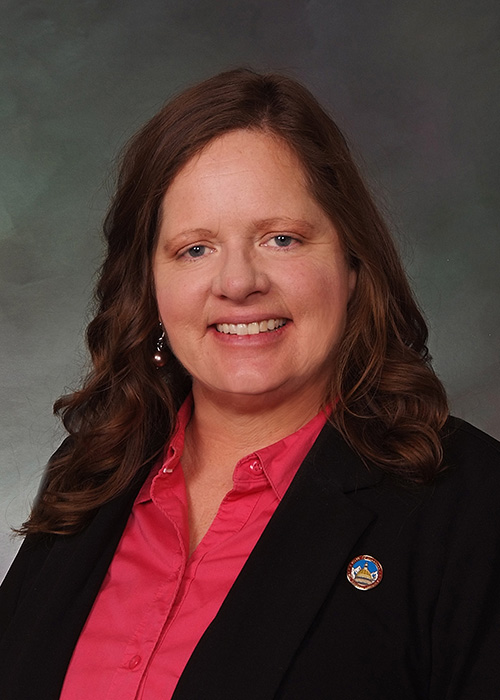
Sen. Janice Marchman
Sponsored bills
The act exempts pilates and barre teacher training courses, programs, and schools from regulation under the 'Private Occupational Education Act of 1981'.(Note: This summary applies to this bill as enacted.)
Maddy summaryThis bill brings Denver School of Science and Technology charter schools into the Denver Public Schools division of the Public Employees' Retirement Association (PERA), allowing their employees to participate in the same retirement benefits as other Denver public school workers. The legislation also changes the PERA Board of Trustees by adding one voting member elected by Denver Public Schools employees and removing a non-voting ex officio member from that division. Additionally, the bill extends the deadline for charter school employees to purchase additional retirement service credit for years worked before affiliation, moving the cutoff date from November 1, 2006, to July 1, 2026. These changes affect Denver public school employees, retirees, and the governance structure of the state's public employee retirement system.
The act implements the recommendations of the department of regulatory agencies in its 2025 sunset review of the 'Pet Animal Care and Facilities Act' (PACFA) as follows:Sections 1 and 2 of the act continue the commissioner of agriculture's (commissioner) function of licensing pet animal facilities in accordance with the PACFA for 8 years, until 2034;Section 3 amends the PACFA's pet animal advisory committee (committee) membership structure by requiring the commissioner, on or before December 1, 2026, to appoint 15 members with certain specifications. Section 3 also specifies that members appointed to the committee on or before December 1, 2026, may serve no more than 2 consecutive terms of 4 years.Section 4 prohibits the importation of certain pet animals into the state without a valid certificate of veterinary inspection by an accredited veterinarian in the state of origin issued within 10 days prior to the pet animal's arrival in Colorado;Section 5 increases the current maximum fee amount of $700 for a pet animal facility license application to $1,500;Section 6 raises the maximum civil penalty amount for a violation of the PACFA or of a rule adopted pursuant to the PACFA from $1,000 per violation to $2,500 per violation;Section 7 states that a person that chooses to request a hearing in response to a cease-and-desist order issued by the commissioner for a violation of the PACFA or of a rule adopted pursuant to the PACFA must do so within 30 days after the issuance of the cease-and-desist order;Section 8 requires the commissioner to develop an administrative process for an interested person to petition for the issuance, amendment, or repeal of a rule by the commissioner;Section 9 amends House Bill 26-1011 concerning the transfer of certain pet animals in Colorado, by clarifying that the prohibition on a broker selling, leasing, offering to sell or lease, bartering, auctioning, or otherwise transferring ownership of a dog or cat does not apply to the sale, transfer, or adoption of a dog or cat to or by a pet store prior to January 1, 2028; andSection 10 relocates the statute that establishes the pet overpopulation authority (authority) so the authority is no longer subject to sunset review as part of the PACFA.(Note: This summary applies to this bill as enacted.)
Beginning June 1, 2027, a person convicted for the first time of certain offenses related to driving while under the influence of drugs or alcohol is required to hold an interlock-restricted license for a consecutive period of nine months following reinstatement of the person's driver's license prior to being eligible to obtain any other driver's license, except in limited circumstances. If a person's driving privileges have been revoked for one year or more because of a refusal related to certain offenses related to driving while under the influence of drugs or alcohol, current law authorizes the person to apply for early reinstatement with an interlock-restricted license after the driving privilege has been revoked for 2 months. Beginning June 1, 2027, the 2-month waiting period is repealed. Under current law, a financial assistance program (assistance program) is available to assist people who apply for an interlock-restricted license and are unable to pay the full cost of an approved ignition interlock device. The act restricts eligibility for the program to those who satisfy certain income criteria. A certified ignition interlock manufacturer (manufacturer) must provide a person who is eligible for the assistance program certain discounts on installation of, lease charges for, and removal of an interlock device. The manufacturer must provide certain information regarding the assistance program at the time the interlock device installation appointment is scheduled and when a person executes an interlock device lease or service agreement. The act appropriates $15,225 to the department of revenue to implement the act.(Note: This summary applies to this bill as enacted.)
The act requires an operator of a social media platform (operator) to ensure that its social media platform provides a streamlined process to allow law enforcement agencies to contact the social media platform. The process must be available to law enforcement agencies at all times and make available a staffed hotline for the purposes of:Receiving and responding to questions about search warrants;Acknowledging the receipt of a search warrant within 8 hours after receipt; andProviding status updates on search warrant compliance to a requesting law enforcement agency. With certain exceptions, an operator must comply with a search warrant within 24 hours if certain conditions apply. A court may reasonably extend this time if the court makes a written finding that the operator or social media platform has shown good cause for the extension and that an extension would not cause an adverse result. The act sets forth enforcement options for the attorney general and district attorneys regarding operators' compliance with search warrants. The act requires an operator to report to a social media platform user's (user's) local law enforcement agency within 24 hours if the operator's social media platform takes any one of certain described adverse actions against a user. A violation of the reporting requirement is a violation of the 'Colorado Consumer Protection Act'. In current law, 'social media platform' is defined as an internet-based service, website, or application that satisfies certain criteria, including having more than 100,000 active users in Colorado. The act removes this criterion. The act makes conforming amendments as necessary to Senate Bill 26-011, as enacted in the 2026 regular legislative session, to have Senate Bill 26-011 conform with the provisions of the act.(Note: This summary applies to this bill as enacted.)
The act prohibits using an automated driving system to drive a commercial motor vehicle unless an individual who holds a commercial driver's license is in the vehicle, monitors the vehicle's driving, and intervenes, if necessary, to avoid illegal or unsafe driving. The individual must be in the driver's seat if hazardous materials are being transported. The penalty is $1,000 for a first offense, is $2,000 for a second offense, and doubles for each subsequent offense. The act does not apply to a light-duty vehicle or a truck-mounted attenuator. The prohibition is repealed September 1, 2031. The chief of the Colorado state patrol will analyze the act's effects on commercial vehicle safety on highways. By November 1, 2030, the chief of the Colorado state patrol will issue a report to the relevant committees of the house of representatives and senate. The report must make recommendations as whether to continue the prohibition and, if continued, any recommended legislation to improve the prohibition. For the 2026-27 state fiscal year, $14,357 is appropriated to the department of revenue from the Colorado DRIVES vehicle services account in the highway users tax fund to implement the act.(Note: This summary applies to this bill as enacted.)
The act extends for an additional 10 years the availability of the state income tax credit allowed to a taxpayer who makes a qualifying monetary contribution to promote child care in the state equal to 50% of the total value of the contribution, not to exceed $100,000, through income tax years commencing prior to January 1, 2038.(Note: This summary applies to this bill as enacted.)
The act makes the following changes to the 'Labor Peace Act':Specifies that employees' right to bargain collectively includes the right to bargain collectively concerning any mandatory subject of bargaining;Eliminates the requirement for a second election to negotiate a union security agreement clause in the collective bargaining process;Declares that it is not an unfair labor practice for an employer to refuse to agree to a lawful proposal made by the exclusive representative of the employees, or for the exclusive representative of the employees to refuse to agree to a lawful proposal made by the employer, concerning a mandatory subject of bargaining if the refusing party has bargained in good faith with the other party; andRequires employers and employees, through their exclusive representative, to bargain in good faith.(Note: This summary applies to this bill as enacted.)
The act clarifies the conduct by which a person can commit criminally negligent homicide to include proximately causing the death of another person while operating or driving a motor vehicle with criminal negligence. The act repeals the class 1 misdemeanor traffic offense of a person being the proximate cause of death to another person while driving a motor vehicle, while clarifying it can be charged as a class 5 felony elsewhere in statute.(Note: This summary applies to this bill as enacted.)