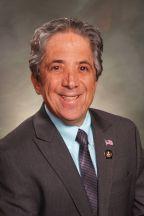
Photo of John Kefalas
D Colorado Senate · District 14

Sen. John Kefalas

Compare
Total votes
970
all sessions
Attendance
0%
254 missed
Near the chamber average
With party
98%
of cast votes
Near the chamber average
Bipartisan score
3%
crosses aisle rarely
Near the chamber average
Sponsored
50
bills & resolutions
Near the chamber average
Committees
0
assignments
50 bills and resolutions

Sponsored bills

Total
50
Primary
50
Co-sponsor
0
This page
50
matching current filters
Primary HB 17-1115
Signed into law · Colorado House · Lead sponsor
Direct Primary Health Care Services

The bill establishes parameters under which a direct primary care agreement (agreement) may be implemented. An agreement may be entered into between a direct primary health care provider (provider) and a patient for the payment of a periodic fee and for a specified period of time. The provider must be a licensed, registered, or certified individual or entity authorized to provide primary care services. The bill establishes that the agreement is not the business of insurance or the practice of underwriting and does not fall under regulation of the division of insurance. The bill outlines the conditions under which a provider may discontinue care to a patient. (Note: This summary applies to this bill as introduced.)

Signed into law Apr 24, 2017 0 co-sponsors
Primary SB 17-205
In committee · Colorado Senate · Lead sponsor
Multimodal Transportation Infrastructure Funding

In 1999, the voters of the state authorized the executive director of the department of transportation (CDOT) to issue transportation revenue anticipation notes (TRANs) in a maximum principal amount of $1.7 billion and with a maximum repayment cost of $2.3 billion in order to provide financing to accelerate the construction of qualified federal aid transportation projects. The executive director of CDOT issued the TRANs as authorized. The final payments of principal and interest on the TRANs will be made during fiscal year 2016-17, which will make available for expenditure for transportation-related purposes only revenues dedicated for transportation by federal law, the state constitution, and state law that the state has been using to make principal and interest payments on the TRANs. Section 9 requires the state transportation commission to submit a ballot question to the voters of the state at the November 2017, 2018, or 2019 election, which, if approved, would increase the state sales and use tax from 2.9% to 3.15%, beginning on the July 1 immediately following the applicable election and would authorize the executive director of CDOT to issue additional TRANs in a maximum principal amount of $4 billion and with a maximum repayment cost of $5.75 billion. If the voters approve the ballot question, sections 3, 4, 5, and 7 implement the increase in the state sales and use tax rate. The additional TRANs must have a maximum repayment term of 20 years, and the certificate, trust indenture, or other instrument authorizing their issuance must provide that the state may pay them in full before the end of the specified payment term without penalty. Additional TRANs must otherwise generally be issued subject to the same requirements and for the same purposes as the original TRANs; except that the transportation commission must pledge to annually allocate from legally available money under its control any money needed for payment of the notes in excess of amounts appropriated by the general assembly from the state highway fund for payment of the notes as authorized by section 5 until the notes are fully repaid. Section 10 specifies that at least $500 million of TRANs proceeds shall be used only for passenger rail service in the interstate 25 corridor and that remaining TRANs proceeds shall be used only to fund projects on CDOT's priority list for transportation funding. Section 10 also specifies additional transportation project contract award process requirements and limitations for a project to be funded in whole or in part with proceeds of additional TRANs. Sections 6 and 8 require all state sales and use tax net revenue that is attributable to any increase in the state sales and use tax rate resulting from the approval of the ballot question submitted pursuant to section 9 to be credited to the HUTF, paid from the HUTF to the state highway fund for use, subject to annual appropriation by the general assembly, for payment of TRANs and, to the extent not used for that purpose, state transportation projects.(Note: This summary applies to this bill as introduced.)

In committee Apr 4, 2017 0 co-sponsors
Primary SB 17-110
Signed into law · Colorado Senate · Lead sponsor
Accessibility Of Exempt Family Child Care

The bill increases the accessibility of legal child care by expanding the circumstances under which an individual can care for children from multiple families for less than 24 hours without obtaining a child care license. (Note: This summary applies to the reengrossed version of this bill as introduced in the second house.)

Signed into law Mar 30, 2017 0 co-sponsors
Primary HB 17-1056
Signed into law · Colorado House · Lead sponsor
Criminal Sentencing Community Service Veterans Organizations

Currently, only an organization that is exempt from taxation under section 501 (c)(3) of the federal internal revenue code (tax code) may accept services offered through a program of community or useful public service operated by a county court, probation department, county sheriff, or other local governmental entity in connection with sentencing for specified misdemeanors. Veterans' service organizations may be organized under other provisions of the tax code such as section 501 (c)(4) or 501 (c)(19). The bill expands the criteria for organizations that may accept community or useful public service assignments to include veterans' service organizations organized under 501 (c)(4) or 501 (c)(19) of the tax code, and specifies that the court or other entity making the assignment retains discretion to determine which organizations may be included in its program of community or useful public service. Section 1 amends the statute dealing with misdemeanor sentencing generally. Sections 2 and 3 insert analogous provisions into the statutes dealing specifically with sentencing of persons convicted of drug offenses and alcohol-related driving offenses, respectively. (Note: This summary applies to the reengrossed version of this bill as introduced in the second house.)

Signed into law Mar 20, 2017 0 co-sponsors
Primary HB 17-1098
In committee · Colorado House · Lead sponsor
Damages For Loss Of Use Of Rental Motor Vehicles

The bill limits the damages that a vehicle rental company can recover for the loss of use of the vehicle to the actual lost profits suffered by the company due to the loss of use of the vehicle. (Note: This summary applies to this bill as introduced.)

In committee Feb 21, 2017 0 co-sponsors
Primary SB 17-098
In committee · Colorado Senate · Lead sponsor
Mobile Home Parks

Notice of sale of a mobile home park. Where the home owners within a mobile home park (park) have formed either a homeowners' association or a cooperative, section 2 of the bill specifies that, not less than 30 days nor more than one year prior to, an owner of a park either entering into a written listing agreement for the sale of the park or making an offer to sell the park to any party must provide written notice to the president, secretary, and treasurer of any homeowners' association or cooperative of the owner's intention to sell the park. The bill specifies certain circumstances in which the park owner is not required to satisfy these notice requirements. During the notice period required by the bill, the owner or management of the park may consider any offer to purchase the park that has been made by a homeowners' association or cooperative of such home owners as long as the association or cooperative is open to all home owners. The owner of the park may consider any reasonable offer made by an association or cooperative representing the home owners and negotiate in good faith with them. If an agreement to purchase the community is reached during the notice period specified in the bill, the association or cooperative has a reasonable time beyond the expiration of such period, if necessary, to obtain financing for the purchase. The bill explicitly specifies that these provisions do not give any home owner or group of home owners within a park any right of first refusal. Terms of written rental agreement. Section 3 permits a written rental agreement for a tenancy in a park to contain a clause that encourages the use of mediation or another form of alternative dispute resolution to resolve any controversy by or among owners, management, and home owners within parks. Alternative dispute resolution. In any controversy between management and a home owner of a park arising out of the bill, except for the nonpayment of rent or in cases in which the health or safety of other home owners is in imminent danger, section 4 permits the parties to submit the dispute to another form of alternative dispute resolution in addition to mediation prior to the filing of a forcible entry and detainer lawsuit. The choice of alternative dispute resolution methods is dependent upon agreement of the parties. Under section 4, the general assembly also encourages the owners and management of parks and home owners within such parks to make use of the state office of dispute resolution to resolve any controversy by or among them in addition to local government agencies and community-based nonprofit organizations that are created and empowered to mediate disputes between or among the owners and management of parks and home owners within such parks. Subtraction of gain from sale of park from calculation of federal taxable income for state income tax purposes. For income tax years commencing on or after January 1, 2018, section 5 subtracts from federal taxable income the following amount of the gain recognized from the sale or exchange of a park where the party purchasing the park is a county, municipality, local housing authority, nonprofit corporation, homeowners' association, or a cooperative: 100% of the recognized gain for a mobile home park with 50 or fewer lots; and 50% of the recognized gain for a mobile home park with more than 50 lots. Encouragement of the preservation and development of mobile and manufactured home parks through county and municipal master plans. Recognizing the importance of manufactured housing as an option for many households, under sections 6 and 7 , counties and municipalities, as applicable, are required to encourage through either their master plans or other land use or planning documents adopted by the particular governmental body the preservation of existing parks and the development of new manufactured home parks within their territorial boundaries, including increasing opportunities for parks that are owned by the owners of homes within the park. Whenever an existing park is located in a hazardous area, the county or municipality, as applicable, is required to make every reasonable effort to reduce or eliminate the hazard, when feasible, or to help mitigate the loss of housing through the relocation of affected households. (Note: This summary applies to this bill as introduced.)


In committee Feb 13, 2017 0 co-sponsors
Primary SB 17-064
In committee · Colorado Senate · Lead sponsor
License Freestanding Emergency Departments

The bill creates a new license, referred to as a 'freestanding emergency department license', for the department of public health and environment to issue on or after July 1, 2019, to a health facility that provides emergency and urgent care and is either independent from and not affiliated with or located in a hospital or is operated by a hospital at a location off the hospital's main campus. The state board of health is to adopt rules regarding the new license, including rules to set licensure requirements and fees, safety and care standards, staffing requirements, fee transparency requirements, and other areas related to the operation of freestanding emergency departments. To qualify for a license, a facility must provide claims and billing data to health insurers and must be able to triage patients to determine the level of care they require. Starting on the date the bill takes effect through June 30, 2019, the department is prohibited from issuing a new license to a person to operate a freestanding health facility that provides emergency care, whether independent from or operated by a hospital, unless the facility will serve an area of the state that has limited access to emergency care. Additionally, the bill requires a health facility that is operating as a freestanding emergency department under current law to: Submit data to insurers to enable reporting of claims and billing data from freestanding emergency departments; Differentiate in a patient's billing statement the facility fee, professional fee, and ancillary service charges; and Post on its website a current facility fee schedule that indicates the range of facility fees that a patient may be charged and a list of health benefit plans or products for which the facility and its health care providers are in-network or out-of-network.(Note: This summary applies to this concurrent resolution as introduced.)

In committee Feb 8, 2017 0 co-sponsors
Showing 41 to 50 of 50 bills
Previous 1 3 4 5