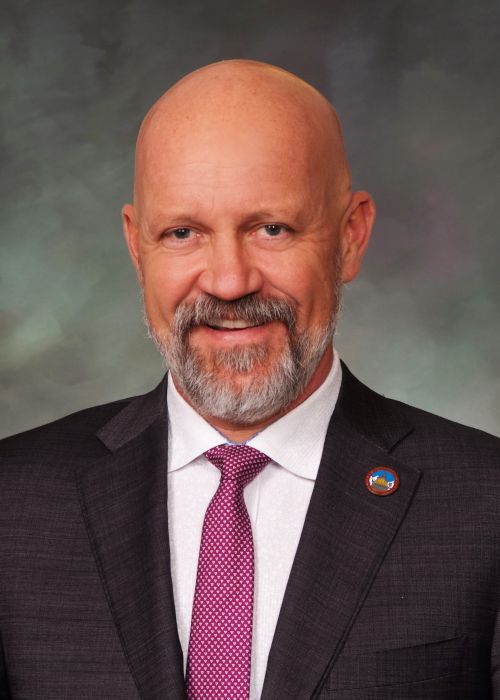
Photo of Scott Bright
R Colorado Senate · District 13

Sen. Scott Bright

Compare
Total votes
1,104
all sessions
Attendance
82%
196 missed
Near the chamber average
With party
95%
of cast votes
Near the chamber average
Bipartisan score
4%
crosses aisle rarely
Lower than 89% of chamber peers
Sponsored
216
bills & resolutions
Near the chamber average
Committees
4
assignments
216 bills and resolutions

Sponsored bills

Total
216
Primary
40
Co-sponsor
176
This page
216
matching current filters
Co-sponsor HJR 1002
Passed · Colorado House · Co-sponsor
MLK Jr. Day

Maddy summaryHJR 1002 is a commemorative resolution honoring Dr. Martin Luther King Jr. It does not create new laws or policies. The resolution recognizes Dr. King's legacy through historical context about his civil rights leadership, his "I Have a Dream" speech, and his role in key legislation like the Civil Rights Act of 1964. It specifically acknowledges Colorado's history of observing MLK Jr. Day, noting that Colorado became the 50th state to recognize the holiday in 2000. The resolution serves only to formally commemorate Dr. King's life and work, with no direct effect on citizens or new government requirements.

Passed Jan 20, 2026 1 co-sponsor
Co-sponsor SJR 3
Passed · Colorado Senate · Co-sponsor
Joint Session Address by Tribal Councils

Maddy summarySJR 3 is a procedural resolution scheduling a joint meeting of Colorado's Senate and House of Representatives on January 16, 2026, to hear a message from representatives of the Ute Mountain Ute Tribal Council and Southern Ute Tribal Council. It directs the appointment of a six-member committee (three from each chamber) to escort tribal representatives to the session. The resolution recognizes the tribes' historical and cultural contributions to Colorado but does not create new laws or policies. This is a formal procedural step to facilitate the tribal message, not a substantive legislative change.

Passed Jan 15, 2026 1 co-sponsor
Co-sponsor SB 25-306
Signed into law · Colorado Senate · Co-sponsor
Performance Audits of Certain State Agencies

The act requires the state auditor to conduct or cause to be conducted performance audits (audits) of the air pollution control division in the department of public health and environment and the division of unemployment insurance in the department of labor and employment (divisions). The audits will determine whether each of the divisions effectively and efficiently performs and fulfills its statutory obligations. In addition, as part of the audits, the state auditor is required to: Determine whether a division complies with statute and its statutory purpose; Assess the impact of a division's processes on providing access to program benefits and, for the labor and employment division audit only, identify any division processes that may be unnecessary, unreasonable, or cause delays; Determine whether a division's staffing and funding levels are sufficient for it to efficiently and effectively perform its statutory duties and responsibilities, which, in for the air pollution control division audit only, must include assessment of how funding or staffing changes made at the state level might impact local governments; and Determine whether a division requested and was appropriated additional resources and whether the approval or denial of such a request impacted program implementation and timing of implementation. The initial audit of the air pollution control division must begin and be completed in calendar year 2026, with an additional audit occurring in calendar year 2031. The initial audit of the division of unemployment insurance must begin and be completed in calendar year 2027, with an additional audit occurring in calendar year 2032. Upon completion of an audit, the state auditor is required to submit a written audit report to the legislative audit committee. (Note: This summary applies to this bill as enacted.)

Signed into law Jun 4, 2025 1 co-sponsor
Co-sponsor SB 25-305
Signed into law · Colorado Senate · Co-sponsor
Water Quality Permitting Efficiency

Current law requires the division of administration (division) within the department of public health and environment to report annually to the water quality control commission (commission) and to include in the report any regulatory or legislative recommendations the division may have. The act requires the report to also include: Information on the division's timing in considering and issuing water quality permits (permits); and For the report submitted in 2026, a detailed discussion of how the division has prioritized reducing the permit backlog, implemented recommendations from water quality permittees (permittees) for permitting efficiency, and increased safe drinking water program inspections. The act requires the division, upon receipt of an application to modify a permit, to limit its review and its approval or denial of the application to the scope of the specific requests contained in the application. The act requires the commission to adopt rules on or before December 31, 2026, that establish procedures whereby the division, prior to giving public notice of a complete permit application for an individual permit and the division's preliminary analysis of the application, may provide a period of public notice and review of a preliminary draft prepared by the division. If a period of public notice and review is required by rules of the commission, the period of public notice and review may not exceed 14 days, and the purpose of the review is limited to identifying errors in the division's preliminary draft. On or before December 31, 2027, the division must propose rules to the commission that establish a time frame during which the division will either grant or deny applications for each type of permitting action. On or before June 30, 2028, the commission shall adopt rules based on the division's proposal. The rules must establish the time frames for permitting actions. The act requires the division to consider current debt service on existing local government water infrastructure when developing schedules of compliance for new effluent limits in local government permits. Any schedule of compliance for new effluent limits in local government permits must, consistent with state and federal law, consider the local government's financial capability to repay existing debt on water infrastructure or to fund water infrastructure upgrades before requiring new water infrastructure upgrades. To the extent allowable under federal law, the division may issue compliance schedules in a local government permit for a new effluent limit in excess of 20 years. The act states that, on and after May 1, 2026, after an application for permit modification or permit renewal has been pending before the division for 60 days, or for any application for permit modification or permit renewal that is pending before the division as of May 1, 2026, or if the division informs an applicant that the division will not process an application for preliminary effluent limitations, the applicant and the division may mutually agree to use a qualified and independent nongovernmental contractor (contractor) under the direction of the division to provide the division with technical assistance in completing the permit action. An applicant shall bear the contractor's costs for any technical assistance provided by the contractor and shall pay the contractor for such costs. The division may charge an applicant an additional fee in an amount not exceeding 10% of the contract amount for contract administration, technical review, and additional permit processing, which fee is credited to the clean water cash fund. The act requires the division, upon a permittee's request, to make available to the permittee all documents, data, and information the division relied upon in developing the permittee's permit modification or permit renewal, except to the extent that such materials are protected by an applicable privilege or exception. The act makes the following transfers of money: On July 1, 2025, $111,000 from the water quality improvement fund to the drinking water cash fund; On July 1, 2025, $3,518,564 from the perfluoroalkyl and polyfluoroalkyl substances cash fund to the clean water cash fund; On July 1, 2026, $3,002,435 from the perfluoroalkyl and polyfluoroalkyl substances cash fund to the clean water cash fund; and On July 1, 2026, $516,129 dollars from the perfluoroalkyl and polyfluoroalkyl substances cash fund to the drinking water cash fund. For the 2025-26 state fiscal year, the act appropriates $2,904,599 to the department of public health and environment. This appropriation consists of $446,315 from the drinking water cash fund and $2,458,284 from the clean water cash fund. For the 2025-26 state fiscal year, the act appropriates $160,611 to the department of law. This appropriation is from reappropriated funds received from the department of public health and environment. The act also makes and reduces certain appropriations as adjustments to the 2025 general appropriations act. (Note: This summary applies to this bill as enacted.)


Signed into law Jun 4, 2025 1 co-sponsor
Co-sponsor HB 25-1038
Signed into law · Colorado House · Co-sponsor
Postsecondary Credit Transfer Website

The act requires the department of higher education (department), subject to available appropriations, to develop and maintain a free, publicly accessible online platform (platform) to provide current and potential students who are pursuing postsecondary education in Colorado with relevant information about which credits and courses, work-related experiences, and prior learning opportunities are transferable to or between the state's public institutions of higher education (institution). On or before January 1, 2026, an institution may submit to the department for inclusion in the platform: A comprehensive record, from the fall 2023 term onward, of the institution's awards of postsecondary transfer credit for all courses that the institution has identified as having learning outcomes equivalent to corresponding offerings at other institutions; and Descriptions of the institution's policy on work-related experiences or prior learning opportunities, and the credentials, licenses, or apprenticeship certificates for which the institution awards postsecondary academic credit. Using the data provided by an institution, the department shall include in the platform information about the transferability to or between institutions for several sources of postsecondary academic credit. These sources include courses in the statewide common course numbering system, now referred to as the guaranteed transfer pathway matrix, and credits earned through various standardized tests. A not-for-profit private institution of higher education may, but is not required to, submit applicable information for inclusion in the platform. The act creates the postsecondary transfer credit platform cash fund to accept gifts, grants, and donations for the development, implementation, and maintenance of the platform. (Note: This summary applies to this bill as enacted.)
Signed into law Jun 3, 2025 1 co-sponsor
Co-sponsor HB 25-1146
Signed into law · Colorado House · Co-sponsor
Juvenile Detention Bed Cap

Under current law, there exists a working group formed by the department of human services and the state court administrator in the judicial department to perform various duties related to the allocation of juvenile detention beds. The act amends these duties. Under current law, 22 emergency detention beds are available statewide. The act expands this to 39 emergency detention beds available statewide. The act requires the department of human services to publish a monthly report concerning the status of all youth who are in detention and are awaiting services that would mitigate the substantial risk of harm to others that are presented by the juvenile or the juvenile's risk of flight from prosecution and the number of emergency beds used by each judicial district or facility. The act requires the division of youth services to: Publish a report by July 1, 2027, concerning available placements for juveniles who are awaiting mitigating services in the state; and Establish a pilot program for certain staff members to wear a body-worn camera while in a facility while interacting with youth. The act requires a court to dismiss a delinquency petition or charges against a juvenile if the court determines that the juvenile is incompetent to proceed and the highest charged act constitutes a class 2 misdemeanor, petty offense, drug misdemeanor, or traffic offense. The act amends and expands considerations for a juvenile's case management plan, if the court determines that a juvenile is incompetent to proceed. The act creates the deflection and community investment grant program in the division of criminal justice to provide grants to eligible applicants to implement a mixed-delivery system of trauma-informed health and development deflection programs for youth, including Native American youth. The grant program repeals on January 1, 2031. For the 2025-26 state fiscal year, the act: Appropriates $6,854,420 from the general fund to the department of human services to implement the act; Reappropriates $122,279 of general funds to the department of education to the department of human services for use by the division of youth services to implement the act; Appropriates $437,264 from the general fund to the department of public safety for use by the division of criminal justice to implement the act; and Appropriates $2,708,316 from the general fund to the department of public safety for use by the division of criminal justice for the deflection and community investment grant program.(Note: This summary applies to this bill as enacted.)

Signed into law Jun 2, 2025 1 co-sponsor
Primary SB 25-168
Signed into law · Colorado Senate · Lead sponsor
Prevention of Wildlife Trafficking

The act adds species that appear in Appendix I to the Convention on International Trade in Endangered Species of Wild Fauna and Flora (CITES Appendix I) to the wildlife covered under Colorado's wildlife trafficking and wildlife possession laws. The act clarifies that species listed on Colorado's endangered and threatened species list or the endangered and threatened species list pursuant to the federal "Endangered Species Act of 1973", 16 U.S.C. sec. 1531 et seq. (federal act) are also covered under Colorado's wildlife possession and wildlife trafficking laws. The act establishes penalties for violating wildlife trafficking laws. A person who violates wildlife trafficking laws commits a class 1 misdemeanor; except that: If a person violates wildlife trafficking laws and the aggregate value of the wildlife involved is more than $1,000 but less than $10,000, the person commits a class 5 felony; If a person is convicted of trafficking wildlife and the wildlife involved is an endangered species or threatened species under Colorado law or the federal act or is a species that appears in CITES Appendix I, the person commits a class 4 felony; or If a person violates wildlife trafficking laws and the aggregate value of the wildlife involved is more than $10,000, the person commits a class 4 felony. The act grants the parks and wildlife commission (commission) in the department of natural resources (department) authority to suspend wildlife licenses held by a person convicted of a violation of wildlife trafficking laws. The act clarifies that the division of parks and wildlife (division) in the department has the authority to pursue a civil action against an individual to recover the possession or value of wildlife that was unlawfully taken and the minimum value that the division may recover for certain animals that are on the federal endangered and threatened species lists. The act requires the division to conduct investigations and surveys to collect information and data related to wildlife trafficking and determine appropriate conservation, management, and law enforcement measures based on those investigations and surveys. The general assembly is required to appropriate sufficient money to implement the act from the wildlife cash fund; except that money from the sale of hunting and fishing licenses in the wildlife cash fund must not be used for these purposes. (Note: This summary applies to this bill as enacted.)

Signed into law Jun 2, 2025 0 co-sponsors
Co-sponsor SB 25-281
Signed into law · Colorado Senate · Co-sponsor
Increase Penalties Careless Driving

Current law states that a person who commits careless driving and thereby causes the death of an individual commits a class 1 misdemeanor traffic offense. The act expands current law to include careless driving resulting in serious bodily injury and states that if a person commits careless driving and thereby causes the serious bodily injury or death of more than one individual, each individual injure or killed is a separate violation. The act also clarifies that careless driving resulting in serious bodily injury or death is an included crime for the purposes of the "Victim Rights Act". (Note: This summary applies to this bill as enacted.)

Signed into law Jun 2, 2025 1 co-sponsor
Primary HB 25-1159
Signed into law · Colorado House · Lead sponsor
Child Support Commission Recommendations

The act implements the legislative recommendations of the child support commission by: Updating the child support guidelines schedule; Updating the monthly incomes eligible for a reduced low-income adjustment; and Replacing the current parenting time credit with a formula that provides parents credit for all overnights spent with that parent. The act appropriates $137,250 to the office of the governor for use by the office of information technology to provide information technology services to the department of human services. (Note: This summary applies to this bill as enacted.)

Signed into law May 31, 2025 0 co-sponsors
Primary HB 25-1304
Signed into law · Colorado House · Lead sponsor
Extension of Restitution Deadlines

Current law gives a trial court judge 91 days from the day a conviction enters in a criminal case to order restitution, which is the monetary loss a victim suffers due to a defendant's criminal conduct, in a criminal case. The act grants the prosecuting attorney 63 days to submit restitution information to the trial court judge following a conviction if the information is not available on the day a conviction enters, and then grants the trial court judge an additional 63 days following the submission of restitution information to order restitution after it receives the information from the prosecuting attorney. The act applies to defendants sentenced on or after the act's effective date. (Note: This summary applies to this bill as enacted.)

Signed into law May 30, 2025 0 co-sponsors
Showing 131 to 140 of 216 bills
Previous 1 13 14 15 22 Next