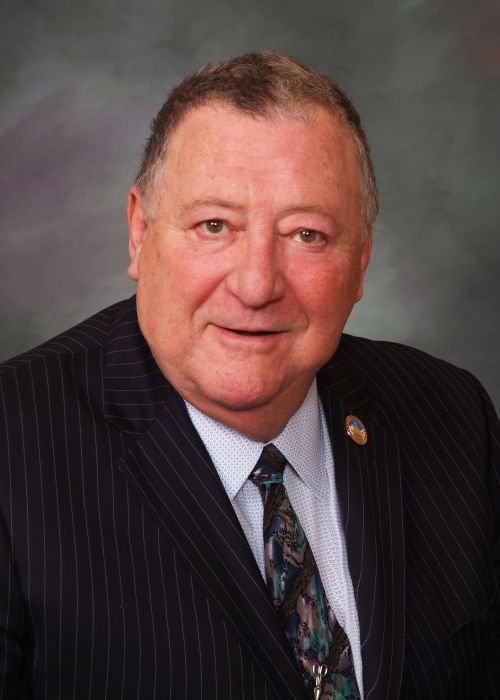
Photo of Marc Snyder
D Colorado Senate · District 12

Sen. Marc Snyder

Compare
Total votes
7,147
all sessions
Attendance
98%
121 missed
Higher than 80% of chamber peers
With party
96%
of cast votes
Near the chamber average
Bipartisan score
2%
crosses aisle rarely
Near the chamber average
Sponsored
543
bills & resolutions
Near the chamber average
Committees
4
assignments
543 bills and resolutions

Sponsored bills

Total
543
Primary
188
Co-sponsor
355
This page
543
matching current filters
Co-sponsor SJR 25-003
Passed · Colorado Senate · Co-sponsor
Colorado Commission on Uniform State Laws Appointments

Maddy summaryThis bill appoints six specific individuals - Senator Marc Snyder, Representative Cecelia Espenoza, Bob Gardner, Claire Levy, Anne McGihon, and Joseph Whitfield - to the Colorado Commission on Uniform State Laws for two-year terms. It directly affects these appointees by granting them membership on the commission, which advises Colorado on adopting uniform state laws. The resolution implements a statutory requirement (C.R.S. § 2-3-601) for filling commission positions, with no policy changes or new provisions beyond the appointments themselves.

Passed Jan 16, 2025 1 co-sponsor
Primary SB 24-016
Signed into law · Colorado Senate · Lead sponsor
Tax Credits for Contributions via Intermediaries

A qualified intermediary is a charitable organization that collects charitable contributions from donors and forwards the contributions to charitable recipient organizations. The act authorizes a taxpayer to make a charitable contribution for which the taxpayer may claim a state income tax credit to a charitable recipient organization through a qualified intermediary that forwards the contribution to the charitable recipient organization, rather than making the contribution directly to the charitable recipient organization, without losing the right to claim the credit. For the Colorado homeless contribution tax credit, the act requires a tax credit certificate to include a unique certificate identification number and the last 4 digits, rather than all digits, of the taxpayer's social security number or the taxpayer's full federal employer identification number. For the 2024-25 state fiscal year, $41,769 is appropriated from the general fund to the department of revenue and $5,000 is appropriated from the general fund to the department of local affairs for implementation of the act. APPROVED by Governor June 7, 2024 EFFECTIVE August 7, 2024(Note: This summary applies to this bill as enacted.)

Signed into law Jun 7, 2024 0 co-sponsors
Primary SB 24-192
Signed into law · Colorado Senate · Lead sponsor
Motor Vehicle Lemon Law

Current law commonly known as the "lemon law" requires a manufacturer, a manufacturer's agent, or a manufacturer's authorized dealer (dealer) to replace or buy back a motor vehicle if the consumer notified the dealer within the earlier of the warranty period or one year after original delivery of the motor vehicle (notification time) of the motor vehicle's nonconformity with the motor vehicle's warranty (nonconformity) and the motor vehicle underwent a reasonable number of attempts to repair. The number of repairs are considered reasonable if: The motor vehicle was out of service for repairs for a cumulative total of 30 or more business days; or The dealer tried unsuccessfully to repair the motor vehicle 4 or more times. The act: Expands the lemon law to cover motor vehicles affected by safety-based nonconformities; Expands the notification time to include the earlier of the motor vehicle's first 24,000 miles or 2 years after original delivery of the motor vehicle; Lowers the number of out-of-service business days from 30 to 24; and Lowers the number of required attempts to repair from 4 to 3 generally and to 2 for a safety-based nonconformity. Current law requires a manufacturer to be notified of a defect and be given an opportunity to cure the defect in order to be subject to the reasonable repairs presumption. The act adds a 10-business-day limit on the opportunity to cure the defect. Current law allows a dealer, when buying back a motor vehicle, to deduct a reasonable allowance for use. The act sets a formula for determining the reasonable allowance for use. Current law exempts from the lemon law motor vehicles that have a problem that does not affect the market value of the motor vehicle. The act provides that the problem must not affect the safety of the motor vehicle to qualify for the exemption. The act changes the statute of limitations from the earlier of 6 months after the expiration of a warranty or within one year after the original delivery of the motor vehicle to 30 months after the original delivery. The act requires a dealer to allow an agent of a purchaser to inspect a motor vehicle or provide a 7-day free-look period, during which the purchaser may return the motor vehicle and receive a refund of all money paid to purchase the motor vehicle. The dealer must notify purchasers of this inspection right. To make the inspection, an agent may have reasonable access to conduct the inspection, but the agent must be qualified to use or operate any equipment used to inspect the vehicle and must not interfere with normal business operations of the dealer. A dealer is required to give certain notices that a motor vehicle was returned, including notifying the department of revenue (department). The department must put a brand on the title to notify subsequent purchasers. Failing to comply with the act is grounds for discipline for a manufacturer or distributor of motor vehicles. To implement the act, $19,605 is appropriated for the 2024-25 state fiscal year to the department from the Colorado DRIVES vehicle services account in the highway users tax fund. APPROVED by Governor June 6, 2024 EFFECTIVE August 7, 2024(Note: This summary applies to this bill as enacted.)

Signed into law Jun 6, 2024 0 co-sponsors
Primary HB 24-1174
Signed into law · Colorado House · Lead sponsor
Concealed Carry Permits & Training

Under existing law, an applicant for a permit to carry a concealed handgun (permit) must demonstrate competence with a handgun. An applicant may demonstrate competence with a handgun in a number of ways, including by completing a training class offered by a certified instructor within 10 years before submitting an application for a permit. Pursuant to the act, beginning July 1, 2025, an applicant may demonstrate competence with a handgun by completing a training class only if the class satisfies the minimum standards for a training class, described below, and the applicant completes the class within one year before submitting an application for a permit. The act also allows a person to demonstrate competence with a handgun for the purpose of obtaining a permit by holding a current certification as a peace officer. An initial concealed handgun training class is a law enforcement training firearms safety course or a firearms safety course taught by an instructor verified by a county sheriff (verified instructor) that is held in person and includes instruction regarding: Knowledge and safe handling of firearms and ammunition; Safe storage of firearms and child safety; Safe shooting fundamentals; Federal and state laws pertaining to the lawful purchase, ownership, transportation, use, and possession of firearms; State law pertaining to the use of deadly force for self-defense; Best practices for safely interacting with law enforcement personnel who are responding to an emergency; and Techniques for avoiding a criminal attack and how to manage a violent confrontation, including conflict resolution and judgmental use of lethal force. A student must achieve a passing score on a written concealed handgun competency exam and in a live-fire exercise to complete an initial concealed handgun training class. An initial concealed handgun training class must provide at least 8 hours of instruction, including the live-fire exercise and written exam. Beginning July 1, 2025, the act requires an applicant to renew a permit to demonstrate competence with a handgun. A renewal applicant may demonstrate competence with a handgun through participation in organized shooting competitions, current military service, or current certification as a peace officer; by being a verified instructor for firearms safety courses; by showing honorable discharge from a branch of the United States armed forces or retirement from a Colorado law enforcement agency with pistol qualifications within 10 years prior to submitting a renewal form; or completing an initial concealed handgun training class or a concealed handgun refresher class (refresher class) within 6 months prior to submitting a renewal form. A refresher class must be held in person, be taught by a verified instructor, include instruction on changes to laws related to firearms, and require a passing score on a live-fire exercise and written exam. A refresher class must provide at least 2 hours of instruction, including the live-fire exercise and written exam. The act requires a county sheriff to verify as training instructors any person whose principal place to conduct firearms training is in the sheriff's county. To be a verified instructor, a person must hold a valid concealed carry permit and be certified as a firearms instructor by a law enforcement agency, college or university, nationally recognized organization that customarily offers firearms training, or firearms training school. Denial, suspension, or revocation of an instructor verification is subject to judicial review. It is a deceptive trade practice for a person to claim to be a verified instructor for a concealed handgun training class unless the person is verified as a firearms instructor by a county sheriff. The act prohibits a person from being issued a permit if the person was convicted of certain misdemeanor offenses within 5 years before submitting a permit application. APPROVED by Governor June 4, 2024 PORTIONS EFFECTIVE August 7, 2024 PORTIONS EFFECTIVE July 1, 2025(Note: This summary applies to this bill as enacted.)


Signed into law Jun 4, 2024 0 co-sponsors
Primary HB 24-1233
Signed into law · Colorado House · Lead sponsor
Homeowners' Association Delinquency Payments Enforcement Procedures

House Bill 22-1137, concerning practices of unit owners' associations, imposed a number of procedural requirements on unit owners' associations (HOAs) with respect to collecting payments from unit owners with delinquent accounts. The act changes some of these procedural requirements by: Removing a requirement that an HOA physically post notice of a unit owner's delinquent account on the unit owner's unit; In addition to sending notice by certified mail, requiring an HOA to contact a unit owner or designated contact by 2, rather than one, of certain described means; Authorizing an HOA to contact a unit owner or designated contact via telephone call to a telephone number that the HOA has on file for the unit owner or the unit owner's designated contact; and Allowing an HOA to charge a unit owner for the cost of sending notices or documentation by certified mail. The act also exempts time share units that are not occupied on a full-time basis from some of the procedural requirements imposed by House Bill 22-1137. APPROVED by Governor June 3, 2024 EFFECTIVE August 7, 2024(Note: This summary applies to this bill as enacted.)
Signed into law Jun 3, 2024 0 co-sponsors
Primary HB 24-1358
Signed into law · Colorado House · Lead sponsor
Film Incentive Tax Credit

The act adds established payments to personal services corporations as a qualified local expenditure (expenditure) for the purpose of qualifying for the film incentive income tax credit (credit), removes a condition that the credit is available only in years that the amount of state revenues are in excess of the limitation of state fiscal year spending by at least $50 million, and extends the deadline from February 4, 2025, to July 1, 2028, for a tax credit effectiveness study to be submitted to the finance committees of the house of representatives and the senate. The act requires a production company to make at least $100,000 in expenditures for the production company to be eligible for the credit. The credit must not exceed 22% of the expenditures of the production company, and $5 million is the maximum aggregate amount of all credits that may be issued in one calendar year. The act establishes a reservation system for a production company to apply for the credit before commencing production activities (activities). If the office of film, television, and media (office) determines that a production company is entitled to a tax credit reservation, the office shall notify the company in writing of the reservation and the amount. Once a production company has completed its activities in the state, the company may be issued a tax credit certificate if the office determines that the production company complied with all the requirements for the issuance of the credit. Activities must be completed on or before December 31, 2031. The office must provide the department of revenue with an electronic report of each production company to which the office issued a tax credit certificate for the preceding income tax year that includes the name of the production company, the amount of the credit awarded, and the production company's social security number or the production company's Colorado account number and federal employer identification number. The act repeals the credit on January 1, 2032. The act appropriates $29,120 from the general fund to the office of the governor for state fiscal year 2024-25. The act also appropriates $400,000 to the office of the governor for state fiscal year 2024-25 from the Colorado office of film, television, and media operational account cash fund. The appropriations may be used by the office to implement the act. APPROVED by Governor May 28, 2024 EFFECTIVE August 7, 2024(Note: This summary applies to this bill as enacted.)

Signed into law May 28, 2024 0 co-sponsors
Primary SB 24-169
Signed into law · Colorado Senate · Lead sponsor
State Firefighter Public Employees' Retirement Association Job Classification

Beginning July 1, 2025, the act requires a duly sworn employee of the division of fire prevention and control in the department of public safety to be classified as a "state trooper" for purposes of the public employees' retirement association if the employee's duties include structural or wildfire management, wildfire response, live-fire training, or wildfire leadership, as determined by the executive director of the department. APPROVED by Governor May 24, 2024 EFFECTIVE August 7, 2024(Note: This summary applies to this bill as enacted.)

Signed into law May 24, 2024 0 co-sponsors
Primary HB 24-1251
Signed into law · Colorado House · Lead sponsor
Sunset Debt-Management Service Providers

The act implements the recommendations in the 2023 sunset report by the department of regulatory agencies by: Continuing the regulation of debt-management service providers for 11 years, to 2035; Requiring a debt-management service provider to maintain records of the education provided to an individual; Requiring settlement agreements between a consumer and creditor to be in writing; and Requiring fees paid by debt-management service providers to be set administratively instead of through the rule-making process. APPROVED by Governor May 22, 2024 EFFECTIVE August 7, 2024(Note: This summary applies to this bill as enacted.)

Signed into law May 22, 2024 0 co-sponsors
Primary SB 24-223
Signed into law · Colorado Senate · Lead sponsor
Licensing for Clinics That Provide Fertility Services

Current law requires a gamete agency, gamete bank, or fertility clinic (clinic) to obtain a license from the department of public health and environment (department) on or after January 1, 2025, before the clinic may match or provide gametes or embryos to recipients in Colorado. The act extends this deadline to July 1, 2025. The act requires that a clinic located outside of Colorado shall not match intended recipients located in Colorado with donors, or provide gametes to a recipient parent or parents located in Colorado or to the recipient parent's medical provider located in Colorado, from a donor who does not agree to the disclosure of the donor's identity. The act adds a requirement that applicants for an original and renewal license must submit documentation to demonstrate compliance with licensing requirements. Subject to available appropriations, the department may, as it deems necessary, perform on-site inspections or complaint investigations of clinics located outside of Colorado. The act extends the deadline for rule-making regarding clinics from July 1, 2024, to January 1, 2025. The act requires that, beginning in fiscal year 2025-26, the general assembly annually appropriate $125,000 to the gamete agency, gamete bank, or fertility clinic fund. APPROVED by Governor May 22, 2024 EFFECTIVE May 22, 2024(Note: This summary applies to this bill as enacted.)

Signed into law May 22, 2024 0 co-sponsors
Primary HB 24-1244
Signed into law · Colorado House · Lead sponsor
Minor Autopsy Report Release Requirements

The act specifies that an autopsy report prepared in connection with the death of a minor is confidential and may be disclosed by the county coroner to another person or entity only in accordance with certain exceptions. The report is not a public record for purposes of the Colorado open records act. Under the act, upon the request of an entity or individual entitled to the report, the coroner or the coroner's designee shall provide a copy of the autopsy report prepared in connection with the death of a minor to: A parent or legal guardian of the deceased; A law enforcement or criminal justice agency that is investigating the death or prosecuting a criminal violation arising out of the death; A requesting party in a civil case; Counsel for the defendant or the respondent for discovery purposes in a criminal case only if discovery has not otherwise been provided and in accordance with any protective order; A state, local, or regional child fatality prevention review team; The Colorado department of public health and environment as necessary for the collection of data in accordance with the Colorado violent death reporting system and the Colorado unintentional drug overdose reporting system; The Colorado child fatality review team; A county department of human or social services; The division of youth services in the Colorado department of human services; A health-care facility where the deceased had received treatment; A community clinic or a treating hospital for inclusion within the medical records of the deceased; An eye bank, organ procurement organization, or tissue bank; A local or regional domestic violence fatality review team; The Colorado department of human services in connection with the investigation of a fatality that has occurred within any facility licensed under the "Child Care Licensing Act"; The office of the child protection ombudsman; A health-care provider that had previously established a patient-provider relationship with the deceased; The Colorado maternal mortality review committee for the purpose of conducting public health death reviews of deceased individuals who are pregnant or within one year postpartum; The Colorado department of public health and environment and county public health agencies for the purpose of data collection related to the department's authority to investigate and control the causes of epidemic and communicable diseases and related board of health rules; The Colorado department of public health and environment's health facility and emergency medical services division for the purpose of health facilities and emergency medical services investigations; or The public if the death occurs while the minor is in the custody or under the supervision of the state or a local government. Upon written request by any individual, the coroner shall not release a copy of the autopsy report and instead shall release the cause, time, place, and manner of the minor's death, and the name, age, gender, and race or ethnicity of the deceased minor. This information must be released within 3 days of the request or 3 days of receiving the information, whichever is later. Under the act, any person may petition a district court to allow the person access to an autopsy report prepared in connection with the death of a minor. The petitioner shall serve process on the coroner and a members of the deceased minor's next of kin pursuant to the Colorado rules of civil procedure. The district court shall hold a hearing including the petitioner, coroner, and a member of the deceased minor's next of kin, if available. The hearing must be conducted under the simplified process in the Colorado rules of civil procedure. The district court shall provide access if: Public disclosure of the report substantially outweighs the harm to the privacy interests of the deceased and members of the family of the deceased; and The information sought by the petitioner is not otherwise publicly available. A coroner is required to provide the name of the deceased minor and the name and address of a member of the deceased minor's next of kin to the district court, which shall disclose that information to the petitioner under a protective order for the purpose of service of process. APPROVED by Governor May 22, 2024 EFFECTIVE January 1, 2025(Note: This summary applies to this bill as enacted.)

Signed into law May 22, 2024 0 co-sponsors
Showing 421 to 430 of 543 bills
Previous 1 … 42 43 44 … 55 Next