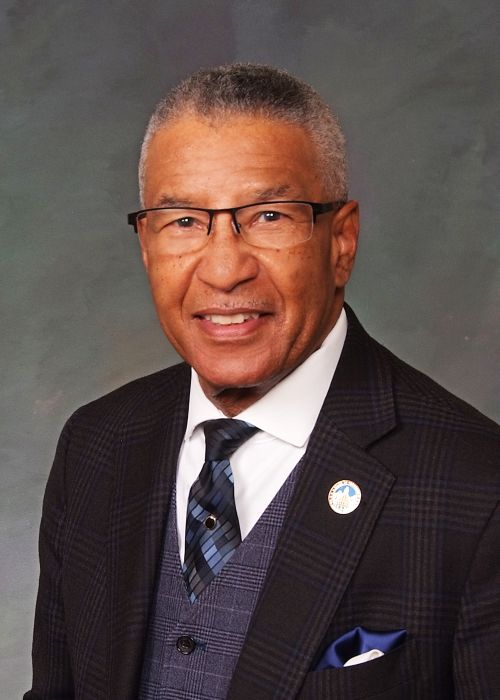
Photo of Tony Exum
D Colorado Senate · District 11 On the 2026 ballot

Sen. Tony Exum

Compare
Total votes
3,266
all sessions
Attendance
98%
74 missed
Near the chamber average
With party
98%
of cast votes
Higher than 80% of chamber peers
Bipartisan score
1%
crosses aisle rarely
Lower than 78% of chamber peers
Sponsored
543
bills & resolutions
Higher than 77% of chamber peers
Committees
6
assignments
543 bills and resolutions

Sponsored bills

Total
543
Primary
95
Co-sponsor
448
This page
543
matching current filters
Co-sponsor HB 1014
Signed into law · Colorado House · Co-sponsor
Extend Colorado Job Growth Incentive Tax Credit

Under current law, the Colorado job growth incentive tax credit (credit) may only be allowed by the economic development commission (commission) through state income tax year 2026. The act amends the Colorado job growth incentive tax credit to authorize the commission to allow new credit awards through state income tax year 2034. The act also extends the commission's annual reporting requirement through September 1, 2042.(Note: This summary applies to this bill as enacted.)

Signed into law May 29, 2026 1 co-sponsor
Co-sponsor HB 1051
Signed into law · Colorado House · Co-sponsor
Continue Microgrid Community Resilience Grant Program

The microgrids for community resilience grant program (grant program) in the division of local government in the department of local affairs provides grants for cooperative electric associations and municipally owned utilities to purchase microgrid resources for eligible rural communities located within their service territories. Under current law, the grant program is set to repeal on September 1, 2026. The act continues the grant program indefinitely by removing the repeal date.(Note: This summary applies to this bill as enacted.)

Signed into law May 29, 2026 1 co-sponsor
Co-sponsor HB 1353
Signed into law · Colorado House · Co-sponsor
Student State Assessment in Social Studies

The act eliminates the requirement for the department of education (department) to administer a state assessment in social studies to elementary school students and specifies that the department is only required to administer a state assessment in social studies to students enrolled in seventh grade in a public school.     The act also eliminates the requirement that the department administer a state assessment in social studies in a representative sample of public schools each year.     The act reduces by the appropriation made in the annual general appropriation act for the 2026-27 state fiscal year to the department of education from the state education fund for the statewide assessment program by $302,835.(Note: This summary applies to this bill as enacted.)

Signed into law May 28, 2026 1 co-sponsor
Co-sponsor HB 1391
Signed into law · Colorado House · Co-sponsor
Safe Drinking Water in Child Care Centers & Schools

In 2022, the general assembly enacted, and the governor subsequently signed into law, House Bill 22-1358 ('Concerning measures to eliminate the presence of lead in the drinking water of certain facilities where children are present, and, in connection therewith, making an appropriation'), which required child care centers, family child care homes, and each public school that serves any of grades preschool through eighth grade to:Test its drinking water sources by having a state-certified laboratory measure the lead content of water drawn from each drinking water source; andSatisfy other requirements concerning the provision of safe drinking water.     House Bill 22-1358 also created the school and child care clean drinking water fund (fund) to help schools, child care centers, and family child care homes comply with House Bill 22-1358.     House Bill 22-1358 included a repeal date of June 30, 2026, for its provisions. The act extends the provisions, with amendments, until June 30, 2029. The act also adds high schools (i.e., schools that serve grades 9 to 12) to the scope of House Bill 22-1358, which means that high schools may receive grants from the fund and must satisfy certain requirements on or before dates specified in the act.     The act requires the department to adopt rules establishing how a child care center shall demonstrate compliance with the requirements concerning the testing for the presence of lead in drinking water.(Note: This summary applies to this bill as enacted.)

Signed into law May 28, 2026 1 co-sponsor
Co-sponsor HB 1286
Vetoed · Colorado House · Co-sponsor
Automated Driving System Commercial Vehicles

The act prohibits using an automated driving system to drive a commercial motor vehicle unless an individual who holds a commercial driver's license is in the vehicle, monitors the vehicle's driving, and intervenes, if necessary, to avoid illegal or unsafe driving. The individual must be in the driver's seat if hazardous materials are being transported. The penalty is $1,000 for a first offense, is $2,000 for a second offense, and doubles for each subsequent offense.     The act does not apply to a light-duty vehicle or a truck-mounted attenuator.     The prohibition is repealed September 1, 2031. The chief of the Colorado state patrol will analyze the act's effects on commercial vehicle safety on highways. By November 1, 2030, the chief of the Colorado state patrol will issue a report to the relevant committees of the house of representatives and senate. The report must make recommendations as whether to continue the prohibition and, if continued, any recommended legislation to improve the prohibition.     For the 2026-27 state fiscal year, $14,357 is appropriated to the department of revenue from the Colorado DRIVES vehicle services account in the highway users tax fund to implement the act.(Note: This summary applies to this bill as enacted.)

Vetoed May 28, 2026 1 co-sponsor
Co-sponsor HB 1004
Signed into law · Colorado House · Co-sponsor
Continuation of Child Care Contribution Tax Credit

The act extends for an additional 10 years the availability of the state income tax credit allowed to a taxpayer who makes a qualifying monetary contribution to promote child care in the state equal to 50% of the total value of the contribution, not to exceed $100,000, through income tax years commencing prior to January 1, 2038.(Note: This summary applies to this bill as enacted.)

Signed into law May 28, 2026 1 co-sponsor
Primary HB 1005
Vetoed · Colorado House · Lead sponsor
Worker Protection Collective Bargaining

The act makes the following changes to the 'Labor Peace Act':Specifies that employees' right to bargain collectively includes the right to bargain collectively concerning any mandatory subject of bargaining;Eliminates the requirement for a second election to negotiate a union security agreement clause in the collective bargaining process;Declares that it is not an unfair labor practice for an employer to refuse to agree to a lawful proposal made by the exclusive representative of the employees, or for the exclusive representative of the employees to refuse to agree to a lawful proposal made by the employer, concerning a mandatory subject of bargaining if the refusing party has bargained in good faith with the other party; andRequires employers and employees, through their exclusive representative, to bargain in good faith.(Note: This summary applies to this bill as enacted.)

Vetoed May 28, 2026 0 co-sponsors
Co-sponsor SB 23
Signed into law · Colorado Senate · Co-sponsor
School Finance Act

The act:Increases the statewide base per pupil funding for the 2026-27 budget year by $208.60 to account for inflation;Sets a new statewide base per pupil funding amount for the 2026-27 budget year at $8,900.40; andSets the total program funding for the 2026-27 budget year at $10,178,856,871.     Under current law, there are 2 total program formulas that are used to determine a school district's total program, commonly referred to as the old formula and the new formula.     A school district's funded pupil count is a figure that is used as a part of determining a school district's total program. Under the new formula, for the 2026-27 budget year and each budget year thereafter, a school district's funded pupil count is calculated by determining the greater of the school district's pupil enrollment for the applicable budget year or the average of the district's pupil enrollment for the applicable budget year and the immediately preceding 2 budget years.     However, the act requires that when specified conditions are met, a school district's funded pupil count is the school district's online pupil enrollment for the budget year, plus the school district's supplemental kindergarten enrollment for the budget year, plus the school district's extended high school pupil enrollment for the budget year, plus the greater of:The school district's pupil enrollment for the budget year;An amount equal to 50% of the school district's pupil enrollment for the budget year, plus an amount equal to 30% of the school district's pupil enrollment for the preceding budget year, plus an amount equal to 20% of the school district's pupil enrollment for the budget year that is 2 years preceding the budget year; orAn amount equal to 97% of the school district's pupil enrollment for the preceding budget year.     A school district's cost of living factor is a figure that is used as a part of determining a school district's total program. Under the old formula and the new formula, the act requires the cost of living factor that was used for the 2025-26 budget year to apply in the 2026-27 budget year.     Under current law, for the 2026-27 budget year, a district's total program is the greater of:The district's total program amount for the 2024-25 budget year; orThe amount calculated for the 2025-26 budget year under the old formula plus an amount equal to 30% of the difference between the amounts calculated between the old formula and the new formula.     The act clarifies that for the 2026-27 budget year, if the calculation under the new formula is less than the calculation under the old formula, then that district's total program for the 2025-26 budget year is the greater of:The district's total program amount for the 2024-25 budget year under the old formula; orThe amount calculated for the 2026-27 budget year under the old formula.     The act permits a school transformation grant recipient that is implementing a priority improvement or turnaround plan to use the grant award to plan for and implement rigorous redesign strategies.     The act changes the provisions that determine the amounts of total program that school districts and the state charter school institute distribute to their charter schools. Related to the changes of these provisions, the act repeals at-risk supplemental aid for charter schools.     The act exempts from a future repeal the general assembly's legislative declaration that using state education fund money for maintaining a website that explains major categories in the chart of accounts for local education providers is a permissible use of state education fund money.     The act repeals the scheduled repeal of, resulting in a continuation of, a statute that authorizes contingency reserve fund payments to be used for rural or small rural school districts if an unusual financial burden would be caused by the withholding of local property taxes due to a delay in filing the audit report due to extraordinary problems that could not have been reasonably foreseen or prevented by the rural or small rural school district. The act adds an assistant superintendent, a vice principal, and an assistant principal to the list of eligible school employees who may receive a salary without a reduction in public employees' retirement association (PERA) benefits if the service retiree meets specified conditions.     The act permits a local education provider to request that the department of education approve the local education provider's use of pencil and paper to complete any or every portion of a state assessment for grades 3 or 4 and requires that the local education provider be responsible for costs owed to the vendor that are associated with the administration of the assessment using pencil and paper.     The act authorizes the state board of education to adopt rules that are necessary to determine the district of residence of a child with a disability for a circumstance that is not described under law.     The act repeals the requirement that $500,000 be distributed to administrative units that enroll children with disabilities and instead requires that $1 million be distributed to fund reimbursements for administrative units that pay tuition or education expenses that ensure a free appropriate public education for a student in out-of-home placement who has an individualized education program.     The act requires the department of education to engage stakeholders concerning public placements in facility schools and on the issue of whether to make recommendations concerning such placements to the state board of education regarding rules or to the general assembly regarding statutes.     Under current law, each participating school food authority that satisfies certain requirements is eligible to receive a local food purchasing grant and an amount to increase wages or stipends for individuals employed to prepare and serve school meals. The act clarifies that a charter school that operates under a participating school food authority is eligible for the awards.     The act:Prohibits a board of cooperative services (BOCES) from acting as a statewide authorizer of programs or schools; andLimits a BOCES to operating a school or program outside the geographic boundaries of its school district members, unless specified conditions are satisfied.     The act permits a local education provider to offer one or more part-time programs for homeschool students if specified conditions are satisfied.     The act requires an authorizer contracting with an education management provider to maintain appropriate independence from, and oversight of, the education management provider. The act prohibits a school district from creating a contract school that is a full-time complete educational program offered exclusively by a private entity pursuant to a contract with the public entity.     The act appropriates:$3,755,558 to the department of education from the state education fund for the state share of districts' total program;$313,395 to the department of education from the state education fund for management and administration for information technology services and for use by school district operations for administration related to public school finance; and$3,385,203 to the department of education from the state education fund for school district operations for costs associated with holding charter schools harmless for changes in the distribution of total program funding.     The act adjusts the 2026-27 long bill by decreasing:$8,502,195 from the appropriation from the state education fund to the department of education for the state share of districts' total program funding; and$3,504,995 from the appropriation from the state education fund to the department of education for use by school district operations for at-risk supplemental aid.(Note: This summary applies to this bill as enacted.)


Signed into law May 28, 2026 1 co-sponsor
Co-sponsor HB 1045
Signed into law · Colorado House · Co-sponsor
Disabilities Housing Protections

The act specifies relevant factors for assessing reasonable accommodations related to assistance animals that may be necessary for an individual with a disability to have an equal opportunity to use and enjoy housing under the 'Colorado Anti-Discrimination Act'. Permitting an assistance animal is presumed to be a reasonable accommodation if a housing provider has been given an opportunity to engage in an interactive accommodation process with the individual requesting the accommodation. The act also:Defines 'reasonable accommodation', as it applies to discriminatory housing practices, as an exception or adjustment to a rule, policy, practice, or service that may be necessary for an individual with a disability to have an equal opportunity to use and enjoy housing, including public and common-use spaces;Defines 'assistance animal' as an animal that does work, performs tasks, assists, or provides therapeutic emotional support to an individual with a disability. 'Assistance animal' includes emotional support animals and service animals.Defines 'emotional support animal' as an animal that provides solely emotional support to an individual to alleviate a symptom or an effect of a disability;Permits a housing provider to request reasonable documentation to support an individual's claim of disability or disability-related need for an assistance animal if the individual's disability or disability-related need is not obvious; andPermits a housing provider, when considering a reasonable accommodation request, to consider documented, specific conduct of an assistance animal that poses a direct threat to the health or safety of others or that causes substantial physical damage to property.(Note: This summary applies to this bill as enacted.)
Signed into law May 28, 2026 1 co-sponsor
Co-sponsor SB 17
Signed into law · Colorado Senate · Co-sponsor
Out-of-Network Health Insurance Dispute Resolution

The act makes changes to the dispute resolution process between health insurance carriers (carriers) and out-of-network health-care providers (providers) by requiring a carrier to provide, with each payment made to a provider, a remittance advice that: Identifies when the associated health benefit plan is regulated by the state and when the payment is made pursuant to services received from an out-of-network provider or at an out-of-network facility; andProvides the carrier's median in-network reimbursement rate for out-of-network claims.(Note: This summary applies to this bill as enacted.)

Signed into law May 28, 2026 1 co-sponsor
Showing 91 to 100 of 543 bills
Previous 1 … 9 10 11 … 55 Next