

The bill makes it a level 1 drug felony if a person sells, dispenses, distributes, or otherwise transfers any quantity of a controlled substance or any material, compound, mixture, or preparation that contains any amount of a schedule I or II controlled substance and the sale, dispensing, distribution, or transfer is the proximate cause of the death of another person who used or consumed the controlled substance material, compound, mixture, or preparation. It is not a violation if the violation involves distribution or transfer of the controlled substance if the distribution or transfer is done without remuneration and is for the purpose of consuming all of the controlled substance with another person or persons at a time substantially contemporaneous with the transfer and the distribution or transfer involves not more than 4 grams of a schedule I or II controlled substance; not more than 2 grams of methamphetamine, heroin, ketamine, or cathinones; or not more than one gram of fentanyl, carfentanil, benzimidazole opiate, or an analog thereof. For a violation of unlawful distribution, manufacturing, dispensing, or sale of the material, compound, mixture, or preparation that weighs more than 225 grams and contains a schedule I or schedule II controlled substance; more than 112 grams and contains methamphetamine, heroin, ketamine, or cathinones; more than50 milligrams and contains flunitrazepam; or more than 50 grams and contains fentanyl, cargentanil, benzimidazole opiate, or an analog thereof that is not a level 1 drug felony, the bill requires, if the court sentences the defendant to incarceration, a mandatory minimum sentence of at least midpoint but no more than the maximum of the sentencing range. (Note: Italicized words indicate new material added to the original summary; dashes through words indicate deletions from the original summary.) (Note: This summary applies to the reengrossed version of this bill as introduced in the second house.)
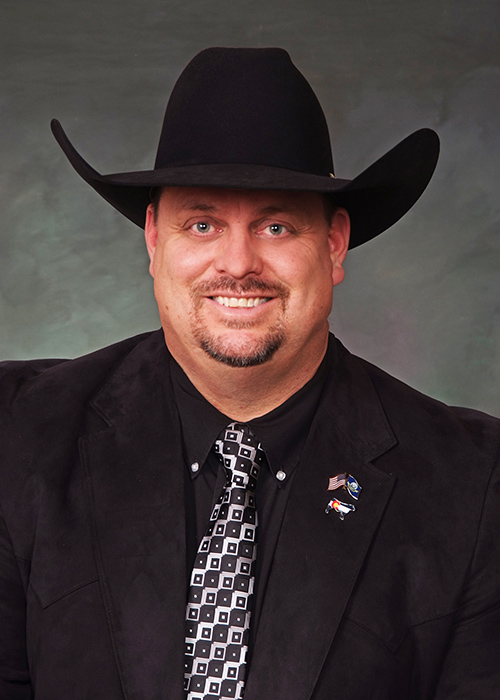
Sen. Byron Pelton
Sponsored bills
The bill creates the property tax task force (task force). The task force consists of both members of the general assembly and individuals who are not members of the general assembly. The purpose of the task force is to develop a permanent and sustainable tax structure for the state of Colorado. The task force is required to: Convene by July 15, 2023; Meet at least 4 times in its first year and at least 8 times every year; and Submit reports with its findings and recommendations to the general assembly by November 1. After the task force makes its first report to the general assembly, the task force may determine that it has fulfilled its purposes and the task force may be disbanded. The task force is repealed on November 1, 2026. (Note: This summary applies to this bill as introduced.)
Statutory Revision Committee. House Bill 22-1034 merged 3 retirement plans administered by the fire and police pension association, the statewide defined benefit plan, the statewide hybrid plan, and the social security supplemental plan, into a single statewide retirement plan. House Bill 22-1034 accomplished the merger in part by repealing several statutes and relocating some of the substantive provisions of those statutes into new statutes. In doing so, certain statutory cross references were not properly updated to reflect the repeals and relocations. The bill updates the obsolete statutory cross references.(Note: This summary applies to this bill as introduced.)
Section 1 of the bill requires the director of the Colorado energy office or the director's designee (director) to conduct or cause to be conducted a study on the feasibility of using small modular nuclear reactors as a carbon-free energy source in the state (feasibility study). On or before July 1, 2025, the director is required to submit the director's findings and conclusions of the feasibility study to the legislative committees with jurisdiction over energy matters. Current law defines recycled energy for purposes of the renewable energy standard as energy produced by a generation unit with a nameplate capacity of not more than 15 megawatts. For pumped hydroelectricity generation only, section 2 specifies that the energy be produced by a generation unit with a nameplate capacity of not more than 400 megawatts.(Note: This summary applies to this bill as introduced.)
The act requires public and private higher education institutions to print Colorado and national crisis and suicide prevention contact information on student identification cards. If an institution does not use student identification cards, the act requires the school to distribute Colorado and national crisis and suicide prevention contact information to the student body each semester or trimester. APPROVED by Governor March 17, 2023 EFFECTIVE March 17, 2023 (Note: This summary applies to this bill as enacted.)
The act clarifies that a member of the Colorado National Guard or any other component of the military forces of the state who is an officer or employee of a public employer is entitled to a leave of absence from employment for training or active state military service for the equivalent of 3 weeks of work on the officer's or employee's regular work schedule each year. The officer or employee is entitled to use any paid leave available to the officer or employee or to use unpaid leave. The act clarifies that a member of the Colorado National Guard or the reserve forces of the United States who is an employee of a private employer is entitled to a leave of absence from employment in order to receive military training with the United States armed forces for the equivalent of 3 weeks of work on the employee's regular work schedule each year. The employee is entitled to use any paid leave available to the employee or to use unpaid leave for the employee's period of absence for military training. The act clarifies that a private employee is entitled to use any paid leave available to the employee or to use unpaid leave in order to engage in active service in the Colorado National Guard. The act repeals the requirement that a public employee or officer not be physically or mentally disabled in order to be reinstated to the employee or officer's public position following a leave of absence for active military service. APPROVED by Governor March 10, 2023 EFFECTIVE March 10, 2023 (Note: This summary applies to this bill as enacted.)
Most real property is reassessed every odd-numbered year. The bill establishes a one-time exception by making the reassessment cycle beginning on January 1, 2021, a 4-year cycle so that the next reassessment cycle will begin in 2025 instead of 2023. Under current law, for the 2023 property tax year, the actual value used for purposes of valuation for assessment is reduced for commercial real property by $30,000 and for residential real property by $15,000. The bill eliminates these reductions. The bill also sets the assessment rates for nonresidential real property and multi-family residential real property for the 2024 property tax year, so that they are the same rates as for the 2023 property tax year. Lastly, the bill ensures that the actual value of property used for purposes of valuation for assessment does not increase by more than 5% between 2022 and 2025, for property that does not have an unusual condition which results in an increase or decrease in actual value. (Note: This summary applies to this bill as introduced.)
Current law requires a county clerk and recorder to designate a minimum number of voter service and polling centers depending on the number of active electors. The bill allows a county clerk and recorder of a county with between 10,000 and 37,500 active electors to apply to the secretary of state for permission to reduce the number of required voter service and polling centers if the county clerk and recorder submits data showing how many registered electors voted at one or more of the county's required voter service and polling centers compared to the county's available resources and showing that the number of designated voter service and polling centers was not required for the number of registered electors. For partisan elections, current law requires a county clerk and recorder to appoint 3 election judges for each voter service and polling center. The bill allows a county clerk and recorder of a county with less than 37,500 active electors (small county) to appoint a member of the county clerk and recorder's staff to serve as one of the required election judges for each voter service and polling center. (Note: This summary applies to this bill as introduced.)
The bill prohibits an executive rule-making agency, on or after September 1, 2023, from amending an existing rule or adopting a new rule concerning the same subject matter as the existing rule for the 3 years following the existing rule's adoption. The following rules are exempt from the 3-year prohibition period: Rules required by state statute, federal statute, or federal regulation; Rules that the rule-making agency determines are imperatively necessary for the preservation of public health, safety, or welfare and for which compliance with the 3-year prohibition would be contrary to the public interest; Rules adopted as temporary or emergency rules, which remain effective for 120 days or less; and Rules that a member of the regulated community petitions to be amended and for which the rule-making agency grants the petition.(Note: This summary applies to this bill as introduced.)