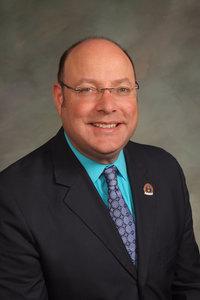
Photo of Paul Rosenthal
D Colorado House · District 9

Rep. Paul Rosenthal

Compare
Total votes
1,080
all sessions
Attendance
100%
of floor votes
Higher than 92% of chamber peers
With party
97%
of cast votes
Near the chamber average
Bipartisan score
2%
crosses aisle rarely
Near the chamber average
Sponsored
20
bills & resolutions
Lower than 94% of chamber peers
Committees
0
assignments
20 bills and resolutions

Sponsored bills

Total
20
Primary
20
Co-sponsor
0
This page
20
matching current filters
Primary SB 17-177
Signed into law · Colorado Senate · Lead sponsor
Children's Code Definition Of Special Respondent

The current definition of 'special respondent' in the Children's Code only allows a party to be involuntarily joined in a dependency or neglect proceeding. The bill amends that definition to allow a party to be voluntarily joined in a dependency or neglect proceeding. (Note: This summary applies to the reengrossed version of this bill as introduced in the second house.)

Signed into law Apr 6, 2017 0 co-sponsors
Primary HB 17-1101
Signed into law · Colorado House · Lead sponsor
Division Of Youth Corrections Monetary Incentives Award Program

The bill authorizes the division of youth corrections in the department of human services (division) to establish, at its discretion, a youth corrections monetary incentives award program (program). The purpose of the program is to provide monetary awards and incentives for academic, social, and psychological achievement to juveniles who were formerly committed to the division to assist and encourage them in moving forward in positive directions in life. If the division does establish a program, it shall devise, in collaboration with a selected nonprofit organization (nonprofit), appropriate participation criteria and criteria for awarding individual scholarships to deserving juveniles. The criteria may include that a juvenile in the program maintains the highest grades possible during each academic term and makes continual progress in therapeutic or other programs, if applicable, during each academic term. The criteria may also require that scholarship money awarded to a juvenile may only be used for educational or other expenses approved as necessary and valid to the juvenile's continued improvement by the division and the nonprofit. If the division establishes a program it shall use a request for proposals process to contract with a nonprofit. The division and the nonprofit are authorized to accept and expend monetary and in-kind gifts, grants, and donations on behalf of the program. Such money must be used to provide scholarships and other incentive awards to the juveniles in the program. (Note: This summary applies to the reengrossed version of this bill as introduced in the second house.)

Signed into law Apr 4, 2017 0 co-sponsors
Primary SB 17-205
In committee · Colorado Senate · Lead sponsor
Multimodal Transportation Infrastructure Funding

In 1999, the voters of the state authorized the executive director of the department of transportation (CDOT) to issue transportation revenue anticipation notes (TRANs) in a maximum principal amount of $1.7 billion and with a maximum repayment cost of $2.3 billion in order to provide financing to accelerate the construction of qualified federal aid transportation projects. The executive director of CDOT issued the TRANs as authorized. The final payments of principal and interest on the TRANs will be made during fiscal year 2016-17, which will make available for expenditure for transportation-related purposes only revenues dedicated for transportation by federal law, the state constitution, and state law that the state has been using to make principal and interest payments on the TRANs. Section 9 requires the state transportation commission to submit a ballot question to the voters of the state at the November 2017, 2018, or 2019 election, which, if approved, would increase the state sales and use tax from 2.9% to 3.15%, beginning on the July 1 immediately following the applicable election and would authorize the executive director of CDOT to issue additional TRANs in a maximum principal amount of $4 billion and with a maximum repayment cost of $5.75 billion. If the voters approve the ballot question, sections 3, 4, 5, and 7 implement the increase in the state sales and use tax rate. The additional TRANs must have a maximum repayment term of 20 years, and the certificate, trust indenture, or other instrument authorizing their issuance must provide that the state may pay them in full before the end of the specified payment term without penalty. Additional TRANs must otherwise generally be issued subject to the same requirements and for the same purposes as the original TRANs; except that the transportation commission must pledge to annually allocate from legally available money under its control any money needed for payment of the notes in excess of amounts appropriated by the general assembly from the state highway fund for payment of the notes as authorized by section 5 until the notes are fully repaid. Section 10 specifies that at least $500 million of TRANs proceeds shall be used only for passenger rail service in the interstate 25 corridor and that remaining TRANs proceeds shall be used only to fund projects on CDOT's priority list for transportation funding. Section 10 also specifies additional transportation project contract award process requirements and limitations for a project to be funded in whole or in part with proceeds of additional TRANs. Sections 6 and 8 require all state sales and use tax net revenue that is attributable to any increase in the state sales and use tax rate resulting from the approval of the ballot question submitted pursuant to section 9 to be credited to the HUTF, paid from the HUTF to the state highway fund for use, subject to annual appropriation by the general assembly, for payment of TRANs and, to the extent not used for that purpose, state transportation projects.(Note: This summary applies to this bill as introduced.)


In committee Apr 4, 2017 0 co-sponsors
Primary HB 17-1156
Passed · Colorado House · Lead sponsor
Prohibits Conversion Therapy Mental Health Provider

The bill prohibits a licensed physician specializing in psychiatry or a licensed or registered mental health care provider from engaging in conversion therapy with a patient under 18 years of age. A licensee who engages in these efforts is subject to disciplinary action by the appropriate licensing board. 'Conversion therapy' means efforts that seek to change an individual's sexual orientation, including efforts to change behaviors or gender expressions or to eliminate or reduce sexual or romantic attraction or feelings toward individuals of the same sex. (Note: This summary applies to this bill as introduced.)
Passed Mar 22, 2017 0 co-sponsors
Primary HB 17-1014
Signed into law · Colorado House · Lead sponsor
Election Offenses Committed By A Voter

For elections conducted under both the 'Uniform Election Code of 1992' (uniform code) and the 'Municipal Election Code of 1965' (municipal code), an elector who shows his or her ballot after it is prepared for voting in such a way as to reveal its contents, commonly known and referred to as a 'ballot selfie', is subject to a criminal misdemeanor penalty. Section 1 of the bill modifies the ballot selfie prohibition in the uniform code. Specifically, section 1 deletes existing language prohibiting a voter from showing his ballot after it is prepared for voting to any person in such a way as to reveal its contents. Under the bill, any voter may show his or her voted ballot to any other person as long as the disclosure is not undertaken in furtherance of any election violation proscribed in the uniform code. The bill further provides that any voter makes available an image of the voter's own ballot through electronic means after it is prepared for voting is deemed to have consented to the transmittal of that image. The ability of a voter to exercise such right at a voter service and polling center (VSPC) or at any other location at which votes are being tabulated is subject to the power of a county clerk and recorder to monitor activity at such VSPC or other location, including placing reasonable restrictions on the use of photography in such settings or imposing other restrictions on activity in such settings as the county clerk and recorder finds necessary, to ensure the fair and efficient conduct of elections. Section 2 of the bill makes parallel modifications to the municipal code as section 1 of the bill makes to the uniform code regarding ballot selfie requirements.(Note: This summary applies to the reengrossed version of this bill as introduced in the second house.)

Signed into law Mar 16, 2017 0 co-sponsors
Primary HB 17-1199
In committee · Colorado House · Lead sponsor
Foreclosure Sale Processes

The bill excludes information relating to violations of the requirement for a single point of contact or dual tracking from the published notice that precedes a foreclosure sale. The bill also clarifies: That the deadline for a public trustee or sheriff (officer) conducting a foreclosure to continue a foreclosure sale is the scheduled date and time of the sale; and What happens if a foreclosure sale violates an automatic stay under the federal bankruptcy code, depending on whether full payment of the successful bid amount is received by the officer. The procedures that apply if a foreclosure sale is set aside by court order are established to mirror the procedures that follow a rescission of a public trustee sale. In addition, a person rescinding a foreclosure sale is no longer required to send envelopes along with their rescission paperwork. (Note: This summary applies to this bill as introduced.)

In committee Mar 8, 2017 0 co-sponsors
Primary HB 17-1154
Passed · Colorado House · Lead sponsor
Creation Of A Sister-state Relationship Program

The bill requires the Colorado office of economic development to establish and maintain an international sister-state relationship program. (Note: This summary applies to the reengrossed version of this bill as introduced in the second house.)

Passed Mar 1, 2017 0 co-sponsors
Primary SB 17-099
In committee · Colorado Senate · Lead sponsor
National Popular Vote Agreement

The bill enacts and enters into with all other states joining therein the agreement among the states to elect the president of the United States by national popular vote (agreement). Among other provisions, the agreement: Permits any state of the United States and the District of Columbia to become members of the agreement by enacting the agreement; Requires each member state to conduct a statewide popular election for president and vice president of the United States; Prior to the time set for the meeting and voting of presidential electors, requires the chief election official of each member state to determine the number of votes cast for each presidential slate in a statewide popular election and to designate the presidential slate with the largest national popular vote total as the national popular vote winner; Requires the presidential elector certifying official of each member state to certify the appointment in that official's own state of the elector slate nominated in that state in association with the national popular vote winner. At least 6 days before the day fixed by law for the meeting and voting by the presidential electors, requires each member state to make a final determination of the number of popular votes cast in the state for each presidential slate and to communicate an official statement of the determination within 24 hours to the chief election official of each other member state. Requires the chief election official of each member state to treat as conclusive an official statement containing the number of popular votes in a state for each presidential slate made by the day established by federal law for making a state's final determination conclusive as to the counting of electoral votes by congress. Specifies that the agreement governs the appointment of presidential electors in each member state in any year in which the agreement is in effect on July 20 in states cumulatively possessing a majority of the electoral votes; Permits a state's withdrawal from the agreement, except in limited circumstances; Specifies that the agreement will terminate if the electoral college is abolished; and Provides that the invalidity of any of the agreement's provisions do not affect the remaining provisions. The bill specifies that when the agreement becomes effective, it supersedes any conflicting provisions of Colorado law. When the agreement becomes effective and governs the appointment of presidential electors, each presidential elector is required to vote for the presidential candidate and, by separate ballot, vice-presidential candidate nominated by the political party or political organization that nominated the presidential elector. (Note: This summary applies to this bill as introduced.)

In committee Feb 15, 2017 0 co-sponsors
Showing 11 to 20 of 20 bills