

Current law establishes the youthful offender system (system) in the department of corrections (department) as a sentencing option that provides a continuum of services. The act:Updates references to the juveniles and young adults who are eligible for or participating in the system;Revises certain legislative intent provisions to emphasize lasting behavioral changes in preparation for reentry, trauma-informed care, addressing criminogenic risk, accountability, healthy relationship building, and system participant and staff safety;Expresses the general assembly's intent that juveniles and young adults with physical, intellectual, mental, or behavioral health disabilities or conditions receive equitable treatment in sentencing to the system and reasonable accommodations once in the system;Adds certain data related to system completion rates to an existing annual reporting requirement for the department;Adds requirements for evidence-informed rehabilitative treatment and life skills programming and for individual therapy, family therapy, or substance use disorder treatment;Establishes requirements for system participant evaluations, plans for addressing participants' needs and skills, and case manager duties;Requires the department, in consultation with relevant experts, to make and publish on its website recommendations for integrating a trauma-informed standard of care with current system practices to promote the health and safety of system participants; andExpands certain procedural protections for system participants with mental or behavioral health conditions or intellectual and developmental disabilities.(Note: This summary applies to this bill as enacted.)
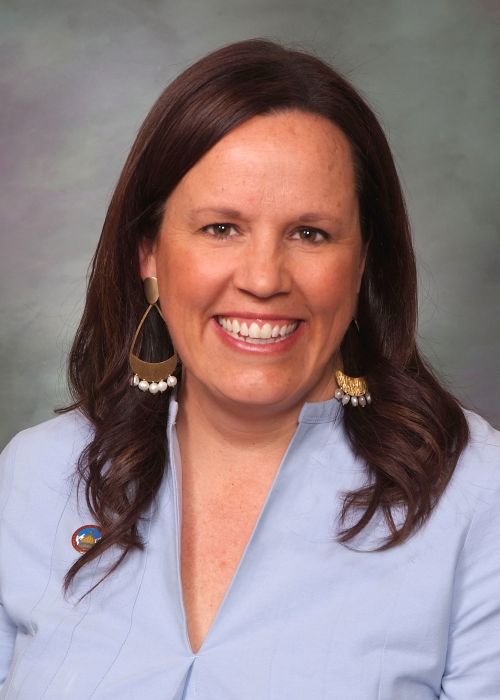
Rep. Lindsay Gilchrist
Sponsored bills
Under current law, a person may be arrested and detained for level 1 drug misdemeanor possession. The act requires that when a colorimetric field drug test was used to test for the presence of a controlled substance and a person is solely suspected of a level 1 drug misdemeanor for possession or solely suspected of a municipal drug possession charge, a peace officer shall not arrest the person and instead shall issue a summons. The act also requires that when a colorimetric field drug test was used, before accepting a plea from a person charged with a drug possession for level 4 drug felony possession and lower, the trial court is required to issue an advisement with specified language, including language stating that colorimetric field drug tests have known error rates and that the defendant has the right to enter a not guilty plea and to request drug testing from an accredited forensic laboratory.(Note: This summary applies to this bill as enacted.)
Maddy summaryThis House Memorial honors the life and service of former Colorado Representative Carl Miller, who passed away in August 2025. The document formally recognizes his contributions to Colorado through his work in local government, the mining industry, and public service, including his role in establishing the National Mining Hall of Fame and Museum. It extends condolences to Miller's family and pays tribute to his dedication to his community and state during his career as a state representative and public utility commissioner.
Maddy summaryThis bill designates March 8, 2026, as International Women's Day in Colorado and acknowledges the historical and ongoing contributions of women to society. It recognizes women's achievements across various fields, including politics, business, and social movements, while highlighting Colorado's early history of women's suffrage and female leadership in state government. The resolution encourages continued celebration of this day and commits the legislature to supporting policies that promote gender equality and women's empowerment.
The bill prohibits local and state law enforcement officers from concealing their identity while interacting with the public, with certain exceptions.The bill clarifies state criminal jurisdiction to cover criminal conduct committed by a federal law enforcement officer in the state, even if the officer was acting under color of federal authority. Federal criminal immunity or defense from prosecution does not prohibit state criminal prosecution of a federal law enforcement officer.The bill requires the peace officer standards and training board (P.O.S.T. board) to deny certification to an individual who has previously been employed or who is currently employed by the United States immigration and customs enforcement agency or the United States customs and border protection agency.The bill requires the P.O.S.T. board to prescribe a training for all current and future peace officers regarding immigration law, a peace officer's duty to intervene, excessive force policies, and a peace officer's jurisdictional limit.A peace officer is required to intervene to prevent a federal law enforcement officer from using excessive force.The bill expands the conduct that can constitute the crime of impersonating a peace officer to include a person performing a law enforcement act while concealing the person's identity.(Note: This summary applies to this bill as introduced.)
Maddy summaryThis bill approves specific updates to eligibility lists for two Colorado water funding programs. It adds new drinking water projects (like Delta County's distribution system) and modifies existing entries (such as adding "green infrastructure" to Loveland's project), while deleting completed projects (like Kiowa's). These changes determine which local water districts, municipalities, and property associations can access financial assistance from the Drinking Water Revolving Fund and Water Pollution Control Revolving Fund. The bill does not create new funding rules but formally adopts the Commission's proposed list adjustments.
Maddy summaryThis Senate Joint Resolution expresses Colorado's legislative support for maintaining national public lands under federal stewardship and opposes efforts that would reduce public access or weaken environmental review laws. The resolution specifically targets potential erosion of bedrock federal laws like NEPA and FLPMA, which require public input and balanced resource management. It calls on state and federal officials to defend statutory safeguards that ensure public lands serve broad public benefits rather than narrow special interests. This non-binding resolution does not change any laws but serves as a formal statement of legislative intent and values regarding public land management.
Maddy summarySJR 11 is a commemorative resolution designating a specific segment of U.S. Highway 34 (between Wilson Ave. and North County Rd. 23H) as the "Sgt. John 'Jack' Thurman Memorial Highway" in honor of a World War II Marine Corps veteran. The bill, which has no policy or funding provisions, simply names the highway section to recognize Sergeant Thurman's service at Iwo Jima, his military awards, and his post-war contributions as an architect and community leader in Colorado. It authorizes the Colorado Department of Transportation to accept donations for signage and explore maintenance agreements with local governments. This is a ceremonial designation with no direct impact on residents or new laws.
Maddy summarySJR 4 designates September 20-26, 2026, as "Frontotemporal Degeneration (FTD) Awareness Week" in Colorado. This symbolic resolution recognizes FTD - a terminal, incurable neurodegenerative disease affecting speech, behavior, and motor skills - and aims to increase public awareness of the condition. It directly supports Coloradans living with FTD, their families, and advocacy groups like the Association for Frontotemporal Degeneration, which focuses on research and care. The bill has no funding or regulatory provisions, as it is purely a recognition measure.
Maddy summaryThis House Memorial (HM 1001) is a formal tribute passed by the Colorado General Assembly honoring former State Representative Dan Williams, who died in October 2025. It recognizes his 1984-1992 service in the Colorado House, his leadership as chair of key committees (including Agriculture and Transportation), and his lifelong advocacy for Colorado ranching and farming communities. The resolution expresses the legislature's condolences to his family and sends copies of the memorial to his partner and children. It has no policy impact, as it is purely a commemorative gesture with no new laws or funding.