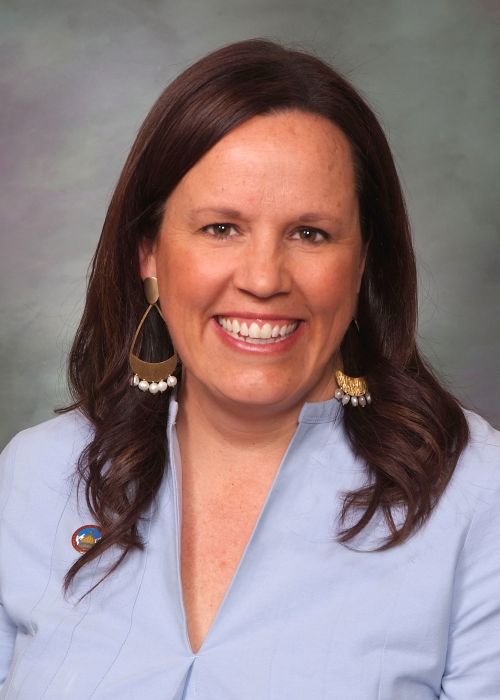
Photo of Lindsay Gilchrist
D Colorado House · District 8 On the 2026 ballot

Rep. Lindsay Gilchrist

Compare
Total votes
1,775
all sessions
Attendance
100%
1 missed
Higher than 93% of chamber peers
With party
98%
of cast votes
Higher than 81% of chamber peers
Bipartisan score
1%
crosses aisle rarely
Near the chamber average
Sponsored
217
bills & resolutions
Near the chamber average
Committees
2
assignments
217 bills and resolutions

Sponsored bills

Total
217
Primary
40
Co-sponsor
177
This page
217
matching current filters
Co-sponsor SJR 7
Passed · Colorado Senate · Co-sponsor
Black History Month February of 2026

Maddy summaryThis Senate Joint Resolution (SJR 7) is a ceremonial resolution recognizing February 2026 as Black History Month. It does not create new laws or affect any individuals or policies - it solely commemorates the annual observance of Black History Month through historical context and Colorado-specific examples. The resolution cites Dr. Carter G. Woodson’s founding of Negro History Week in 1926, its evolution into Black History Month during the Civil Rights Movement, and highlights Colorado’s Black historical figures like Barney Ford, Clara Brown, and early state representatives. It serves as a symbolic acknowledgment of contributions to American history, not a policy change.

Passed Feb 4, 2026 1 co-sponsor
Co-sponsor SJR 5
Passed · Colorado Senate · Co-sponsor
Colorado 4-H Day

Maddy summarySJR 5 designates January 26, 2026, as "Colorado 4-H Day" to recognize the 4-H program's work with Colorado youth. The resolution honors the program's role in developing leadership and life skills through hands-on learning in areas like health, agriculture, and citizenship. It does not create new laws or requirements but formally acknowledges the efforts of 4-H volunteers and staff who serve over 110,000 youth annually in Colorado.

Passed Jan 28, 2026 1 co-sponsor
Co-sponsor HJR 1003
Passed · Colorado House · Co-sponsor
National Blood Donor Month

Maddy summaryHJR 1003 is a ceremonial joint resolution designating January as National Blood Donor Month in Colorado. It formally recognizes voluntary blood donors and urges all eligible Coloradans to donate regularly, while encouraging businesses and organizations to sponsor community blood drives with centers like Vitalant. The resolution has no binding legal effect - it expresses support and promotes awareness but does not create new laws, funding, or requirements. It directly affects Colorado residents (especially eligible donors), blood collection organizations, and local businesses through its non-binding recommendations.

Passed Jan 26, 2026 1 co-sponsor
Co-sponsor HJR 1002
Passed · Colorado House · Co-sponsor
MLK Jr. Day

Maddy summaryHJR 1002 is a commemorative resolution honoring Dr. Martin Luther King Jr. It does not create new laws or policies. The resolution recognizes Dr. King's legacy through historical context about his civil rights leadership, his "I Have a Dream" speech, and his role in key legislation like the Civil Rights Act of 1964. It specifically acknowledges Colorado's history of observing MLK Jr. Day, noting that Colorado became the 50th state to recognize the holiday in 2000. The resolution serves only to formally commemorate Dr. King's life and work, with no direct effect on citizens or new government requirements.

Passed Jan 20, 2026 1 co-sponsor
Co-sponsor SB 25-017
Signed into law · Colorado Senate · Co-sponsor
Measures to Support Early Childhood Health

The act implements and describes the operation of the pediatric primary care practice program (primary care program) in the department of early childhood (department). The purpose of the primary care program is to provide funding and support to a pediatric primary care medical practice (medical practice) to integrate into the medical practice a professional who specializes in whole-child and whole-family health and well-being. The department shall contract with an implementation partner (primary care partner) to implement, operate, and administer the primary care program. The primary care partner shall create and implement a team-based, research-informed pediatric primary care practice evidence-based model (evidence-based model). The evidence-based model must be a comprehensive approach to guide pediatric care medical practices to deliver services to children from birth to 3 years of age and their families. The primary care partner shall: Establish an application and selection process with the department for select medical practices to participate in the primary care program; Review applications from medical practices and select applicants to participate in the primary care program; Work with selected applicants to complete assessments on the applicants' community health-care systems, health and well-being practices, and related concerns; and Train and support the medical practices selected to participate in the primary care program to maintain fidelity to the evidence-based model. The executive director of the department may adopt rules to carry out the purposes of the primary care program. (Note: This summary applies to this bill as enacted.)

Signed into law Jun 4, 2025 1 co-sponsor
Co-sponsor SB 25-304
Signed into law · Colorado Senate · Co-sponsor
Measures to Address Sexual Assault Kit Backlog

The act creates the Colorado sexual assault forensic medical evidence review board (board), consisting of the attorney general, or their designee, as board chair; the executive director of the Colorado district attorneys' council, or their designee; and various members appointed by the attorney general or the governor. The board's duties include reviewing and monitoring processes related to sexual assault response, making recommendations to improve sexual assault response, and submitting an annual report concerning its duties. The act creates a notification requirement under the "Victim Rights Act" that requires a law enforcement agency to notify a victim every 90 days when the law enforcement agency has not received the results of the forensic medical evidence DNA analysis from an accredited crime laboratory. The act requires an accredited crime laboratory to endeavor to analyze forensic medical evidence within 60 days after its receipt. The act expands public reporting requirements concerning forensic medical evidence and DNA evidence backlogs. For the 2025-26 state fiscal year, the act appropriates $112,365 from the general fund to the department of law for use by the administration division to implement the act. (Note: This summary applies to this bill as enacted.)

Signed into law Jun 3, 2025 1 co-sponsor
Co-sponsor HB 25-1149
Signed into law · Colorado House · Co-sponsor
Comprehensive Black History & Culture Education in K-12

The act requires the state board of education (state board) to adopt standards related to Black historical and cultural studies (standards). Local education providers shall incorporate the standards into courses for public elementary and secondary school students in the state no later than 2 years after the state board adopts the standards. The act aligns the timeline for the development, adoption, and integration of the standards with the 6-year cycle that the state board of education currently uses for revising the state academic standards. The act creates the Black historical and cultural studies advisory committee (committee) in the department of education (department) to recommend standards and related materials and to provide technical assistance at the request of local education providers implementing the standards. The committee's recommendations must include updates to the state's history and civics standards and must advance developmentally appropriate but comprehensive instruction that features factual accounts of the struggles and contributions of Black Americans in all fields of endeavor. Using the committee's recommendations, the department will create and maintain a resource bank of research-based, scholarly articles and promising program materials and curricula pertaining to Black historical and cultural studies. For the 2025-26 state fiscal year, the act appropriates $19,225 from the general fund to the department for costs related to content specialists. (Note: This summary applies to this bill as enacted.)

Signed into law Jun 3, 2025 1 co-sponsor
Co-sponsor SB 25-048
Signed into law · Colorado Senate · Co-sponsor
Diabetes Prevention & Obesity Treatment Act

Beginning January 1, 2027, the act requires large group health benefit plans to provide coverage for the treatment of the chronic disease of obesity and the treatment of pre-diabetes, including coverage for a comparable program to the national diabetes prevention program, medical nutrition therapy, intensive behavioral or lifestyle therapy, and metabolic and bariatric surgery. For a large group health benefit plan offered in the state, the act requires carriers to offer the policyholder the option to purchase coverage for FDA-approved anti-obesity medications, including at least one FDA-approved GLP-1 medication. The commissioner of insurance may adopt rules for the implementation of the act. (Note: This summary applies to this bill as enacted.)

Signed into law Jun 3, 2025 1 co-sponsor
Co-sponsor SB 25-214
Signed into law · Colorado Senate · Co-sponsor
Healthy School Meals for All Program

The healthy school meals for all program (program) reimburses participating school food authorities for meals that those authorities provide to students without charge. Section 2 of the act allows the amount of these reimbursements to be modified in 2 different scenarios. First, if a referred measure that would, in combination with the income tax deduction modification that was approved by the voters in connection with the program, result in the collection of at least $150 million for the income tax year commencing on January 1, 2026, is not approved by the voters voting on the referred measure at the 2025 statewide election, the department of education (department) is required to only provide reimbursements to participating school food authorities for meals served at eligible sites. Eligible sites are those that either: Qualify for the community eligibility provision program, as that program exists on November 15, 2025; or Are identified as eligible sites by the department based on the amount that the general assembly appropriates for the purpose of providing reimbursements to a participating school food authority for offering eligible meals without charge and the percentage of a site's student enrollment who are certified as eligible for free meals based on documentation of benefit receipt or categorical eligibility as described in federal rule, or any successor regulations. Second, if the department, in consultation with the office of state planning and budgeting, determines that the amount that the general assembly appropriated for the purpose of providing reimbursements to a participating school food authority is less than the costs of the department providing those reimbursements, the department may determine a prorated reimbursement amount for the reimbursements that the department provides through the program to each participating school food authority for the remainder of that budget year. Sections 4 and 6 limit the existing authority of the department, if the department determines that there is an insufficient amount of money in the healthy school meals for all program cash fund (fund) for the department to provide reimbursements to a participating school food authority for offering eligible meals without charge, to make an expenditure from the general fund to provide those reimbursements to state fiscal years commencing on or before July 1, 2024. Section 3 allows the general assembly to appropriate money from the state education fund to cover program costs for which there is not sufficient money in the fund, as it was required to do for state fiscal years 2024-25, for state fiscal year 2025-26. Section 4 requires the department, on January 15, 2027, in consultation with the office of state planning and budgeting, to report to the joint budget committee on whether there is a sufficient balance in the fund for: The state treasurer to transfer an amount from the fund to the state education fund equal to the total amount of expenditures from the state education fund for the program for state fiscal years 2022-23, 2023-24, 2024-25, and 2025-26 minus the amount of additional tax revenue deposited in the state education fund as a result of the increase in state income tax generated in connection with voter approval of the program for those same fiscal years; and The department to provide reimbursements to a participating school food authority for offering eligible meals without charge. Section 8 extends the local school food purchasing program indefinitely, so that the program extends beyond the 2024-25 school year. Section 9 similarly extends the required reporting on the local school food purchasing program. Section 11 decreases the appropriation for school meal reimbursements provided through the program from the general fund by $42,240,242 and increases the appropriation from the state education fund by $8,119,271 for the same purpose. (Note: This summary applies to this bill as enacted.)


Signed into law Jun 3, 2025 1 co-sponsor
Co-sponsor HB 25-1274
Signed into law · Colorado House · Co-sponsor
Healthy School Meals for All Program

The act refers 2 ballot issues to the voters at the November 2025 statewide election concerning funding for the healthy school meals for all program. Section 2 refers a ballot issue to the voters at the November 2025 statewide election to allow the state to retain and spend state revenue that would otherwise need to be refunded for exceeding the estimate in the ballot information booklet analysis for Proposition FF and to allow the state to maintain the increases in state taxable income established in Proposition FF that would otherwise need to be decreased. If voters reject the ballot issue, the state will both: Refund $12,430,388 to individuals who have a federal taxable income of $300,000 or more and claimed itemized or standard state income tax deductions greater than $12,000 for single tax return filers and $16,000 for joint tax return filers; and Adjust the limit on itemized deductions established in Proposition FF to a level that would have reduced the amount of income tax revenue attributable to these itemized deductions by $12,430,388. If voters approve the ballot measure: The state will not refund $12,430,388 to individuals who have a federal taxable income of $300,000 or more and claimed itemized or standard state income tax deductions greater than $12,000 for single tax return filers and $16,000 for joint tax return filers; and The increases in federal taxable income as a result of Proposition FF will stay at the levels established by Proposition FF. Section 3 refers a ballot issue to the voters at the November 2025 statewide election to allow the state to increase taxes by $95 million annually by increasing state taxable income to support the healthy school meals for all program. If voters approve the ballot issue: Income tax deductions for individuals who have a federal taxable income of $300,000 or more will be reduced from current levels to $1,000 for single filers and $2,000 for joint filers; and The state will allocate the additional revenue generated by the reduction in income tax deductions to the healthy school meals for all program. If voters reject the ballot issue, income tax deductions will not be reduced, and there will not be any additional revenue to be allocated to the healthy school meals for all program. In addition to the income tax changes and potential refunds that may result from voters approving or rejecting the ballot issues described in sections 2 and 3, the act also changes the healthy school meals for all program cash fund (fund) and healthy school meals for all programs. If voters approve the ballot issue submitted pursuant to section 2 and reject the ballot issue submitted pursuant to section 3, $1 million is transferred annually from the fund to local school food purchasing programs. If voters approve the ballot issue submitted pursuant to section 3, regardless of whether the voters approve the ballot issue submitted pursuant to section 2: The permissible distribution of local food purchasing grants is modified; Certain school food authorities are allowed to collaborate to implement advisory committees; The duties of an advisory committee are clarified; and The distribution of funds from the fund is changed so that the amounts distributed through local food purchasing grants for increasing wages or providing stipends for individuals whom the participating school food authority employs to directly prepare and serve food for school meals and through the local school food purchasing technical assistance and education grant program are modified based on the amount of money in the fund. NOTE: Certain provisions of the act are contingent on the results a measure concerning Proposition FF refunds or Proposition FF revenue increases being either approved or not approved by a majority of voters at the November 2025 statewide election.(Note: This summary applies to this bill as enacted.)
Signed into law Jun 3, 2025 1 co-sponsor
Showing 91 to 100 of 217 bills
Previous 1 … 9 10 11 … 22 Next