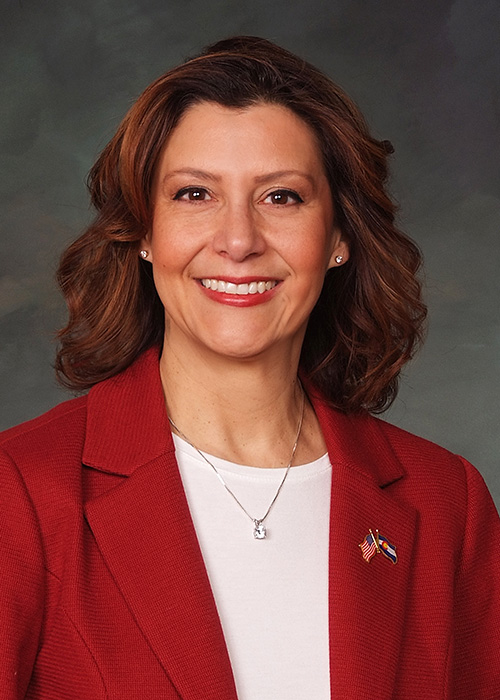
Photo of Lori Garcia Sander
R Colorado House · District 65 On the 2026 ballot

Rep. Lori Garcia Sander

Compare
Total votes
1,703
all sessions
Attendance
98%
25 missed
Lower than 80% of chamber peers
With party
94%
of cast votes
Near the chamber average
Bipartisan score
5%
crosses aisle rarely
Near the chamber average
Sponsored
162
bills & resolutions
Lower than 87% of chamber peers
Committees
3
assignments
162 bills and resolutions

Sponsored bills

Total
162
Primary
25
Co-sponsor
137
This page
162
matching current filters
Co-sponsor HJR 1003
Passed · Colorado House · Co-sponsor
National Blood Donor Month

Maddy summaryHJR 1003 is a ceremonial joint resolution designating January as National Blood Donor Month in Colorado. It formally recognizes voluntary blood donors and urges all eligible Coloradans to donate regularly, while encouraging businesses and organizations to sponsor community blood drives with centers like Vitalant. The resolution has no binding legal effect - it expresses support and promotes awareness but does not create new laws, funding, or requirements. It directly affects Colorado residents (especially eligible donors), blood collection organizations, and local businesses through its non-binding recommendations.

Passed Jan 26, 2026 1 co-sponsor
Co-sponsor HJR 1002
Passed · Colorado House · Co-sponsor
MLK Jr. Day

Maddy summaryHJR 1002 is a commemorative resolution honoring Dr. Martin Luther King Jr. It does not create new laws or policies. The resolution recognizes Dr. King's legacy through historical context about his civil rights leadership, his "I Have a Dream" speech, and his role in key legislation like the Civil Rights Act of 1964. It specifically acknowledges Colorado's history of observing MLK Jr. Day, noting that Colorado became the 50th state to recognize the holiday in 2000. The resolution serves only to formally commemorate Dr. King's life and work, with no direct effect on citizens or new government requirements.

Passed Jan 20, 2026 1 co-sponsor
Co-sponsor HR 1001
Passed · Colorado House · Co-sponsor
House Officers & Employees

Maddy summaryHouse Resolution 1001 appoints specific staff members to roles within the Colorado House of Representatives for the 75th General Assembly's Second Regular Session. It names individuals to positions including Chief Clerk, Assistant Chief Clerk, Journal Clerk, sergeants-at-arms, and leadership support staff for both majority and minority parties, plus student interns from Arrupe Jesuit High School. The resolution was approved without amendments on January 20, 2026, and serves as routine staffing for legislative operations. This procedural resolution does not create new laws or affect public policy.

Passed Jan 20, 2026 1 co-sponsor
Co-sponsor SJR 3
Passed · Colorado Senate · Co-sponsor
Joint Session Address by Tribal Councils

Maddy summarySJR 3 is a procedural resolution scheduling a joint meeting of Colorado's Senate and House of Representatives on January 16, 2026, to hear a message from representatives of the Ute Mountain Ute Tribal Council and Southern Ute Tribal Council. It directs the appointment of a six-member committee (three from each chamber) to escort tribal representatives to the session. The resolution recognizes the tribes' historical and cultural contributions to Colorado but does not create new laws or policies. This is a formal procedural step to facilitate the tribal message, not a substantive legislative change.

Passed Jan 15, 2026 1 co-sponsor
Co-sponsor SB 25-306
Signed into law · Colorado Senate · Co-sponsor
Performance Audits of Certain State Agencies

The act requires the state auditor to conduct or cause to be conducted performance audits (audits) of the air pollution control division in the department of public health and environment and the division of unemployment insurance in the department of labor and employment (divisions). The audits will determine whether each of the divisions effectively and efficiently performs and fulfills its statutory obligations. In addition, as part of the audits, the state auditor is required to: Determine whether a division complies with statute and its statutory purpose; Assess the impact of a division's processes on providing access to program benefits and, for the labor and employment division audit only, identify any division processes that may be unnecessary, unreasonable, or cause delays; Determine whether a division's staffing and funding levels are sufficient for it to efficiently and effectively perform its statutory duties and responsibilities, which, in for the air pollution control division audit only, must include assessment of how funding or staffing changes made at the state level might impact local governments; and Determine whether a division requested and was appropriated additional resources and whether the approval or denial of such a request impacted program implementation and timing of implementation. The initial audit of the air pollution control division must begin and be completed in calendar year 2026, with an additional audit occurring in calendar year 2031. The initial audit of the division of unemployment insurance must begin and be completed in calendar year 2027, with an additional audit occurring in calendar year 2032. Upon completion of an audit, the state auditor is required to submit a written audit report to the legislative audit committee. (Note: This summary applies to this bill as enacted.)

Signed into law Jun 4, 2025 1 co-sponsor
Co-sponsor SB 25-305
Signed into law · Colorado Senate · Co-sponsor
Water Quality Permitting Efficiency

Current law requires the division of administration (division) within the department of public health and environment to report annually to the water quality control commission (commission) and to include in the report any regulatory or legislative recommendations the division may have. The act requires the report to also include: Information on the division's timing in considering and issuing water quality permits (permits); and For the report submitted in 2026, a detailed discussion of how the division has prioritized reducing the permit backlog, implemented recommendations from water quality permittees (permittees) for permitting efficiency, and increased safe drinking water program inspections. The act requires the division, upon receipt of an application to modify a permit, to limit its review and its approval or denial of the application to the scope of the specific requests contained in the application. The act requires the commission to adopt rules on or before December 31, 2026, that establish procedures whereby the division, prior to giving public notice of a complete permit application for an individual permit and the division's preliminary analysis of the application, may provide a period of public notice and review of a preliminary draft prepared by the division. If a period of public notice and review is required by rules of the commission, the period of public notice and review may not exceed 14 days, and the purpose of the review is limited to identifying errors in the division's preliminary draft. On or before December 31, 2027, the division must propose rules to the commission that establish a time frame during which the division will either grant or deny applications for each type of permitting action. On or before June 30, 2028, the commission shall adopt rules based on the division's proposal. The rules must establish the time frames for permitting actions. The act requires the division to consider current debt service on existing local government water infrastructure when developing schedules of compliance for new effluent limits in local government permits. Any schedule of compliance for new effluent limits in local government permits must, consistent with state and federal law, consider the local government's financial capability to repay existing debt on water infrastructure or to fund water infrastructure upgrades before requiring new water infrastructure upgrades. To the extent allowable under federal law, the division may issue compliance schedules in a local government permit for a new effluent limit in excess of 20 years. The act states that, on and after May 1, 2026, after an application for permit modification or permit renewal has been pending before the division for 60 days, or for any application for permit modification or permit renewal that is pending before the division as of May 1, 2026, or if the division informs an applicant that the division will not process an application for preliminary effluent limitations, the applicant and the division may mutually agree to use a qualified and independent nongovernmental contractor (contractor) under the direction of the division to provide the division with technical assistance in completing the permit action. An applicant shall bear the contractor's costs for any technical assistance provided by the contractor and shall pay the contractor for such costs. The division may charge an applicant an additional fee in an amount not exceeding 10% of the contract amount for contract administration, technical review, and additional permit processing, which fee is credited to the clean water cash fund. The act requires the division, upon a permittee's request, to make available to the permittee all documents, data, and information the division relied upon in developing the permittee's permit modification or permit renewal, except to the extent that such materials are protected by an applicable privilege or exception. The act makes the following transfers of money: On July 1, 2025, $111,000 from the water quality improvement fund to the drinking water cash fund; On July 1, 2025, $3,518,564 from the perfluoroalkyl and polyfluoroalkyl substances cash fund to the clean water cash fund; On July 1, 2026, $3,002,435 from the perfluoroalkyl and polyfluoroalkyl substances cash fund to the clean water cash fund; and On July 1, 2026, $516,129 dollars from the perfluoroalkyl and polyfluoroalkyl substances cash fund to the drinking water cash fund. For the 2025-26 state fiscal year, the act appropriates $2,904,599 to the department of public health and environment. This appropriation consists of $446,315 from the drinking water cash fund and $2,458,284 from the clean water cash fund. For the 2025-26 state fiscal year, the act appropriates $160,611 to the department of law. This appropriation is from reappropriated funds received from the department of public health and environment. The act also makes and reduces certain appropriations as adjustments to the 2025 general appropriations act. (Note: This summary applies to this bill as enacted.)


Signed into law Jun 4, 2025 1 co-sponsor
Primary SB 25-147
Signed into law · Colorado Senate · Lead sponsor
Modify Board Management Public Employees' Retirement Association

Section 1 of the act defines the board of trustees of the public employees' retirement association (board) as a local public body for purposes of the open meetings law. Section 2 limits the terms of both elected and appointed members of the board to not more than 2 consecutive 4-year terms; except that the state treasurer is not subject to the 2-term limit. A former trustee who has served 2 consecutive terms may be reelected or reappointed to the board after not serving on the board for a period of at least one term. Section 2 also clarifies how such term limits apply in the case of a vacancy appointment. Section 3 requires the board, on and after January 1, 2025, to conduct its meetings in accordance with the open meetings law as a local public body and requires the board to post and regularly maintain and update the public employees' retirement association's (association) website with information including: The notice with specific agenda information, if available, for the board's next public meeting; The policy for and process by which a member of the public may participate in any public meeting of the board; A link or other means of public access to the records of past public meetings of the board; and The official email address of the board. Section 3 also requires that, on or before January 1, 2026, and on or before January 1 of each calendar year thereafter, the board post certain financial information of the association on the association's website. Section 4 clarifies that, while the board may delegate any of its responsibilities, duties, and powers to the executive director of the association or other designated agents, the board retains authority and responsibility for the management of the association and all its statutory duties and powers through a specified existing administrative process. (Note: This summary applies to this bill as enacted.)
Signed into law Jun 3, 2025 0 co-sponsors
Co-sponsor HB 25-1121
Signed into law · Colorado House · Co-sponsor
Permanent Trailer Registration

The act authorizes the owner of a trailer to register the trailer for as long as the owner owns the trailer. The trailer must be class B or class D personal property. To register the trailer, the owner must pay: 2 years of annual specific ownership tax; and $55.82 to cover fees. Upon the transfer of ownership of the trailer, the owner is required to notify the department of revenue of the transfer. (Note: This summary applies to this bill as enacted.)

Signed into law Jun 3, 2025 1 co-sponsor
Primary SB 25-083
Signed into law · Colorado Senate · Lead sponsor
Limitations on Restrictive Employment Agreements

Under current law, there is an exemption from the general prohibition against covenants not to compete. The exemption allows for a covenant not to compete under specified conditions governing an individual who earns an amount of annualized cash compensation equivalent to or greater than the threshold amount for highly compensated workers. The act excludes from the highly compensated worker exemption a covenant not to compete that restricts the practice of medicine, the practice of advanced practice registered nursing, or the practice of dentistry in this state. Under current law, there is also an exemption from the general prohibition against covenants not to solicit customers (nonsolicitation covenant) that allows for a nonsolicitation covenant governing an individual who earns an amount of annualized cash compensation equivalent to or greater than 60% of the threshold amount for highly compensated workers if the nonsolicitation covenant is no broader than reasonably necessary to protect the employer's legitimate interest in protecting trade secrets. The act also excludes from the highly compensated worker exemption for nonsolicitation covenants a covenant not to compete that restricts the practice of medicine, the practice of advanced practice registered nursing, or the practice of dentistry. A covenant not to compete governing an individual who has a minority ownership share of a business and who received their ownership share in the business as equity compensation or otherwise in connection with services rendered is permissible if the covenant's duration in years does not exceed a number calculated by the total consideration received by the individual from the sale divided by the average annualized cash compensation received by the individual from the business, including income received on account of the individual's ownership interest during the preceding 2 years or during the period of time that the individual was affiliated with the business, whichever period of time is shorter. The act prohibits a covenant that prevents or materially restricts a health-care provider from disclosing to a patient to whom the health-care provider was providing consultation or treatment before the health-care provider's departure from a medical or dental practice the following information: The health-care provider's continuing practice of medicine; The health-care provider's new professional contact information; or The patient's right to choose a health-care provider.(Note: This summary applies to this bill as enacted.)

Signed into law Jun 3, 2025 0 co-sponsors
Primary SB 25-193
Signed into law · Colorado Senate · Lead sponsor
Sunset Primary Care Payment Reform Collaborative

In 2019, the division of insurance within the department of regulatory agencies (department) established the primary care payment reform collaborative (collaborative) to, among other things, advise in the development of affordability standards and targets for insurance carrier investments in primary care, identify barriers to the adoption of alternative payment models by health-care providers and insurers, and develop recommendations to address barriers. The act implements the recommendations of the department's sunset review and report by: Continuing the collaborative for 7 years, until September 1, 2032; and Scheduling the next sunset review of the collaborative to be conducted pursuant to the sunset review structure for advisory committees. In addition, the act clarifies that the collaborative is required to ensure the development and consideration of alternative payment models that are responsive to the needs of primary care delivery in pediatrics and that the commissioner of insurance is required to invite pediatric primary care providers to participate in the collaborative. (Note: This summary applies to this bill as enacted.)

Signed into law Jun 3, 2025 0 co-sponsors
Showing 71 to 80 of 162 bills
Previous 1 … 7 8 9 … 17 Next