

Maddy summaryThis House Resolution establishes March 31, 2026, as Farm Workers Day in Colorado to honor the contributions of agricultural workers to the state's economy and food supply. The measure recognizes that farm workers make up a significant portion of Colorado's rural workforce, including many immigrant and Latina women who face unique challenges in the industry. The resolution acknowledges the historical efforts of farm worker organizations that fought for better pay, safety, and union rights, while celebrating the dignity and hard work of those who grow and harvest food. Copies of the resolution will be sent to state officials and the UFW Foundation to commemorate this observance.
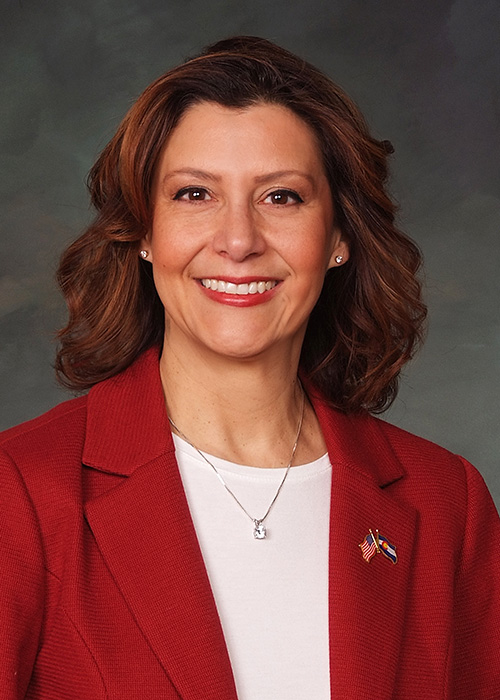
Rep. Lori Garcia Sander
Sponsored bills
Maddy summaryThis bill officially designates a specific section of Arapahoe Road in Boulder County, Colorado, as the "Road of Remembrance" to honor local World War I veterans. It authorizes the Colorado Department of Transportation to accept donations for placing commemorative signs along the road and to explore agreements with Boulder County for maintaining those signs. The legislation also acknowledges the historical significance of the nearby stone pillars, known as the Gateway, which were originally built in 1928 to mark the entrance to a planned memorial roadway that was never fully completed.
Previously, money in the diseased livestock indemnity fund could be used only to pay indemnity to a livestock owner whose herd had been sold for slaughter or destroyed because the herd was exposed to or diagnosed with an infectious or contagious disease. The act expands the permissible uses of the money in the diseased livestock indemnity fund by allowing the commissioner of agriculture to authorize using the money to prepare for and respond to certain emerging threats to livestock health. The act renames the fund the 'livestock health preparedness, response, and diseased livestock indemnity fund' to reflect the expanded scope of the permissible uses of money in the fund.(Note: This summary applies to this bill as enacted.)
Maddy summaryThis bill approves specific updates to eligibility lists for two Colorado water funding programs. It adds new drinking water projects (like Delta County's distribution system) and modifies existing entries (such as adding "green infrastructure" to Loveland's project), while deleting completed projects (like Kiowa's). These changes determine which local water districts, municipalities, and property associations can access financial assistance from the Drinking Water Revolving Fund and Water Pollution Control Revolving Fund. The bill does not create new funding rules but formally adopts the Commission's proposed list adjustments.
Maddy summaryThis House Resolution honors Bob Holder, a wildlife manager from Colorado who has dedicated 50 years to protecting wildlife resources in southern Colorado. The measure formally recognizes his contributions to conservation efforts, including his work with black bear education, wildlife enforcement, and habitat preservation through land acquisitions and conservation easements. The resolution expresses gratitude for his service and directs that a copy be sent to Holder as a token of appreciation upon his retirement.
Maddy summarySJR 11 is a commemorative resolution designating a specific segment of U.S. Highway 34 (between Wilson Ave. and North County Rd. 23H) as the "Sgt. John 'Jack' Thurman Memorial Highway" in honor of a World War II Marine Corps veteran. The bill, which has no policy or funding provisions, simply names the highway section to recognize Sergeant Thurman's service at Iwo Jima, his military awards, and his post-war contributions as an architect and community leader in Colorado. It authorizes the Colorado Department of Transportation to accept donations for signage and explore maintenance agreements with local governments. This is a ceremonial designation with no direct impact on residents or new laws.
Maddy summarySJR 4 designates September 20-26, 2026, as "Frontotemporal Degeneration (FTD) Awareness Week" in Colorado. This symbolic resolution recognizes FTD - a terminal, incurable neurodegenerative disease affecting speech, behavior, and motor skills - and aims to increase public awareness of the condition. It directly supports Coloradans living with FTD, their families, and advocacy groups like the Association for Frontotemporal Degeneration, which focuses on research and care. The bill has no funding or regulatory provisions, as it is purely a recognition measure.
Maddy summaryThis House Memorial (HM 1001) is a formal tribute passed by the Colorado General Assembly honoring former State Representative Dan Williams, who died in October 2025. It recognizes his 1984-1992 service in the Colorado House, his leadership as chair of key committees (including Agriculture and Transportation), and his lifelong advocacy for Colorado ranching and farming communities. The resolution expresses the legislature's condolences to his family and sends copies of the memorial to his partner and children. It has no policy impact, as it is purely a commemorative gesture with no new laws or funding.
Maddy summaryHJR 1018 designates the 61-mile stretch of State Highway 86 through Elbert County, Colorado, as the "Plains-to-Pines Scenic Corridor." The resolution authorizes the Colorado Department of Transportation (CDOT) to accept donations for signage, markers, and landscaping to promote this scenic route connecting the eastern plains to the Rocky Mountain foothills. It specifically enables CDOT to collaborate with Elbert County and the towns of Kiowa and Elizabeth for maintenance of these promotional elements. This is a commemorative designation without new regulatory requirements, focusing on tourism and regional identity.
Maddy summarySJR 14 is a symbolic resolution declaring February 28, 2026, as "Rare Disease Day" in Colorado. It recognizes over 500,000 Coloradans living with rare diseases - conditions affecting fewer than 200,000 people - and highlights challenges like limited treatments and high costs. The resolution encourages public awareness through events (like lighting Denver's City and County Building) and acknowledges the resilience of affected individuals. It does not create new laws, funding, or services, but formally supports the rare disease community through recognition.