

The public employees' retirement association (PERA) board (board) conducts or causes to be conducted an actuarial experience study of PERA and a periodic actuarial audit of PERA. Both the actuarial experience study and the periodic actuarial audit, neither of which were referenced in law prior to passage of the act, are conducted approximately once every 5 years, but the timing of the actuarial experience study and the periodic actuarial audit is not aligned. The act requires the board to conduct or cause to be conducted the actuarial experience study every 4 years, beginning with the actuarial experience study that the board conducted in the 2024 calendar year, rather than every 5 years. In addition, the act requires the board to conduct or cause to be conducted the periodic actuarial audit of PERA in the 2026 calendar year and every 4 years thereafter , rather than every 5 years, and to ensure that each periodic actuarial audit takes into consideration the results and findings of the most recent actuarial experience study that was conducted or caused to be conducted by the board. For several years, the pension review commission has been required to commission an independent review of the economic and investment assumptions used to model PERA's financial situation. The act requires the commission to commission the independent review every 4 years, rather than every 3 years, within 3 months of the release of the periodic actuarial audit of PERA conducted or caused to be conducted by the board. (Note: This summary applies to this bill as enacted.)
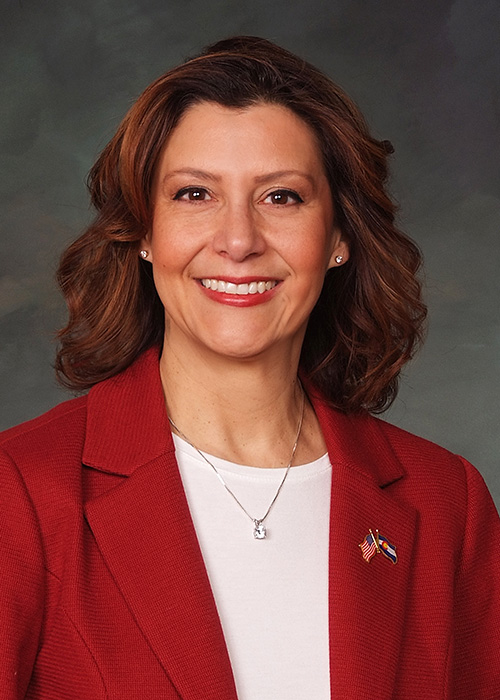
Rep. Lori Garcia Sander
Sponsored bills
The act requires the Colorado bureau of investigation (CBI) to spend $3,000,000 in specifically appropriated money from House Bill 24-1430, concerning the provision for payment of the expenses of the executive, legislative, and judicial departments of the state of Colorado, and of its agencies and institutions, for and during the fiscal year beginning July 1, 2024, except as otherwise noted, on backlogged DNA evidence and sexual assault kit tests, as well as DNA retesting related to CBI's laboratory misconduct that was discovered in 2023. Additionally, the act allows CBI to contract with external labs to perform the testing. The act requires CBI to create a dashboard on the department of public safety's website to update the public on the backlog at least every 30 days. CBI shall provide the general assembly with updates on the sexual assault kit backlog, including the number of cases pending, the number of tests CBI's lab conducted, the number of tests CBI contracted out, an update on CBI's laboratory staffing levels, the average turnaround time for a sexual assault kit test, and other relevant data points every 30 days from March 10, 2025, through June 30, 2026. (Note: This summary applies to this bill as enacted.)
Maddy summaryThis is a ceremonial resolution designating March 17, 2025, as "Colorado FFA Day." It recognizes the Future Farmers of America (FFA) organization's role in supporting agricultural education and youth development in Colorado. The resolution directly affects Colorado FFA members, educators, and supporters by formally honoring their contributions through this annual recognition. It does not create new laws or policy changes, as it is a symbolic gesture celebrating the organization's work.
In the case of a veterinary health-care worker, dog groomer, humane agency personnel, professional dog handler, or trainer acting in the performance of that person's professional duties, the bill removes the term "or serious bodily injury" to the list of provisions that the statute does not apply to, leaving just "bodily injury". (Note: This summary applies to this bill as enacted.)
Maddy summaryThis joint resolution declares February 28, 2025, as Rare Disease Day in Colorado to raise awareness about rare diseases. It directly affects Colorado residents living with rare diseases - over 500,000 people - and their families, recognizing the challenges they face, including high medical costs and limited treatments. The resolution makes no new policy changes but symbolically honors those impacted by urging the state to "show our stripes" in solidarity. It references national statistics (e.g., 1 in 10 Americans affected) and the "zebra" awareness symbol for rare conditions, without creating any legal obligations or funding.
Section 1 of the bill repeals provisions in the Colorado open meetings law that specifically apply to the general assembly that were enacted in 2024 by Senate Bill 24-157. Section 2 requires that the database created and maintained by the peace officer standards and training board that includes specified information related to peace officer conduct and discipline be sortable in addition to being searchable and that it be available upon request to any member of the public with only personal information of peace officers redacted at no cost to the requester. Sections 3, 4, and 5 make the following changes to the Colorado open records act (CORA): Specifies the manner in which service of requests for public records must be made; Requires that a requester of public records submit with the request an affidavit of service, which creates a rebuttable presumption of the date that service is made; Clarifies that any rules made by a custodian for the inspection of public records cannot increase any costs charged to a requester and cannot expand the date and time for inspection of public records; Removes the requirement that a requester must request that the custodian notify the requester that requested public records are in active use, in storage, or otherwise not readily available; Clarifies that computation of time for response periods is in accordance with the generally applicable law for computation of time and does not include the day that service is made; Permits computation of time for a request that was mailed to begin on the third day after the date of mailing; Changes the reasonable time to respond to a request for public records from 3 working days to 5 days; For a custodian to not be required to produce a digital public record in a searchable or sortable format, requires documentary evidence that producing the record in that format would violate the terms of a copyright or licensing agreement or documentary evidence, including an opinion from legal counsel, that producing the record in that format would result in the release of a third party's proprietary information; Although a custodian is allowed to deny inspection of a personnel file, allows inspection of any writings that reflect or discuss the exercise of official government functions by any public employee subject to certain permissible redactions; Allows for the first 5 hours of time expended in connection with the research and retrieval of public records to be free of charge to the requester; Caps the amount of the hourly fee that can be imposed for research and retrieval of public records to $25; Allows a $50 fee to be imposed for attorney review which is limited to review of requested public records for attorney-client privileged communication; and Invalidates any fee imposed by a custodian if the custodian does not provide information in writing to the requester concerning an estimate of time to be expended and fees to be charged in connection with responding to the request. Sections 6, 7, 8, and 9 make the following changes to the Colorado Criminal Justice Records Act (CCJRA): Adds to the definition of "official record" any incident report or other record of an interaction between any on-duty peace officer and any member of the public; Modifies the provisions on the response period to state that a custodian shall respond to a request for criminal justice records 3 days after the day the request is received unless extenuating circumstances apply, in which case the 3-day response period may be extended for a period not to exceed 10 days. The extenuating circumstances set forth in CORA are the extenuating circumstances applicable for requests under the CCJRA. Requires that records in a completed internal investigation be available for public inspection within 21 days of a request being submitted and whether or not the investigation involved a member of the public; Removes the court's discretion and the requirement that the court find that improper denial of records is arbitrary or capricious to award court costs and attorney fees; and Applies the same parameters as those established under CORA for search and retrieval and attorney fees.(Note: This summary applies to this bill as introduced.)
The act requires third-party payers to reimburse the department of health care policy and financing (state department) for health-care items and services rendered to a medicaid member regardless of whether prior authorization was obtained. The act requires third-party payers to respond to an inquiry from the state department regarding a claim for payment no later than 60 days after receiving the state department's inquiry. The third party must respond either by paying the claim or issuing a written denial of the claim to the state department. (Note: Italicized words indicate new material added to the original summary; dashes through words indicate deletions from the original summary.) (Note: This summary applies to this bill as enacted.)
Current law authorizes the executive director of the department of early childhood (department) to adopt all rules for the administration of the department, for the execution and administration of department functions, and for the programs and services managed by the department. The bill repeals the executive director's rule-making authority and creates the state board of early childhood services (state board). The bill authorizes the state board to adopt all rules for the administration of the department, for the execution and administration of department functions, and for the programs and services managed by the department. Current law allows a local coordinating organization (LCO) to participate in the Colorado universal preschool program (program) by allocating funding to school- and community-based preschool providers (preschool providers), ensuring a mixed delivery system of preschool providers, and coordinating with preschool providers and the early childhood and family support programs and services. On June 1, 2026, LCOs will no longer participate in the program, but LCOs will continue to support families who apply for early childhood and family support programs and services, coordinate with county departments and tribal agencies, and work with early child care providers to increase recruitment and retention of individuals in the early child care workforce. The bill requires the department to modify the unified application to grant administrative access to a preschool provider who participates in the program to help families enroll their children in the program and to assist families with their administrative needs, including with the completion of their first program application and maintaining the continued enrollment of their children who have been receiving preschool services from the preschool provider. Administrative units will also have access to the unified application to help families enroll children with disabilities in the program and to assist families with their administrative needs. Current law requires the executive director to adopt rules for the maximum allowable educator-to-child ratios and group sizes (ratios and group sizes) in alignment with national best practices. The bill requires the state board to adopt rules for ratios and group sizes in alignment with state licensing standards. When the department adjusts ratios and group sizes, and prior to adopting rules for the preschool program, the department is required to coordinate with preschool providers to determine the ratios and group sizes. The bill requires the department to distribute funding to preschool providers in advance of services provided throughout the school year based on enrollment data. (Note: This summary applies to this bill as introduced.)
Maddy summaryHJR 25-1018 is a Colorado legislative resolution recognizing the service of Latina and Latino veterans who have served in the U.S. Armed Forces. It formally commends their contributions across military conflicts from the Revolutionary War through modern operations, highlighting historical units like the "Borinqueneers" and the American GI Forum. The resolution does not create new policies, benefits, or legal obligations - instead, it serves as a symbolic gesture of appreciation. A copy will be sent to the American GI Forum of Colorado, as specified in the resolution.
Maddy summaryThis House Joint Resolution (HJR 25-1017) is a ceremonial resolution honoring the historical legacy of the 10th Mountain Division, a U.S. Army unit that trained at Camp Hale in Colorado during World War II. It recognizes the division’s combat service in the Italian Alps, its postwar conservation efforts by veterans through the 10th Mountain Division Hut Association, and President Biden’s 2022 designation of Camp Hale as a national monument. The resolution expresses the Colorado General Assembly’s appreciation for the division’s bravery and its enduring connection to Colorado’s history and landscape. As a symbolic gesture, it does not create new laws or obligations but serves to memorialize the unit’s contributions.