

Under current law, certain provisions are required in a public school contract (contract), and if the provisions are omitted from a contract, the law deems that the provisions are automatically included in the contract. The act clarifies that the list includes that a contractor is required to comply with accessibility standards adopted by the office of information technology for an individual with a disability. The act adds a provision to the list to require a contractor to indemnify, hold harmless, and assume liability on behalf of a public school contracting entity, the public school, and the public school's employees and agents, for all remedies for noncompliance with standards that ensure technology accessibility to persons with disabilities. The act requires that a contract or agreement entered into between a state agency or public entity and a contractor must require a contractor to comply with accessibility standards adopted by the office of information technology for an individual with a disability. Additionally, the contractor must indemnify, hold harmless, and assume liability on behalf of a state agency or public entity's officers, employees, and agents for all remedies for noncompliance with standards that ensure technology accessibility to persons with disabilities. If the provisions are omitted from a contract, the law deems that the provisions are automatically included in the contract. (Note: This summary applies to this bill as enacted.)
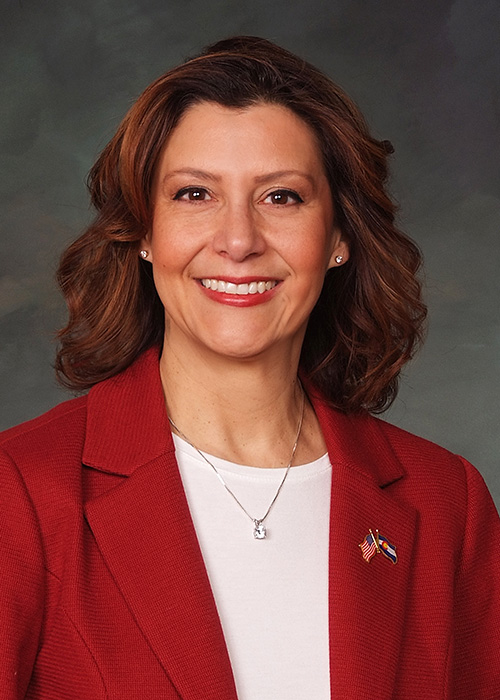
Rep. Lori Garcia Sander
Sponsored bills
Under current law, there are 2 total program formulas to finance public schools. Absent the satisfaction of a statutorily specified condition, the first formula is scheduled to stop determining total program after the 2024-25 budget year (expiring formula), and the second formula is scheduled to determine total program beginning in the 2030-31 budget year (new formula). For the 2025-26 budget year through the 2029-30 budget year (transition period), total program is scheduled to be determined by using figures that were calculated under both the expiring formula and the new formula. The act: Extends the transition period by one year, so that it is from the 2025-26 budget year through the 2030-31 budget year; and Postpones the exclusive use of the new formula to determine total program until the 2031-32 budget year. The act changes how each school district's and institute charter school's annual total program is determined during the transition period. For the 2025-26 and 2026-27 budget years, each school district's and institute charter school's annual total program is the greater of the school district's or institute charter school's total program for the 2024-25 budget year or the amount calculated under the expiring formula plus an amount equal to 15% in 2025-26 and 30% in 2026-27 of the difference between the amounts calculated under the new formula and the expiring formula. For the 2027-28 budget year through the 2030-31 budget year, each school district's and institute charter school's annual total program is the greater of the district's or institute charter school's calculation under the expiring formula plus 1% of that calculation, or: For the 2027-28 budget year, the amount calculated under the expiring formula plus an amount equal to 45% of the difference between the amounts calculated under the new formula and the expiring formula; For the 2028-29 budget year, the amount calculated under the expiring formula plus an amount equal to 60% of the difference between the amounts calculated under the new formula and the expiring formula; For the 2029-30 budget year, the amount calculated under the expiring formula plus an amount equal to 75% of the difference between the amounts calculated under the new formula and the expiring formula; and For the 2030-31 budget year, the amount calculated under the expiring formula plus an amount equal to 90% of the difference between the amounts calculated under the new formula and the expiring formula. Under current law, there are specified conditions that apply to the transition period. If the joint budget committee determines that a specified condition occurs in a budget year during the transition period, then for the next budget year and each budget year thereafter, the transition is suspended, and each school district's total program is determined pursuant to the calculation and determination required for the budget year when the condition occurred. For one of the existing conditions, the act specifies that an income tax deposit to the state education fund that was made to correct an error does not count toward determining whether the condition has been satisfied. A school district's funded pupil count is a figure that is used as a part of determining a school district's total program. Under the expiring formula, a school district's funded pupil count is calculated by determining the greater of the school district's pupil enrollment for the applicable budget year or the average of the school district's pupil enrollment for the applicable budget year and the immediately preceding 4 budget years. Under current law, the new formula calculates a school district's funded pupil count by determining the greater of the school district's pupil enrollment for the applicable budget year or the average of the school district's pupil enrollment for the applicable budget year and the immediately preceding 3 budget years. The act changes the new formula so that: For the 2025-26 budget year, a school district's funded pupil count is calculated by determining the greater of the school district's pupil enrollment for the applicable budget year or the average of the school district's pupil enrollment for the applicable budget year and the immediately preceding 3 budget years; and For the 2026-27 budget year and each budget year thereafter, a school district's funded pupil count is calculated by determining the greater of the school district's pupil enrollment for the applicable budget year or the average of the district's pupil enrollment for the applicable budget year and the immediately preceding 2 budget years. However: If a statutorily specified condition is satisfied, and consequently for the 2026-27 budget year, a district's total program is not determined as scheduled under the transition period, then for the 2026-27 budget year, and each budget year thereafter, funded pupil count will continue to be determined by the greater of the school district's pupil enrollment for the applicable budget year or the average of the school district's pupil enrollment for the applicable budget year and the immediately preceding 3 budget years; and If, for the 2027-28 budget year, the state education fund balance is projected to be less than $200 million, then the general assembly is required to implement a smoothing factor or the funded pupil count will be determined by the greater of the school district's pupil enrollment for the applicable budget year or the average of the school district's pupil enrollment for the applicable budget year and the immediately preceding budget year for the 2027-28 budget year and each budget year thereafter. The act expiring formula is changed so that, starting in the 2027-28 budget year, the funded pupil count used in the expiring formula is the same funded pupil count that is used in the new formula to determine a district's total program during the transition period. The total program for the 2025-26 budget year is determined using the formula changes in the act. The act: Increases the statewide base per pupil funding for the 2025-26 budget year by $195.42 to account for inflation; Sets a new statewide base per pupil funding amount for the 2025-26 budget year at $8,691.80; and Sets the total program funding for the 2025-26 budget year for all school districts and institute charter schools to at least $10,036,070,748 or $10,031,606,090, depending upon whether Senate Bill 25-315 becomes law. Under current law, a new at-risk measure is required to be implemented in the 2025-26 budget year. The act repeals this requirement and requires the department of education (department) to collect data necessary to identify individual student census block groups to account for students who are at-risk of below-average academic performance and education outcomes because of socioeconomic disadvantages or poverty, but who may not qualify for free or reduced price lunch. Under current law, as a part of the charter contract, a district charter school and the school district, or the institute charter school and state charter school institute (institute), must agree on funding and services provided by the school district or institute to the charter school, subject to parameters. The act: Suspends the use of these provisions after the 2025-26 budget year; Repeals charter school at-risk supplemental aid after the 2026-27 budget year, following its gradual phase out during the 2025-26 and 2026-27 budget years; Creates incremental funding for charter schools for the 2025-26 budget year; and Requires the general assembly to consult with charter school representatives to ensure that charter schools are aligned with the implementation of the new formula. The act raises the limit from $750 million to $1 billion for the amount of money that the general assembly may appropriate to restore any or all qualified charter school debt reserve funds to their qualified charter school debt service fund requirements. Under current law, $41 million of interest and income earned on money in the public school fund is credited to certain purposes, and any remaining interest and income may be credited as specified by the general assembly or remain in the public school fund. The act requires that any remaining interest and income is credited to the public school capital construction assistance fund. The total annual amount of revenue credited to the public school capital construction fund is capped at $150 million, adjusted for inflation; except that money received from public school fund interest and income does not apply toward the cap. Any amount above the cap is credited to the state public school fund instead. The act creates the kids matter account within the state education fund. Beginning July 1, 2026, the state treasurer must deposit in the account all state revenues collected from an existing tax on 0.00065% on federal taxable income, as modified by law, of every individual, estate, trust, and corporation. The money in the account must only be used for district total program funding and total state funding for all categorical programs. Under current law, the department is required to contract with an entity to develop and implement a public information campaign to emphasize the importance of learning to read by third grade and highlight local education providers that are achieving high percentages of third-grade students who demonstrate reading competency. The act repeals the requirement that the department contract with an entity to develop and implement the information campaign. The act authorizes the department to use any unexpended money that was appropriated for the out-of-school time program grant program and is remaining at the end of the 2024-25 or 2025-26 state fiscal years in the 2025-26 or 2026-27 state fiscal years without further appropriation. The act creates and implements certain parameters for multifunction school activity buses. For the 2025-26 state fiscal year, the act: Appropriates $7,009,989 to the department from the state education fund for at-risk supplemental aid; Appropriates $7.6 million to the department from the public school capital construction assistance fund for public school capital construction assistance board cash grants; Appropriates $25 million to the department from the public school capital construction assistance fund for public school capital construction assistance board lease payments; and Adjusts the 2025-26 long bill by decreasing the cash funds appropriation from the state education fund for the state share of district's total program by $15,775,837; decreasing the cash funds appropriation from the state education fund for at-risk per pupil additional funding by $5 million; and decreasing the cash funds appropriation from the public school capital construction assistance fund for public school capital construction assistance board cash grants by $45,648,087.(Note: This summary applies to this bill as enacted.)
Beginning with the 2027-28 school year, the act requires each individual career and academic plan (ICAP) to include a requirement that, during the student's graduation year, the student has exposure to federal financial aid eligibility tools and net price calculators and practices filling out a free application for federal student aid or the Colorado application for state financial aid, unless the student or student's parent or legal guardian affirmatively declines to practice filling out the application or authorized school personnel determines it is not feasible for the student to practice filling out an application. The act requires each school district board of education to incorporate all the financial literacy standards into a course that is required for high school graduation. The act authorizes the department of education (department) to seek, accept, and expend gifts, grants, or donations for the purpose of supporting educators in implementing a financial literacy course. For the 2025-26 state fiscal year, the act appropriates $210,389 to the department for distribution to school districts to support implementation of a financial literacy course and the ICAP requirement. The act requires the department to distribute money to school districts that do not currently offer a course based on a formula determined by the department, which may include determining eligibility based on attestations from school districts. For the 2025-26 state fiscal year, the act appropriates $9,611 to the department of higher education for use by the Colorado commission on higher education and higher education special purpose programs for administration. (Note: This summary applies to this bill as enacted.)
The act clarifies when a teacher may conclude that an early elementary school student has a significant reading deficiency requiring remediation through a specialized approach to instruction (READ plan) based on a body of evidence that includes information in addition to the student's scores on a reading assessment. Current law requires certain parental communications in connection with a student's READ plan. The act requires the addition of specific information regarding characteristics of dyslexia, if applicable, to the parental communications. Beginning no later than the 2027-28 school year, a local education provider must either develop its own screening process for identifying early elementary school students with characteristics of dyslexia or implement a universal dyslexia screener that conforms to certain new requirements. A local education provider that implements a screener may include the screener in an interim reading assessment or administer the screener separately from the interim assessment. Either way, the screener must accurately and reliably identify students at risk of reading difficulties. If an interim reading assessment includes a screener, the assessment must meet standards for validity and reliability, encourage data-driven instructional decision making, and promote efficient administration and effective follow-up. (Note: This summary applies to this bill as enacted.)
The act allows, but does not require, an eligible patient to request from a manufacturer the manufacturer's individualized investigational drug, biological product, or device, which is a drug, biological product, or device that is unique and produced exclusively for use by an individual patient based on the patient's own genetic profile. The manufacturer must be operating within an institution that operates under federal rules for the protection of human subjects. An eligible patient is an individual who has: A life-threatening or severely debilitating illness, as attested to by the patient's treating physician; Considered all other treatment options currently approved by the United States food and drug administration; Received a recommendation from the patient's treating physician; Given written, informed consent for the use of the individualized investigational drug, biological product, or device; and Documentation from the treating physician that the individual meets the definition of "eligible patient". The act authorizes, but does not require, a manufacturer to make the individualized investigational drug, biological product, or device available to an eligible patient at no charge, but the manufacturer may require payment to cover the cost. If any harm is caused to the eligible patient resulting from the use of the individualized investigational drug, biological product, or device, a private right of action cannot be brought against the manufacturer or against any other individual or entity involved in the care of the eligible patient with regard to the eligible patient's use of the individualized investigational drug, biological product, or device, so long as the manufacturer, individual, or entity complied with the law and exercised reasonable care. The act prohibits disciplinary action against a health-care provider's license based on the health-care provider's recommendations regarding the use of the individualized investigational drug, biological product, or device. The act does not affect a health-care insurer's obligation under current law relating to coverage for an insured's participation in a clinical trial. (Note: This summary applies to this bill as enacted.)
Current law requires a motor vehicle to be designed for operation on a highway to be covered by the "Uniform Motor Vehicle Law", which governs driver's licenses, registrations, and traffic regulation. The bill authorizes the owner of a surplus military vehicle to register the vehicle and be issued a license plate. If the vehicle is registered, it may be driven on the road but must comply with the registration provisions. The driver's license provisions and the traffic regulations apply to these vehicles.(Note: This summary applies to this bill as introduced.)
For construction of multifamily, attached housing of 2 or more units, the act creates the multifamily construction incentive program (program). A builder may chose to participate in the program by: Providing a warranty that covers any defect and damage at no cost to the homeowner for specified periods; Having a third-party inspection performed on the property; and Recording a notice of election to participate in the program in the real property records before the property is offered for sale. For construction defect claims brought for the construction of housing for which the builder is a participant in the program, the act: Requires a claimant to file a certificate of review with the complaint, if the complaint is against an architect or engineer; Limits actions to claims that have resulted in: Actual damage to real or personal property; actual loss of the use of real or personal property; actual bodily injury or wrongful death; an unreasonable reduction in the capability of, or an actual failure of, a building component to perform an intended function or purpose; or an unreasonable risk of bodily injury or death to, or a threat to the life, health, or safety of, the occupants of the residential property; and Requires that a construction professional must send or deliver to the claimant an offer to settle the claim or a written response that identifies the standards that apply to the claim and explains why the defect does not require repair. For all construction defect claims, the act: Establishes a claimant's duty to mitigate an alleged construction defect and specifies how a claimant may satisfy this duty and the consequences to a claimant that fails to satisfy this duty; Requires a construction professional who is the defendant in a construction defect action to submit specified information to the claimant; Prohibits an insurer from cancelling, denying, or reducing coverage based on any claim for benefits covered by an existing liability insurance policy issued to a construction professional based on the construction professional's offer to repair or settle a construction defect claim; Tolls the statute of limitations or repose during a claimant's mitigation of an alleged construction defect; Increases the percentage of owners that an executive board of a unit owners' association (executive board) must obtain approval from before initiating a construction defect claim on behalf of the owners from a majority to 65%; and Requires an executive board that is successful in a construction defect claim or settlement to first use the net monetary damages or net proceeds received as a result of the claim to repair the construction defect. The act requires a local government to establish a fast-track approval process for an application for for-sale multifamily condominium projects in order to qualify for assistance from the state affordable housing fund. (Note: This summary applies to this bill as enacted.)
Maddy summaryHJR 25-1028 designates Friday, April 25, 2025, as "Sportsmen's Day" in Colorado. This resolution aims to recognize the contributions of Colorado's sportsmen and women to conservation efforts and the state's economy. It also encourages members of the General Assembly to join the Colorado Legislative Sportsmen's Caucus and urges public and private institutions to work with the caucus.
Maddy summaryHouse Joint Resolution 25-1027 designates a specific portion of Colorado State Highway 1 in Larimer County, from East County Road 60 to Interstate 25, as the "Commissioner Lew Gaiter III Memorial Highway." It authorizes the Colorado Department of Transportation (CDOT) to accept donations for the initial placement of signs and to explore a cooperative agreement with Larimer County for sign maintenance.
Maddy summaryHouse Joint Resolution 25-1030 expresses the State of Colorado's strong opposition to the use of forced labor in the production of goods. The resolution states that Colorado will use its purchasing power to support businesses that ethically source or manufacture products without forced labor. It also encourages state and local economic development offices to attract businesses that avoid these labor practices. This joint resolution aims to influence state and local government purchasing decisions and promote ethical business standards.