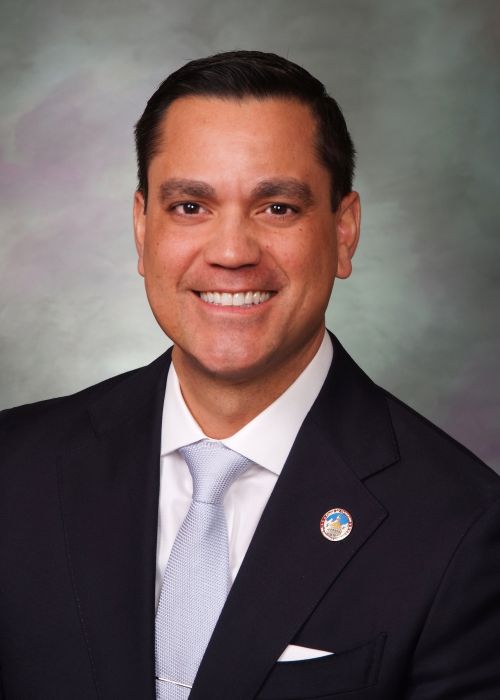
Photo of Sean Camacho
D Colorado House · District 6

Rep. Sean Camacho

Compare
Total votes
1,710
all sessions
Attendance
99%
20 missed
Near the chamber average
With party
98%
of cast votes
Higher than 80% of chamber peers
Bipartisan score
1%
crosses aisle rarely
Lower than 76% of chamber peers
Sponsored
359
bills & resolutions
Near the chamber average
Committees
4
assignments
359 bills and resolutions

Sponsored bills

Total
359
Primary
53
Co-sponsor
306
This page
359
matching current filters
Co-sponsor HJR 1001
Passed · Colorado House · Co-sponsor
General Assembly Positions & Salary Ranges

Maddy summaryHJR 1001 establishes salary ranges for various positions within the state legislature, including clerks, sergeants-at-arms, communications staff, and chaplains. The bill specifies pay grades (e.g., H1B5 for Chief Clerk) and fixed rates (like $25 per visit for the Chaplain) for over 30 legislative roles. It directly affects legislative staff members by defining their compensation structures without altering job duties or creating new policies. This procedural resolution sets standardized pay levels for existing positions in both the Senate and House of Representatives.

Passed Jan 21, 2026 1 co-sponsor
Co-sponsor HJR 1002
Passed · Colorado House · Co-sponsor
MLK Jr. Day

Maddy summaryHJR 1002 is a commemorative resolution honoring Dr. Martin Luther King Jr. It does not create new laws or policies. The resolution recognizes Dr. King's legacy through historical context about his civil rights leadership, his "I Have a Dream" speech, and his role in key legislation like the Civil Rights Act of 1964. It specifically acknowledges Colorado's history of observing MLK Jr. Day, noting that Colorado became the 50th state to recognize the holiday in 2000. The resolution serves only to formally commemorate Dr. King's life and work, with no direct effect on citizens or new government requirements.

Passed Jan 20, 2026 1 co-sponsor
Co-sponsor HR 1001
Passed · Colorado House · Co-sponsor
House Officers & Employees

Maddy summaryHouse Resolution 1001 appoints specific staff members to roles within the Colorado House of Representatives for the 75th General Assembly's Second Regular Session. It names individuals to positions including Chief Clerk, Assistant Chief Clerk, Journal Clerk, sergeants-at-arms, and leadership support staff for both majority and minority parties, plus student interns from Arrupe Jesuit High School. The resolution was approved without amendments on January 20, 2026, and serves as routine staffing for legislative operations. This procedural resolution does not create new laws or affect public policy.

Passed Jan 20, 2026 1 co-sponsor
Co-sponsor SJR 3
Passed · Colorado Senate · Co-sponsor
Joint Session Address by Tribal Councils

Maddy summarySJR 3 is a procedural resolution scheduling a joint meeting of Colorado's Senate and House of Representatives on January 16, 2026, to hear a message from representatives of the Ute Mountain Ute Tribal Council and Southern Ute Tribal Council. It directs the appointment of a six-member committee (three from each chamber) to escort tribal representatives to the session. The resolution recognizes the tribes' historical and cultural contributions to Colorado but does not create new laws or policies. This is a formal procedural step to facilitate the tribal message, not a substantive legislative change.

Passed Jan 15, 2026 1 co-sponsor
Primary SB 25-300
Signed into law · Colorado Senate · Lead sponsor
Revisor's Bill

To improve the clarity and certainty of the statutes, the act amends, repeals, and reconstructs various statutory provisions of law that are obsolete, imperfect, or inoperative. The specific reasons for each amendment or repeal are set forth in the appendix to the act. The amendments made by the act are not intended to change the meaning or intent of the statutes. (Note: This summary applies to this bill as enacted.)

Signed into law Jun 4, 2025 0 co-sponsors
Co-sponsor SB 25-306
Signed into law · Colorado Senate · Co-sponsor
Performance Audits of Certain State Agencies

The act requires the state auditor to conduct or cause to be conducted performance audits (audits) of the air pollution control division in the department of public health and environment and the division of unemployment insurance in the department of labor and employment (divisions). The audits will determine whether each of the divisions effectively and efficiently performs and fulfills its statutory obligations. In addition, as part of the audits, the state auditor is required to: Determine whether a division complies with statute and its statutory purpose; Assess the impact of a division's processes on providing access to program benefits and, for the labor and employment division audit only, identify any division processes that may be unnecessary, unreasonable, or cause delays; Determine whether a division's staffing and funding levels are sufficient for it to efficiently and effectively perform its statutory duties and responsibilities, which, in for the air pollution control division audit only, must include assessment of how funding or staffing changes made at the state level might impact local governments; and Determine whether a division requested and was appropriated additional resources and whether the approval or denial of such a request impacted program implementation and timing of implementation. The initial audit of the air pollution control division must begin and be completed in calendar year 2026, with an additional audit occurring in calendar year 2031. The initial audit of the division of unemployment insurance must begin and be completed in calendar year 2027, with an additional audit occurring in calendar year 2032. Upon completion of an audit, the state auditor is required to submit a written audit report to the legislative audit committee. (Note: This summary applies to this bill as enacted.)

Signed into law Jun 4, 2025 1 co-sponsor
Co-sponsor SB 25-173
Signed into law · Colorado Senate · Co-sponsor
Revenue Classification Taxpayers Bill of Rights

Section 20 of article X of the state constitution (TABOR) defines "fiscal year spending" as not including either "damage awards" or "property sales". Although TABOR does not define either "damage award" or "property sale", the TABOR implementing statutes do. The act clarifies both of these definitions for state fiscal years commencing on or after July 1, 2024. The act clarifies that "damage award", as used for the purpose of determining whether specific money received by the state is subject to the TABOR limitation on state fiscal year spending, includes certain fines and monetary penalties imposed by the state. The act also clarifies that "property sale", as used for the purpose of determining whether specific money received by the state is subject to the TABOR limitation on state fiscal year spending, includes certain specified types of sales by the state. (Note: This summary applies to this bill as enacted.)

Signed into law Jun 4, 2025 1 co-sponsor
Co-sponsor HB 25-1108
Signed into law · Colorado House · Co-sponsor
Prohibitions in Rental Agreements Due to Death

The act prohibits residential rental agreements, in relation to a tenant's death, from requiring acceleration of rent beyond the end of the month or more than 10 business days after the dwelling unit is vacated after notice to the landlord of the tenant's death, whichever is later. Further, the act prohibits the enforcement of terms in rental agreements that authorize liquidated damages or other penalties if the rental agreement is terminated before the end of its term due to the death of a tenant. The act authorizes a landlord to take possession of the dwelling unit without filing an eviction action or otherwise obtaining a court order if the personal representative of the tenant's estate notifies the landlord of the surrender of the premises or,30 days after the death of the tenant, rent remains unpaid or substantially all of the tenant's property has been removed. In addition, a landlord may retain a security or damages deposit sufficient to cover costs of damages caused by the death of the tenant. (Note: This summary applies to this bill as enacted.)

Signed into law Jun 4, 2025 1 co-sponsor
Co-sponsor SB 25-299
Signed into law · Colorado Senate · Co-sponsor
Consumer Protection Residential Energy Systems

The act defines a solar sales company as an entity that: Transacts with a consumer to sell, or negotiate or execute a contract for the sale of, a residential solar electric system or residential battery energy storage system (system); or Transacts with a consumer to lease or enter into a power purchase agreement for a system. The act requires a solar sales company to provide to a consumer certain disclosures when entering into an agreement with the consumer for the purchase or lease of a system or a power purchase agreement for a system (agreement). The act also specifies the terms that an agreement must contain, including payment terms and contact information for the solar sales company. A solar sales company is required to retain a copy of a signed agreement for at least 4 years after the date the agreement is entered into. The personal information of a consumer must be maintained consistent with applicable data privacy laws. In the event of a sale of a system, the consumer has at least 3 business days after the date of the transaction to cancel the agreement without financial penalty, besides any nonrefundable deposits. The act requires a solar sales company to conduct a welcome call with the consumer, which welcome call must include certain disclosures. The consumer's 3-day cancellation period does not begin to run until the welcome call is conducted. The act describes the terms that any financing documents must contain if the purchase of a system is financed. The act sets forth requirements for a salesperson of a solar sales company and prohibits a solar sales company from using written or digital sales materials with names, logos, pictures, or other indicia of association with a public utility, cooperative electric association, or municipal utility, unless the solar sales company has received express, written consent from the relevant utility to do so or is complying with federal fair use laws. A solar sales company is also prohibited from representing that the solar sales company is affiliated with, sponsored by, or approved by a state incentive program without the express, written consent of the state agency in charge of the state incentive program. The act requires a solar sales company to provide certain warranties for the installation and workmanship of a residential solar electric system. Lastly, the act requires an investor-owned utility serving more than 500,000 customers that offers financial incentives for a system to provide certain information about the offered incentives to customers. A violation of the requirements of the act is enforceable as a deceptive trade practice under the "Colorado Consumer Protection Act". The act's requirements apply to agreements between a solar sales company and a consumer that are entered into on or after July 1, 2026. (Note: This summary applies to this bill as enacted.)


Signed into law Jun 4, 2025 1 co-sponsor
Co-sponsor SB 25-122
Signed into law · Colorado Senate · Co-sponsor
Extending Organ & Tissue Donation Fund

The act extends the Emily Keyes - John W. Buckner organ and tissue donation awareness fund indefinitely. (Note: This summary applies to this bill as enacted.)
Signed into law Jun 4, 2025 1 co-sponsor
Showing 191 to 200 of 359 bills
Previous 1 … 19 20 21 … 36 Next