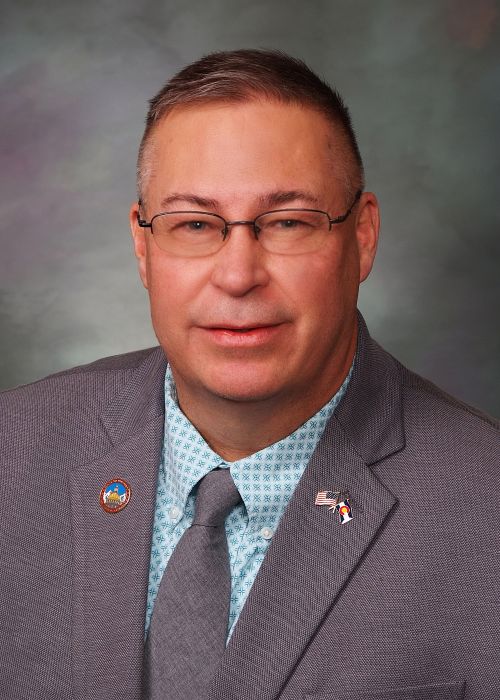
Photo of Chris Richardson
R Colorado House · District 56 On the 2026 ballot

Rep. Chris Richardson

Compare
Total votes
1,763
all sessions
Attendance
100%
4 missed
Near the chamber average
With party
94%
of cast votes
Near the chamber average
Bipartisan score
5%
crosses aisle rarely
Near the chamber average
Sponsored
151
bills & resolutions
Lower than 82% of chamber peers
Committees
5
assignments
151 bills and resolutions

Sponsored bills

Total
151
Primary
38
Co-sponsor
113
This page
151
matching current filters
Co-sponsor HR 1004
Passed · Colorado House · Co-sponsor
Farm Workers Day

Maddy summaryThis House Resolution establishes March 31, 2026, as Farm Workers Day in Colorado to honor the contributions of agricultural workers to the state's economy and food supply. The measure recognizes that farm workers make up a significant portion of Colorado's rural workforce, including many immigrant and Latina women who face unique challenges in the industry. The resolution acknowledges the historical efforts of farm worker organizations that fought for better pay, safety, and union rights, while celebrating the dignity and hard work of those who grow and harvest food. Copies of the resolution will be sent to state officials and the UFW Foundation to commemorate this observance.

Passed Mar 31, 2026 1 co-sponsor
Co-sponsor HB 1025
Signed into law · Colorado House · Co-sponsor
Exempt Auctioneers Charitable Solicitation Requirements

As defined in the 'Colorado Charitable Solicitations Act', a 'paid solicitor' is a person that, for monetary compensation, performs a service in which contributions are solicited in Colorado for a charitable purpose or for the benefit of a charitable organization.     The act excludes from the definition of 'paid solicitor' an auctioneer who provides auctioneer services to a charitable organization. As a result, the auctioneer is exempted from the requirements of the 'Colorado Charitable Solicitations Act' for paid solicitors. The exemption applies regardless of whether the auctioneer is contracted or paid to provide their auctioneer services to the charitable organization or is volunteering their auctioneer services to the charitable organization without compensation. However, for the exemption to apply, an auctioneer who provides auctioneer services to a charitable organization may not directly receive or handle contributions or charitable funding on behalf of the charitable organization for which the auctioneer is contracted or volunteering.(Note: This summary applies to this bill as enacted.)

Signed into law Mar 27, 2026 1 co-sponsor
Co-sponsor HJR 1022
Passed · Colorado House · Co-sponsor
Boulder County Road of Remembrance

Maddy summaryThis bill officially designates a specific section of Arapahoe Road in Boulder County, Colorado, as the "Road of Remembrance" to honor local World War I veterans. It authorizes the Colorado Department of Transportation to accept donations for placing commemorative signs along the road and to explore agreements with Boulder County for maintaining those signs. The legislation also acknowledges the historical significance of the nearby stone pillars, known as the Gateway, which were originally built in 1928 to mark the entrance to a planned memorial roadway that was never fully completed.

Passed Mar 26, 2026 1 co-sponsor
Primary SB 46
Signed into law · Colorado Senate · Lead sponsor
Property Tax Administrative Procedures

The act makes multiple changes to procedural requirements for the administration of property tax in 2 broad categories: Deadlines and requirements for transmitting information.      Modifications to deadlines. The act modifies property tax-related deadlines as follows:Aligns the regular and late application dates for the qualified-senior primary residence real property classification and the property tax exemption for qualifying veterans with disabilities and their spouses with those for the property tax exemption for qualifying seniors and their spouses. The regular application deadline is July 15, and late applications may be accepted until August 15.Increases from $10,000 to $20,000 the current threshold for a board of county commissioners (board) to recommend, or a county assessor with the approval of a board to settle, an abatement or refund of taxes. The threshold for the board being required to submit recommended abatement applications to the property tax administrator (administrator) for review is similarly increased from $10,000 to $20,000. The board is not required to submit an application to the administrator in the case of an abatement or refund caused by a valuation change made to ensure matching values within the same reassessment cycle.Clarifies the timeline for a petitioner to appeal a decision of the board of county equalization to the board of assessment appeals or submit the case to arbitration;Changes the real property protest deadline from June 8 to June 1;Changes the deadline from June 15 to July 15 for a county assessor to send a notice of valuation of personal property and changes the personal property protest deadline from June 30 to July 31 for a county that uses alternate protest and appeal procedures (alternate procedures) to determine objections and protests for taxable property;Clarifies that a county's use of alternate procedures may apply to real or personal property, or both; andAligns the protest deadline for personal property with the date that county assessors must conclude their hearings on such protests so that both the protest and hearing conclusion dates for personal property are June 30, or, for a county that uses alternate procedures, July 31.      Modifications to requirements for transmitting information. The act modifies requirements for transmitting property tax information as follows:Clarifies that a county assessor or the board may transmit a required abstract of assessment, certification of taxes levied, or application for a recommended abatement or refund in excess of $20,000 to the administrator in a paper or electronic format;Reduces the number of copies of an application for a recommended abatement or refund in excess of $20,000 that the board must send to the administrator for review to one;Repeals the requirement that the administrator conduct a public hearing on proposed changes to property tax manuals, appraisal procedures, instructions, and guidelines, which are still required to be reviewed by the advisory committee to the administrator;Requires the administrator to prepare and publish standardized forms, including a letter of authorization, for all levels of property tax appeals;Reduces the number of copies of a notice of determination that an assessor must send to a taxpayer who has objected to the valuation of the taxpayer's property to one; andReduces the number of copies of an abstract of assessment that needs to be prepared to one.(Note: This summary applies to this bill as enacted.)


Signed into law Mar 26, 2026 0 co-sponsors
Primary SB 1
Signed into law · Colorado Senate · Lead sponsor
Workforce Housing & Housing Tax Credit

The act allows a board of county commissioners and the governing body of a municipality to sell and dispose of property owned by the county or municipality, as applicable, to provide for affordable housing and allows a municipality to enter into a long-term rental or lease agreement for the development of affordable housing.     The act allows for the approval of a mutijurisdictional housing authority at a biennial local election instead of only during a general election or an election held on the first Tuesday in November of an odd-numbered year. The ballot question about establishing the authority may be combined with a question about a tax, impact fee, multiple-fiscal year debt, or other financial obligation.     The act allows a board of county commissioners to use ad valorem tax revenue for housing authorities, housing programs, and workforce housing.     The act entitles an entity subject to income tax to which a middle-income housing tax credit is transferred by a governmental entity or quasi-governmental entity to claim the credit without owning an interest in a qualified project.     The sale and use of construction materials by contractors is exempt from taxation if the materials are used by the state in its governmental capacity only. The act provides that 'governmental capacity' includes the construction of workforce housing projects undertaken by counties.(Note: This summary applies to this bill as enacted.)
Signed into law Mar 25, 2026 0 co-sponsors
Co-sponsor HB 1067
Signed into law · Colorado House · Co-sponsor
Diseased Livestock Indemnity Fund

Previously, money in the diseased livestock indemnity fund could be used only to pay indemnity to a livestock owner whose herd had been sold for slaughter or destroyed because the herd was exposed to or diagnosed with an infectious or contagious disease. The act expands the permissible uses of the money in the diseased livestock indemnity fund by allowing the commissioner of agriculture to authorize using the money to prepare for and respond to certain emerging threats to livestock health.     The act renames the fund the 'livestock health preparedness, response, and diseased livestock indemnity fund' to reflect the expanded scope of the permissible uses of money in the fund.(Note: This summary applies to this bill as enacted.)

Signed into law Mar 24, 2026 1 co-sponsor
Co-sponsor SB 64
Signed into law · Colorado Senate · Co-sponsor
Modify Colorado Agricultural Future Loan Program

The act modifies the Colorado agricultural future loan program (program) to permit certain eligible entities to receive funding from the program. An eligible entity is defined as an entity that is certified by the division of conservation (division) or an entity that:Is a district that has authority to conduct water activities, an irrigation district, or a ditch and reservoir company; andHas a letter of support from an entity certified by the division.     The act directs the commissioner of agriculture to adopt rules that prioritize awarding loans to eligible entities that seek to acquire and conserve agriculturally productive land and to transfer ownership of that land to an eligible farmer or rancher who qualifies for a loan from the program.(Note: This summary applies to this bill as enacted.)

Signed into law Mar 24, 2026 1 co-sponsor
Co-sponsor HR 1002
Passed · Colorado House · Co-sponsor
Recognizing Bob Holder

Maddy summaryThis House Resolution honors Bob Holder, a wildlife manager from Colorado who has dedicated 50 years to protecting wildlife resources in southern Colorado. The measure formally recognizes his contributions to conservation efforts, including his work with black bear education, wildlife enforcement, and habitat preservation through land acquisitions and conservation easements. The resolution expresses gratitude for his service and directs that a copy be sent to Holder as a token of appreciation upon his retirement.

Passed Mar 11, 2026 1 co-sponsor
Co-sponsor SB 10
Signed into law · Colorado Senate · Co-sponsor
Agricultural Property Tax Definitions

The act broadens the definition of 'ranch' for purposes of property taxation to mean a parcel of land that is predominantly used for grazing livestock for the primary purpose of obtaining a monetary profit. A ranch must operate through a pasture-based operation, which is newly defined as a method of livestock management where pasture-grazed livestock have regular access to open pasture and derive a majority of their diet through grazing.     The act also broadens the definition of 'farm' for purposes of property taxation to mirror the predominant use language in the definition of 'ranch'. With this change, a farm means a parcel of land that is predominantly used to produce agricultural products that originate from the land's productivity for the primary purpose of obtaining a monetary profit.(Note: This summary applies to this bill as enacted.)

Signed into law Mar 9, 2026 1 co-sponsor
Primary HB 1278
In committee · Colorado House · Lead sponsor
Local Government Approval of Transmission Infrastructure

The bill requires that an investor-owned electric utility receive a certificate of public convenience and necessity (certificate) from the public utilities commission and obtain all necessary local government land use approvals and permits prior to initiating any condemnation proceedings related to a high-voltage transmission infrastructure project requiring the certificate.The bill does not change existing application and review processes related to the development of transmission projects that have been established by the public utilities commission or a relevant local government.(Note: This summary applies to this bill as introduced.)

In committee Mar 5, 2026 0 co-sponsors
Showing 51 to 60 of 151 bills
Previous 1 … 5 6 7 … 16 Next