

The bill grants a person who is at least 18 years of age and permitted to possess a handgun pursuant to federal and state law the same authority to carry a concealed handgun as a person who holds a permit to carry a concealed handgun (permit). A person who carries a concealed handgun without a permit has the same rights, limitations, and authority to carry as a person who holds a permit. A person may obtain a permit for the purpose of using the permit to carry a concealed handgun in another state that recognizes a Colorado permit. The bill makes the minimum age to obtain a permit 18 years of age. Under existing law, Colorado recognizes permits issued in other states that meet certain criteria, including that the holder of the out-of-state permit is at least 21 years of age. The bill changes the minimum age for recognition of an out-of-state permit to 18 years of age. Under existing law, a permit is valid for 5 years. The bill makes a permit valid for the life of the permit holder. Existing permits, other than temporary emergency permits, are converted to lifetime permits. Because the bill makes permits valid for the life of the holder, the bill repeals provisions relating to the renewal of permits. The bill repeals the temporary emergency permit to carry a concealed handgun. The bill repeals local government authority to regulate open or concealed carry of a handgun, including repealing the authority of special districts and the governing boards of institutions of higher education, as applicable. (Note: This summary applies to this bill as introduced.)
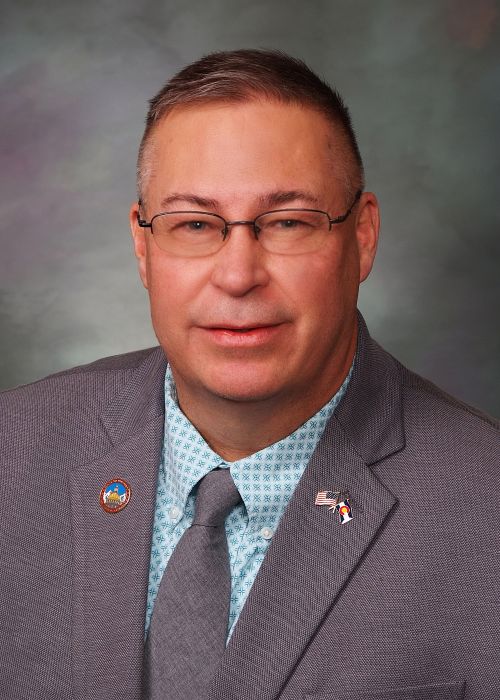
Rep. Chris Richardson
Sponsored bills
Maddy summaryThis is a ceremonial resolution (not a policy bill) designating September 14-20, 2025, as "Co-Responder Units and Behavioral Health Crisis Professionals Week" in Colorado. It honors professionals who work alongside law enforcement in crisis situations involving mental health or substance use, recognizing their role in de-escalating emergencies and connecting individuals to resources like counseling and housing. The resolution expresses legislative appreciation for their service but does not create new laws, funding, or policy changes.
The bill clarifies that a public entity is not required to pay any portion of the civil judgment or settlement if the peace officer's underlying conduct resulted in the peace officer's criminal conviction, unless the public entity played a causal role in the violation.(Note: This summary applies to this bill as introduced.)
Maddy summaryThis procedural resolution designates February 4 of each year as "Missing Persons Day" in Colorado. It formally recognizes the issue of missing persons through state-wide awareness, encouraging public support for families and law enforcement efforts without creating new legal requirements or funding. The resolution aligns with Colorado's existing AMBER Alert and Missing Indigenous Person Alert programs.
The secretary of state must maintain the computerized statewide voter registration list on as current a basis as possible, including in a manner that ensures that the names of electors who are not eligible to vote are removed from the list. In furtherance of this responsibility, the department of state regularly and securely exchanges information with the department of revenue (DOR), the department of public health and environment (CDPHE), and the department of corrections (DOC) to enable the transfer and verification of voter registration information. Section 1 of the bill requires that, on and after July 1, 2025, the secretary of state, on behalf of the department of state, modify its agreements with DOR, CDPHE, and DOC to expressly include access to any available citizenship-related information in the databases already subject to shared access between the department of state and DOR, CDPHE, and DOC, respectively. Section 2 requires the executive director of DOR to furnish 2 separate quarterly reports to the secretary of state of all persons who are not citizens based on: Information contained in the database of the division of motor vehicles subject to the existing sharing agreement with the department of state as modified in section 1; and Information obtained from the federal commissioner of social security and required to be made accessible to the department of state for verification of a person's name, date of birth, and the last 4 digits of the person's social security number. Section 2 requires the executive directors of CDPHE and DOC, respectively, to furnish the same type of quarterly report to the secretary of state based on the information in the databases of CDPHE and DOC subject to existing information-sharing agreements with the department of state and as modified in section 1. Section 2 also requires the state court administrator to provide the secretary of state with a quarterly report of all persons who report as ineligible to serve as a trial or grand juror because they are not citizens. Section 2 requires the secretary of state to forward quarterly to each county clerk and recorder the information received from the executive directors of DOR, CDPHE, DOC, and the state court administrator, and requires a county clerk and recorder to cancel the voter registration of any elector who is not a citizen according to the information received from the secretary of state. Additionally, the secretary of state may electronically cancel the voter registration of any elector who is not a citizen and who the secretary of state has received notice of from the executive directors of DOR, CDPHE, or DOC, or the state court administrator.(Note: This summary applies to this bill as introduced.)
Maddy summaryThis bill designates Monday, January 27, 2025, as "Colorado 4-H Day" to recognize the Colorado 4-H Youth Development program. It is a symbolic resolution honoring 4-H's work with youth aged 5-19, including its role in community engagement, leadership development, and STEM education through Colorado State University Extension. The resolution has no legal effect or new requirements - it simply encourages public acknowledgment of the program. (HJR 25-1006, passed by both chambers on January 27-30, 2025)
Maddy summaryThis bill (HJR 25-1007) is a commemorative resolution designating a specific segment of Interstate 25 in Colorado - southbound from mile marker 199.4 and northbound from mile marker 194.8 - as the "Firefighters Memorial Hwy in Memory of Chief Troy Jackson." It honors Troy Jackson, a 30-year firefighter with South Metro Fire Rescue who developed cancer prevention programs for first responders before passing in 2019. The resolution allows the Colorado Department of Transportation to accept donations for signage and coordinate with Arapahoe and Douglas counties for sign maintenance. As a naming resolution, it has no policy or funding changes beyond this memorial designation.
The bill increases the maximum number of transportation planning regions of the state from 15 to 16. This increase in the maximum number of transportation planning regions results in the potential membership of the statewide transportation advisory committee also increasing by one member, from 17 to 18 members. (Note: This summary applies to this bill as introduced.)
The bill repeals standards created in House Bill 20-1343, enacted in 2020, regarding confinement standards for egg-laying hens whose eggs are sold. (Note: This summary applies to this bill as introduced.)
Maddy summaryHJR 25-1003 is a procedural resolution that schedules a joint session of the Colorado General Assembly for January 16, 2025, to hear a message from representatives of the Ute Mountain Ute Tribe and Southern Ute Indian Tribe tribal councils. It directs the appointment of a committee consisting of three House members and three Senate members to escort tribal representatives to the session. The resolution does not create new laws or alter policies but formalizes a ceremonial meeting to recognize the tribes' historical and cultural contributions to Colorado. This is a standard procedural step for legislative recognition events, not a substantive policy change.