

The act prevents a pharmacy benefit manager (PBM) from prohibiting a rural independent pharmacy from using a private courier or a delivery service to deliver a prescription drug to a patient. A PBM is required to reimburse a rural independent pharmacy for a prescription drug in an amount not less than the national average drug acquisition cost for the dispensed prescription drug ingredients, plus pay a dispensing fee. When a PBM conducts an audit of a rural independent pharmacy and the audit results in a recoupment of more than $1,000 or a penalty of more than $1,000, the PBM must: Electronically notify the rural independent pharmacy of the rural independent pharmacy's rights to appeal at least 30 days before the recoupment of funds; If the rural independent pharmacy does not respond to the electronic notification within 30 days after the electronic notification, again electronically notify the rural independent pharmacy of the rural independent pharmacy's rights to appeal at least 30 days before the recoupment of funds; and If the rural independent pharmacy does not respond to the second electronic notification within 30 days after the second electronic notification, serve process on the rural independent pharmacy notifying of the rural independent pharmacy's rights to appeal at least 30 days before the recoupment of funds. The act allows a rural independent pharmacy to operate without being under the direct charge of a pharmacist if the initial interpretation and final evaluation of the prescription is done by a state-licensed pharmacist in person or remotely. (Note: This summary applies to this bill as enacted.)
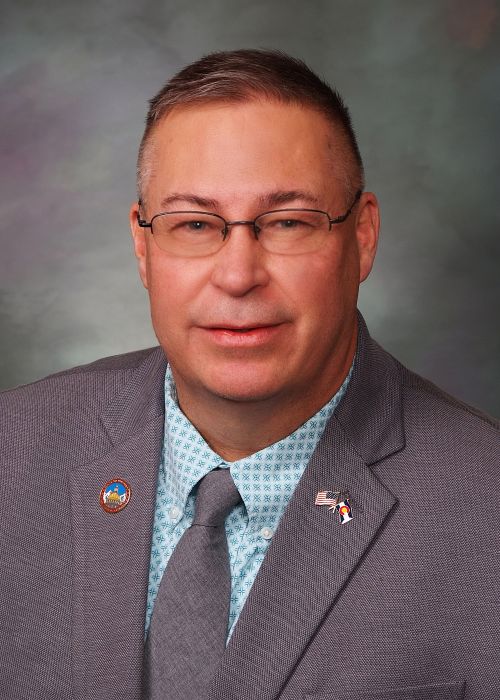
Rep. Chris Richardson
Sponsored bills
The act authorizes the department of health care policy and financing (HCPF) to seek and accept gifts from private or public sources for the primary care fund. The act authorizes a federally qualified health center (FQHC) to establish a separate subsidiary company for the purpose of providing fee-for-service services outside of the FQHC's standard cost report if the subsidiary is providing fee-for-service services that have historically been provided and reimbursed on a fee-for-service basis and if HCPF determines that the subsidiary's reimbursements would be budget neutral. Upon receiving any necessary federal authorization, HCPF is required to reimburse a subsidiary of an FQHC on a fee-for-service basis for services that are eligible for fee-for-service reimbursement. A subsidiary that receives reimbursement is authorized to pass through money received from the reimbursement directly to the FQHC operating as the subsidiary's parent corporation. Services reimbursed to an FQHC's subsidiary are excluded from the FQHC's cost report. The act requires HCPF to exclude all costs associated with a subsidiary company from the calculation of a FQHC's reimbursement rates and requires a FQHC that establishes a separate subsidiary company to include the costs associated with the subsidiary in its cost report that is necessary to calculate reimbursement rates. (Note: This summary applies to this bill as enacted.)
The act appropriates the following amounts for the 2025-26 state fiscal year from the Colorado water conservation board (CWCB) construction fund to the CWCB or the division of water resources in the department of natural resources for the following projects: Continuation of the satellite monitoring system, $380,000 (section 1 of the act); Continuation of the floodplain map modernization program, $500,000 (section 2); Continuation of the weather modification permitting program, $500,000 (section 3); Continuation of the Colorado Mesonet project, $200,000 (section 5); Continuation of the water forecasting partnership project, $2,000,000 (section 6); Continuation of the Arkansas river decision support program, $300,000 (section 7); Continuation of technical assistance for the federal irrigation improvement cost-sharing program, $500,000 (section 8); Decision support systems model enhancements to support the Colorado water plan, $1,000,000 (section 9); Support for the basin implementation plan analysis and updates, $4,500,000 (section 10); Continuation of the Colorado watershed restoration and wildfire ready watershed programs, $5,000,000 (section 11); Support for a statewide turf analysis, $1,400,000 (section 12); Support for the Yampa river and Walton creek confluence restoration project, $2,000,000 (section 14); and Support for the south fork focus zone irrigated acreage retirement, $6,000,000 (section 15). Section 4 directs the state treasurer to transfer up to $2,000,000 from the CWCB construction fund to the CWCB litigation fund on July 1, 2025. Section 13 directs the state treasurer to transfer $500,000 from the CWCB construction fund to the plant health, pest control, and environmental protection cash fund on July 1, 2025, and makes an appropriation of that amount to the department of agriculture for use by the conservation services division for the Colorado soil health program. Section 16 authorizes the CWCB to make a loan in an amount of $12,978,500 from the severance tax perpetual base fund to the North Poudre Irrigation Company to support the park creek expansion project. Section 17 appropriates $29,200,000 from the water plan implementation cash fund to the CWCB to award grants that will help implement the state water plan. Sections 18, 19, 20, and 21 eliminate the office of water conservation under the CWCB and the water efficiency grant program, transfer remaining money from the water efficiency grant program cash fund to the severance tax perpetual base fund, and make conforming amendments accordingly. Current law authorizes the governor to appoint a director of compact negotiations. Section 22 states that the governor or the executive director of the department of natural resources shall appoint the director of compact negotiations within 30 days after a vacancy of the position. (Note: This summary applies to this bill as enacted.)
The bill creates the fallen firefighter special license plate. An applicant becomes eligible to use the plate by providing a certificate to the department of revenue (department) confirming that the applicant has made a donation to a nonprofit organization (organization) chosen by the department based on the organization's provision of services to the families of firefighters who have been killed in the line of duty. In addition to the normal fees for a license plate, a person must pay 2 additional one-time fees in the amount of $25, one of which is credited to the highway users tax fund and the other to the Colorado DRIVES vehicle services account. (Note: This summary applies to this bill as introduced.)
For construction of multifamily, attached housing of 2 or more units, the act creates the multifamily construction incentive program (program). A builder may chose to participate in the program by: Providing a warranty that covers any defect and damage at no cost to the homeowner for specified periods; Having a third-party inspection performed on the property; and Recording a notice of election to participate in the program in the real property records before the property is offered for sale. For construction defect claims brought for the construction of housing for which the builder is a participant in the program, the act: Requires a claimant to file a certificate of review with the complaint, if the complaint is against an architect or engineer; Limits actions to claims that have resulted in: Actual damage to real or personal property; actual loss of the use of real or personal property; actual bodily injury or wrongful death; an unreasonable reduction in the capability of, or an actual failure of, a building component to perform an intended function or purpose; or an unreasonable risk of bodily injury or death to, or a threat to the life, health, or safety of, the occupants of the residential property; and Requires that a construction professional must send or deliver to the claimant an offer to settle the claim or a written response that identifies the standards that apply to the claim and explains why the defect does not require repair. For all construction defect claims, the act: Establishes a claimant's duty to mitigate an alleged construction defect and specifies how a claimant may satisfy this duty and the consequences to a claimant that fails to satisfy this duty; Requires a construction professional who is the defendant in a construction defect action to submit specified information to the claimant; Prohibits an insurer from cancelling, denying, or reducing coverage based on any claim for benefits covered by an existing liability insurance policy issued to a construction professional based on the construction professional's offer to repair or settle a construction defect claim; Tolls the statute of limitations or repose during a claimant's mitigation of an alleged construction defect; Increases the percentage of owners that an executive board of a unit owners' association (executive board) must obtain approval from before initiating a construction defect claim on behalf of the owners from a majority to 65%; and Requires an executive board that is successful in a construction defect claim or settlement to first use the net monetary damages or net proceeds received as a result of the claim to repair the construction defect. The act requires a local government to establish a fast-track approval process for an application for for-sale multifamily condominium projects in order to qualify for assistance from the state affordable housing fund. (Note: This summary applies to this bill as enacted.)
Maddy summaryHJR 25-1028 designates Friday, April 25, 2025, as "Sportsmen's Day" in Colorado. This resolution aims to recognize the contributions of Colorado's sportsmen and women to conservation efforts and the state's economy. It also encourages members of the General Assembly to join the Colorado Legislative Sportsmen's Caucus and urges public and private institutions to work with the caucus.
Maddy summaryHouse Joint Resolution 25-1027 designates a specific portion of Colorado State Highway 1 in Larimer County, from East County Road 60 to Interstate 25, as the "Commissioner Lew Gaiter III Memorial Highway." It authorizes the Colorado Department of Transportation (CDOT) to accept donations for the initial placement of signs and to explore a cooperative agreement with Larimer County for sign maintenance.
Maddy summaryHouse Joint Resolution 25-1030 expresses the State of Colorado's strong opposition to the use of forced labor in the production of goods. The resolution states that Colorado will use its purchasing power to support businesses that ethically source or manufacture products without forced labor. It also encourages state and local economic development offices to attract businesses that avoid these labor practices. This joint resolution aims to influence state and local government purchasing decisions and promote ethical business standards.
Maddy summaryHJR 25-1026 designates Colorado State Highway 402, from United States Highway 287 to Interstate 25, as the "Rep. Hugh McKean Memorial Highway." It also authorizes the Colorado Department of Transportation (CDOT) to accept donations for the initial placement of signs and to explore agreements with Larimer County for sign maintenance.
Maddy summarySenate Joint Resolution 25-015 designates a specific portion of Colorado State Highway 58 as the "Officer Evan A. Dunn Memorial Highway." This action honors Officer Evan A. Dunn, a Golden Police Department officer who died in the line of duty. The bill authorizes the Colorado Department of Transportation to accept donations for the initial placement of memorial signs and to explore a cooperative agreement with the City of Golden for their maintenance.