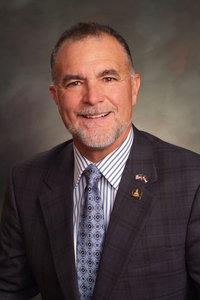
Photo of Yeulin Willett
R Colorado House · District 54

Rep. Yeulin Willett

Compare
Total votes
1,196
all sessions
Attendance
98%
14 missed
Near the chamber average
With party
88%
of cast votes
Lower than 78% of chamber peers
Bipartisan score
7%
crosses aisle rarely
Higher than 75% of chamber peers
Sponsored
36
bills & resolutions
Near the chamber average
Committees
0
assignments
36 bills and resolutions

Sponsored bills

Total
36
Primary
36
Co-sponsor
0
This page
36
matching current filters
Primary SB 18-194
In committee · Colorado Senate · Lead sponsor
Contributions Colorado Natural Resources Foundation Fund

Current law allows the department of natural resources to receive or reject gifts and devises of money or property. The bill allows the department of natural resources and each of its divisions to receive or reject gifts, grants, donations, and devises of money or property. (Note: This summary applies to this bill as introduced.) , Read More

In committee Mar 13, 2018 0 co-sponsors
Primary SB 18-030
Signed into law · Colorado Senate · Lead sponsor
Relocate Auto Industry Division To Title 44

Committee on Legal Services. Current law directs the office of legislative legal services to study the organizational recodification of title 12 of the Colorado Revised Statutes, which relates to professions and occupations. One recommendation of the study is to relocate laws located in title 12 that are administered by the department of revenue to a new title 44, which will consist solely of laws administered by the department of revenue that regulate a variety of activities. To implement this recommendation, section 1 of the bill creates title 44 and section 2 relocates laws related to the sale of motor vehicles and powersports vehicles from article 6 of title 12 to article 20 of title 44. Section 3 relocates part 4 of article 6 of title 12 related to event data recorders to part 24 of article 4 of title 42. Section 4 repeals the article where these laws were previously codified.(Note: This summary applies to the reengrossed version of this bill as introduced in the second house.) , Read More

Signed into law Mar 1, 2018 0 co-sponsors
Primary SB 18-029
In committee · Colorado Senate · Lead sponsor
Development of Marijuana Tracking Technology

The bill requires the institute of cannabis research at Colorado state university - Pueblo (institute) to develop marijuana tracking technology (technology). The technology must include an agent that is applied to a marijuana plant, marijuana product, industrial hemp, or industrial hemp product and then scanned by a device. The scan, at a minimum, would indicate whether the marijuana or hemp was cultivated, manufactured, or sold by a licensed marijuana business or registered hemp cultivator. The institute shall select a vendor to develop the technology. After the technology is developed, the state licensing authority must be satisfied that the technology provides an effective means of tracking marijuana. After the state licensing authority determines the technology is an effective means of tracking marijuana, it shall promulgate rules that require the technology to be used by licensed marijuana businesses, and the commissioner of the department of agriculture shall promulgate rules that require registered industrial hemp cultivators to use the technology. The technology that scans the marijuana must be made available to law enforcement and the department of revenue. The bill clarifies that the gray and black market marijuana enforcement grant program could award grants to law enforcement agencies to purchase the marijuana scanning technology. (Note: This summary applies to this bill as introduced.) , Read More

In committee Feb 7, 2018 0 co-sponsors
Primary SB 17-126
Signed into law · Colorado Senate · Lead sponsor
Domestic Violence Fatality Review Board

The bill creates the Colorado domestic violence fatality review board (board) in the department of law (department). The review board includes the attorney general or his or her designee, who acts as chair, and at least 17 other members, to be appointed by the attorney general. The review board shall: Coordinate with local and regional domestic violence review teams (review teams) to collect data; Review and analyze the data; and Prepare recommendations for the general assembly. The board shall submit a written report of its recommendations to the health and human services and judiciary committees of the senate and the public health care and human services and judiciary committees of the house of representatives on or before December 1, 2018, and on or before December 1 each year thereafter through December 1, 2021. The report may include, but is not limited to the following: Recommendations for improving communication between public and private organizations and agencies; The number of domestic violence fatalities and near-death incidents that occurred in each county during the preceding year and the factors associated with each fatality; Recommendations for reducing the incidence of domestic violence in the state, and for improving responses to domestic violence incidents by the legal system and by communities; and Recommendations directed at primary prevention of domestic violence. A city, county, or district court may establish a review team to review fatal and near-fatal incidents of domestic violence, related domestic violence matters, and suicides related to domestic abuse. Each review team shall collect data and report it to their communities and to the review board. A local or regional child fatality prevention review team may operate as a domestic violence review team. The bill creates the Colorado domestic violence review board cash fund (fund) and authorizes the department and the review board to seek, accept, and expend gifts, grants, and donations to the fund from private or public sources. The board is repealed, effective September 1, 2022. Before the repeal, the review board shall be reviewed by the department of regulatory agencies. (Note: This summary applies to the reengrossed version of this bill as introduced in the second house.)


Signed into law Jun 8, 2017 0 co-sponsors
Primary HB 17-1221
Signed into law · Colorado House · Lead sponsor
Grey And Black Market Marijuana Enforcement Efforts

Committee on Cost-benefit Analysis of Legalized Marijuana in Colorado. The state constitution grants a person the authority to assist another person in cultivating medical and recreational marijuana plants. The bill states that a person is not in compliance with the authority to assist another individual and is subject to marijuana cultivation criminal offenses and penalties if the person possesses any marijuana plant that he or she is growing on behalf of another individual, unless he or she is the primary caregiver for the individual and is in compliance with the requirements of section 25-1.5-106. The bill creates the gray and black market marijuana enforcement grant program (grant program) in the division of local government in the department of local affairs (division). The grant program awards grants to local governments to reimburse the local governments, in part or in full, for law enforcement and prosecution costs associated with gray and black marijuana markets. A rural local government has priority in receiving grants. The general assembly may appropriate money from the marijuana tax cash fund or the proposition AA refund account to the division for the grant program. The bill appropriates $5,945,392 from the marijuana tax cash fund to the division to fund the grant program. The division shall adopt policies and procedures for the administration of the grant program, including rules related to the application process and the grant award criteria. The division shall include information regarding the effectiveness of the grant program in its SMART presentation beginning in November 2019. (Note: This summary applies to the reengrossed version of this bill as introduced in the second house.)
Signed into law Jun 8, 2017 0 co-sponsors
Primary HB 17-1302
Signed into law · Colorado House · Lead sponsor
Juvenile Sexting Crime

The bill creates the criminal offense of posting a private image by a juvenile. The offense can be committed in 2 ways. The first way is if a juvenile, through digital or electronic means, knowingly distributes, displays, or publishes to the view of another person a sexually explicit image of a person other than himself or herself who is at least 14 years of age or is less than 4 years younger than the juvenile: Without the depicted person's permission; or When the recipient did not solicit or request to be supplied with the image and suffered emotional distress; or When the juvenile knew or should have known that the depicted person had a reasonable expectation that the image would remain private. The second way is if the juvenile knowingly distributes, displays, or publishes, to the view of another person who is at least 14 years of age or is less than 4 years younger than the juvenile, a sexually explicit image of himself or herself when the recipient did not solicit or request to be supplied with the image and suffered emotional distress. The offense is a class 2 misdemeanor; except that it is a class 1 misdemeanor if: The juvenile committed the offense with the intent to coerce, intimidate, threaten, or otherwise cause emotional distress to the depicted person; or The juvenile had previously posted a private image and completed a diversion program or education program for the act pursuant to the provisions of the bill or had a prior adjudication for posting a private image by a juvenile; or The juvenile distributed, displayed, or published 3 or more images that depicted 3 or more separate and distinct persons. The bill creates the criminal offense of possessing a private image by a juvenile that prohibits a juvenile, through digital or electronic means, from knowingly possessing a sexually explicit image of another person who is at least 14 years of age or is less than 4 years younger than the juvenile without the depicted person's permission. It is not an offense if the juvenile: Took reasonable steps to either destroy or delete the image within 72 hours after initially viewing the image; or Reported the initial viewing of such image to law enforcement or a school resource officer within 72 hours after initially viewing the image. The offense is a petty offense; except that it is a class 2 misdemeanor if the unsolicited possessor of the image possessed 10 or more separate images that depicted 3 or more separate and distinct persons. The bill creates a civil infraction of exchange of a private image by a juvenile if a juvenile, through digital or electronic means: Knowingly sends a sexually explicit image or images of himself or herself to another person who is at least 14 years of age or is less than 4 years younger than the juvenile, and the image or images depict only the sender and no other person and the sender reasonably believed that the recipient had solicited or otherwise agreed to the transmittal of the image or images; or Knowingly possesses a sexually explicit image or images of another person who is at least 14 years of age or is less than 4 years younger than the juvenile, and the image or images depict only the sender and no other person and the juvenile reasonably believed that the depicted person had transmitted the image or images or otherwise agreed to the transmittal of the image or images. The civil infraction can be punished by participation in a program designed by the school safety resource center or other appropriate program addressing the risks and consequences of exchanging a sexually explicit image of a juvenile or a fine of up to $50, which may be waived by the court upon a showing of indigency. If a juvenile's conduct is limited to the elements of the petty offense of possession of a private image by a juvenile or limited to the elements of the civil infraction of exchange of a private image by a juvenile, then the juvenile cannot be charged with sexual exploitation of a child. If a juvenile is charged with posting a private image by a juvenile, he or she cannot be charged with sexual exploitation of a child. The bill allows a juvenile to petition the court to not impose sex offender registration if he or she is charged with sexual exploitation of a child and the juvenile's conduct satisfies posting a private image by a juvenile or possession of a private image by a juvenile. It is an affirmative defense to the two criminal offenses and the civil infraction if a juvenile is coerced, threatened, or intimated into distributing, displaying, publishing, possessing, or exchanging a sexually explicit image of a person under 18 years of age. The court must order the records of any of the 2 criminal offenses or civil infraction expunged within 42 days of completion of the sentence or program. The bill requires the school safety resource center to make available a sexting curriculum for school districts to use. (Note: This summary applies to the reengrossed version of this bill as introduced in the second house.)

Signed into law Jun 6, 2017 0 co-sponsors
Primary SB 17-222
Signed into law · Colorado Senate · Lead sponsor
Relocate Title 12 Fireworks

Committee on Legal Services. Current law directs the office of legislative legal services to study the organizational recodification of title 12 of the Colorado Revised Statutes, which relates to professions and occupations. To implement the initial recommendations of the study, section 1 of the bill relocates article 28 of title 12, which relates to fireworks, to a new part 20 of article 33.5 of title 24, which title pertains to the department of public safety. Section 8 repeals the article in title 12 where these laws were previously codified, and sections 2 through 7 make conforming amendments.(Note: This summary applies to the reengrossed version of this bill as introduced in the second house.)

Signed into law May 25, 2017 0 co-sponsors
Primary SB 17-225
Signed into law · Colorado Senate · Lead sponsor
Relocate Title 12 Farm Products And Warehouses

Committee on Legal Services. Current law directs the office of legislative legal services to study the organizational recodification of title 12 of the Colorado Revised Statutes, which relates to professions and occupations. To implement the initial recommendations of the study, the bill relocates the following laws: Part 2 of article 16 of title 12, the 'Commodity Handler Act', to article 36 of title 35 ( section 1 of the bill); and Part 1 of article 16 of title 12, the 'Farm Products Act', to article 37 of title 35 ( section 2 of the bill). Section 10 of the bill repeals the article where these laws were previously codified, and sections 3 through 9 make conforming amendments.(Note: This summary applies to the reengrossed version of this bill as introduced in the second house.)

Signed into law May 25, 2017 0 co-sponsors
Primary HB 17-1243
Signed into law · Colorado House · Lead sponsor
Relocate Title 12 Wholesale Sales Representatives

Committee on Legal Services. Current law directs the Office of Legislative Legal Services to study the organizational recodification of title 12 of the Colorado Revised Statutes, which relates to professions and occupations. To implement the initial recommendations of the study, section 1 of the bill relocates article 66 of title 12, which relates to wholesale sales representatives, to title 13. Section 2 repeals the article where this law was previously codified.(Note: This summary applies to the reengrossed version of this bill as introduced in the second house.)

Signed into law May 25, 2017 0 co-sponsors
Primary HB 17-1113
Signed into law · Colorado House · Lead sponsor
Allow Electronic Committee Participation During Interim

The bill gives the executive committee of the legislative council the ability to consider, recommend, and establish policies regarding electronic participation by senators or representatives in committee meetings during the legislative interim. (Note: This summary applies to the reengrossed version of this bill as introduced in the second house.)

Signed into law May 24, 2017 0 co-sponsors
Showing 11 to 20 of 36 bills
Previous 1 2 3 … 4 Next