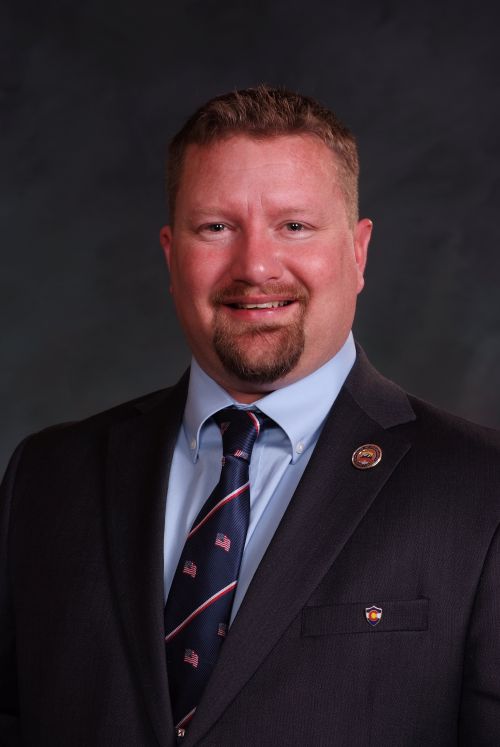
Photo of Ron Weinberg
R Colorado House · District 51

Rep. Ron Weinberg

Compare
Total votes
3,548
all sessions
Attendance
98%
65 missed
Near the chamber average
With party
84%
of cast votes
Lower than 91% of chamber peers
Bipartisan score
9%
crosses aisle rarely
Higher than 90% of chamber peers
Sponsored
223
bills & resolutions
Lower than 77% of chamber peers
Committees
5
assignments
223 bills and resolutions

Sponsored bills

Total
223
Primary
85
Co-sponsor
138
This page
223
matching current filters
Co-sponsor HJR 1032
Passed · Colorado House · Co-sponsor
Notify Governor of Adjournment

Maddy summaryThis bill establishes a joint committee of five legislators to inform the Governor that the current legislative session is about to end. The committee, composed of three House members and two Senate members, will also ask the Governor if he has any final messages for the assembly. Although the bill was introduced in 2026, it was ultimately not passed as the Senate laid it on the table. Its primary function is a procedural step to ensure proper communication between the legislature and the executive branch at the conclusion of a session.

Passed May 22, 2026 1 co-sponsor
Co-sponsor SB 182
Signed into law · Colorado Senate · Co-sponsor
Updated Clean Energy Plan Municipally Owned Utility

Current law requires certain entities to file, or allows certain entities to voluntarily file, a clean energy plan to achieve an 80% reduction in greenhouse gas emissions caused by the entity's electricity sales in Colorado by 2030, relative to 2005 levels (2030 emission reductions).     The act repeals current law stating that clean energy plans submitted by a cooperative electric association or a municipally owned utility under certain circumstances are deemed approved by the public utilities commission (commission) and requiring the division of administration in the department of public health and environment (division) to consult with the commission in verifying a clean energy plan submitted by a cooperative electric association or a municipally owned utility. The act also repeals current law stating that voluntary submission of a clean energy plan by a cooperative electric association or a municipally owned utility does not alter the entity's regulatory status with respect to the commission.     A municipally owned utility that has encountered challenges in achieving the 2030 emission reductions may submit to the division, no later than December 31, 2026, an updated clean energy plan that demonstrates achievement of the 2030 emission reductions by the earliest date possible on or after December 31, 2029, but no later than December 31, 2032.     A municipally owned utility that submits an updated clean energy plan to the division must:Provide a detailed generation and transmission plan to the division with the updated clean energy plan;Provide an annual report to the division beginning January 1, 2028, and continuing each year until December 31, 2033, that contains certain information related to the updated clean energy plan;Cease burning coal by December 31, 2032; andSeek to achieve certain additional reductions in greenhouse gas emissions without impairing the municipally owned utility's ability to maintain certain electric reliability standards.     The updated clean energy plan must be verified by the division.(Note: This summary applies to this bill as enacted.)

Signed into law May 21, 2026 1 co-sponsor
Co-sponsor SB 101
Signed into law · Colorado Senate · Co-sponsor
Local Government Landfill Methane Emission Reduction Regulations

The act:Allows the department of public health and environment (department) to expend money from the community impact cash fund to provide grants for municipal solid waste landfill methane emission reduction projects;Requires the environmental justice advisory board to prioritize a grant request from a local government that owns or operates a municipal solid waste landfill over a grant request from a private entity that owns or operates a municipal solid waste landfill;Requires an entity that receives money from the department to use the money as supplemental funding only; andAmends the definition of 'disproportionately impacted community'.(Note: This summary applies to this bill as enacted.)

Signed into law May 21, 2026 1 co-sponsor
Co-sponsor SB 144
Signed into law · Colorado Senate · Co-sponsor
Modify Property Tax Lien Sales Treasurer Deeds & Fees

The act modifies the fees of county treasurers by specifying fee amounts treasurers are required or allowed to collect in connection with the public auction and related proceedings for issuance of a treasurer's deed. Commencing on or before December 31, 2026, and every second year thereafter, the act requires an upward adjustment of the maximum dollar amount of all treasurer fees.     The act make technical modifications to the provisions governing county treasurer tax lien sales for the collection of delinquent property taxes. It clarifies certain definitions and standardizes the use of defined terms. The act also modifies certain provisions and repeals obsolete provisions in conformity with the new process to obtain a treasurer's deed for a property subject to a tax lien.     Additionally, the act repeals and reenacts, with changes, the public auction process established in 2024 that is required prior to the issuance of a treasurer's deed to protect against an unconstitutional taking of a taxpayer's property or property value, in excess of their tax debt. The act models the public auction process on the public trustee foreclosure process. The act creates new definitions and modifies and expands the provisions for a public auction, including related rights, limitations, and records. The modified process applies to a treasurer's deed issued on or after June 1, 2026, regardless of the date of the tax lien sale, application for treasurer's deed, or commencement of any related proceeding.(Note: This summary applies to this bill as enacted.)


Signed into law May 19, 2026 1 co-sponsor
Co-sponsor SB 95
Signed into law · Colorado Senate · Co-sponsor
Measures to Support Victim-Survivors of Crimes

The act requires a licensee, nurse, or certified midwife who performs a medical forensic examination to inform the victim-survivor about how to determine when the testing related to the examination is complete and how to obtain the results and records.     The act subjects a cause of action against a person arising from any protected statement by a victim-survivor to a special motion to dismiss unless the court determines that the plaintiff has established that there is a reasonable likelihood that the plaintiff will prevail on the claim.     The act makes a predispute arbitration agreement and predispute joint-action waiver void and unenforceable upon request of an individual who alleges conduct that results in a sexual harassment dispute or a sexual misconduct dispute or upon request of a named representative of a joint action, class action, or collective action that results in a sexual harassment dispute or a sexual misconduct dispute.     The act requires a judge to allow a forensic scientist to testify remotely in a criminal proceeding if a party requests and both parties consent to the remote testimony.     The act authorizes the court to order that the testimony of a victim-survivor of domestic violence, unlawful sexual behavior, stalking, human trafficking for involuntary servitude, or human trafficking for sexual servitude be taken in a room other than the courtroom and be televised by closed-circuit television in the courtroom under certain circumstances.     The act requires peace officer annual in-service training programs to include a 2-hour training to improve a peace officer's understanding of the impact of trauma on victim-survivors of crimes and the optimal way for a peace officer to respond to victim-survivors who are experiencing trauma and includes trauma-informed investigation and response training as a permissible use of peace officer training and support fund money.     The act renames the Colorado sexual assault forensic medical evidence review board as the Colorado sexual assault response review board and adds 4 members to the board.(Note: This summary applies to this bill as enacted.)
Signed into law May 19, 2026 1 co-sponsor
Co-sponsor SJR 25
Passed · Colorado Senate · Co-sponsor
Colorado Mining Association's 150th Anniversary

Maddy summaryThis bill is a Senate Joint Resolution that formally recognizes the Colorado Mining Association for its 150th anniversary in 2026. It highlights the organization's historical significance and its role in supporting Colorado's mining industry, which contributes billions to the state's economy and supports tens of thousands of jobs. The resolution acknowledges the association's partnerships with state and federal agencies in promoting safety, environmental stewardship, and responsible mineral development. This measure does not change any laws or policies but serves as an official acknowledgment of the association's contributions to Colorado's history and economy.

Passed May 13, 2026 1 co-sponsor
Co-sponsor SB 122
Signed into law · Colorado Senate · Co-sponsor
Fuel Standards & Liability of Petroleum Storage Tank Fund

Under current law, the maximum amount of liability of the petroleum storage tank fund for an individual occurrence of a leak, spill, or release of a petroleum product from an underground storage tank (occurrence) is $2,000,000. The act allows an owner or operator of an underground or aboveground storage tank (owner or operator) to exceed this amount of liability with the permission of the director of the division of oil and public safety (director) and the petroleum storage tank committee (committee). If the director and the committee grant such permission, the director and committee shall establish a new maximum amount of liability per occurrence for the owner or operator.     Under current law, all class I, II, and III liquid fuel products must comply with the most current applicable standards of ASTM International. The act allows the director to adopt a rule or issue policy guidance that provides exceptions to specific requirements established in an ASTM standard.(Note: This summary applies to this bill as enacted.)

Signed into law May 5, 2026 1 co-sponsor
Co-sponsor HB 1297
Signed into law · Colorado House · Co-sponsor
Uniform Language for Misdemeanor Traffic Offense

In existing law, both 'misdemeanor traffic offense' and 'traffic misdemeanor' are used to describe the same type of traffic offense. The act amends instances of 'traffic misdemeanor' to make 'misdemeanor traffic offense' the uniform term used throughout statute.(Note: This summary applies to this bill as enacted.)

Signed into law May 5, 2026 1 co-sponsor
Co-sponsor HB 1238
Signed into law · Colorado House · Co-sponsor
Designating Emergency Medical Services Essential Services

The act declares emergency medical services as an essential service in the state and an integral part of the state's health-care infrastructure.      The act also declares that emergency medical service providers, whether responding on duty or as a volunteer and regardless of location, provide essential services when providing emergency ambulance services and nonemergency ambulance services.      The act also updates certain definitions related to emergency medical services, including the addition of a definition of 'out-of-hospital services', which term is defined to mean the furnishing of necessary health-care goods and services outside of a hospital setting but does not include prehospital setting transports.     The act clarifies that an off-duty emergency medical service provider is not obligated to respond to the scene of a medical emergency or provide emergency medical services.(Note: This summary applies to this bill as enacted.)

Signed into law May 5, 2026 1 co-sponsor
Co-sponsor SB 121
Signed into law · Colorado Senate · Co-sponsor
Overtime Threshold for Agricultural Employees

Beginning January 1, 2027, the act requires an agricultural employer to pay certain agricultural employees overtime pay for time worked in excess of 56 hours in a workweek. The act also increases penalties for an agricultural employer who commits wage theft and repeals the authority of the director of the division of labor standards and statistics to adopt rules concerning overtime pay for agricultural employees.(Note: This summary applies to this bill as enacted.)

Signed into law May 4, 2026 1 co-sponsor
Showing 31 to 40 of 223 bills
Previous 1 … 3 4 5 … 23 Next