

The bill grants a person who is at least 18 years of age and permitted to possess a handgun pursuant to federal and state law the same authority to carry a concealed handgun as a person who holds a permit to carry a concealed handgun (permit). A person who carries a concealed handgun without a permit has the same rights, limitations, and authority to carry as a person who holds a permit. A person may obtain a permit for the purpose of using the permit to carry a concealed handgun in another state that recognizes a Colorado permit. The bill makes the minimum age to obtain a permit 18 years of age. Under existing law, Colorado recognizes permits issued in other states that meet certain criteria, including that the holder of the out-of-state permit is at least 21 years of age. The bill changes the minimum age for recognition of an out-of-state permit to 18 years of age. Under existing law, a permit is valid for 5 years. The bill makes a permit valid for the life of the permit holder. Existing permits, other than temporary emergency permits, are converted to lifetime permits. Because the bill makes permits valid for the life of the holder, the bill repeals provisions relating to the renewal of permits. The bill repeals the temporary emergency permit to carry a concealed handgun. The bill repeals local government authority to regulate open or concealed carry of a handgun, including repealing the authority of special districts and the governing boards of institutions of higher education, as applicable. (Note: This summary applies to this bill as introduced.)
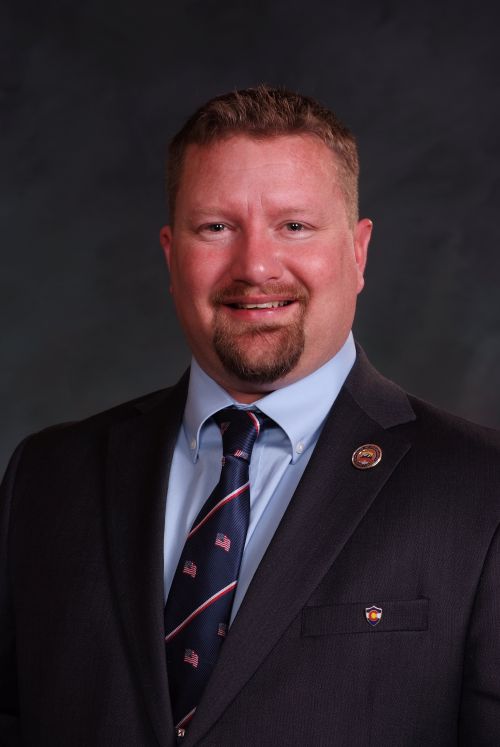
Sponsored bills
Maddy summaryThis is a ceremonial resolution (not a policy bill) designating September 14-20, 2025, as "Co-Responder Units and Behavioral Health Crisis Professionals Week" in Colorado. It honors professionals who work alongside law enforcement in crisis situations involving mental health or substance use, recognizing their role in de-escalating emergencies and connecting individuals to resources like counseling and housing. The resolution expresses legislative appreciation for their service but does not create new laws, funding, or policy changes.
The bill requires that causes of action for intentional or negligent acts constituting youth gender transition procedures performed on a youth under 26 years of age must be brought before the youth reaches 38 years of age. (Note: This summary applies to this bill as introduced.)
The bill clarifies that the existing naturopathic doctor formulary (existing formulary) includes prescription classes of medicines and clarifies what the practice of naturopathic medicine includes. In addition, the bill creates a new formulary for certain naturopathic doctors, which new formulary includes: All legend drugs, other than schedule I or II controlled substances or devices identified in the federal "Controlled Substances Act"; For a naturopathic doctor with a federal drug enforcement administration registration, anabolic steroids listed on schedule III of the "Uniform Controlled Substances Act of 2013"; and All drugs listed on schedules IV and V of the "Uniform Controlled Substances Act of 2013", except for benzodiazepines, oncological chemotherapeutics, and narcotics (new formulary). Before obtaining, dispensing, administering, injecting, ordering, or prescribing any of the medicines or devices included in the new formulary, a naturopathic doctor who is registered with the department of regulatory agencies (department) must provide proof of: Completion of 12 hours of pharmacological continuing education pertinent to or reflective of the naturopathic formulary; Passage of the elective pharmacology examination of the Naturopathic Physicians Licensing Examinations; or Licensure in good standing in another state that has equivalent prescribing authority. A naturopathic doctor who does not provide such proof is limited to the medicines and devices contained within the existing formulary. The bill prohibits a naturopathic doctor from prescribing: A medicine or device to an individual under 18 years of age; or Antipsychotics or ketamine to an individual of any age unless recommended by the naturopathic medicine advisory committee and approved by the director of the division of professions and occupations in the department (director). The bill requires an individual applying for issuance, renewal, or reinstatement of a registration as a naturopathic doctor on or after September 1, 2025, to pass a pharmacology examination administered by the North American Board of Naturopathic Examiners or a nationally recognized, director-approved successor entity. Upon passage of the exam, the individual is able to obtain, dispense, administer, inject, order, or prescribe any of the medicines or devices included in the new formulary. For the renewal of a naturopathic doctor's registration on or after June 1, 2026, the bill requires a naturopathic doctor to complete 8 hours per year of continuing education in pharmacology. Lastly, the bill prohibits a naturopathic doctor from administering intravenous therapy without first being certified by a nationally recognized, director-approved entity. (Note: This summary applies to this bill as introduced.)
Maddy summaryThis procedural resolution designates February 4 of each year as "Missing Persons Day" in Colorado. It formally recognizes the issue of missing persons through state-wide awareness, encouraging public support for families and law enforcement efforts without creating new legal requirements or funding. The resolution aligns with Colorado's existing AMBER Alert and Missing Indigenous Person Alert programs.
The bill creates the Colorado Eagles special license plate. To be issued a plate, an applicant must make a donation to the Colorado Eagles Charities, Inc., and pay the normal fees for a license plate plus 2 one-time fees of $25. One of the $25 fees is transferred to the highway users tax fund and the other is transferred to the Colorado DRIVES vehicle services account. (Note: This summary applies to this bill as introduced.)
Maddy summaryThis bill designates Monday, January 27, 2025, as "Colorado 4-H Day" to recognize the Colorado 4-H Youth Development program. It is a symbolic resolution honoring 4-H's work with youth aged 5-19, including its role in community engagement, leadership development, and STEM education through Colorado State University Extension. The resolution has no legal effect or new requirements - it simply encourages public acknowledgment of the program. (HJR 25-1006, passed by both chambers on January 27-30, 2025)
Maddy summaryThis bill (HJR 25-1007) is a commemorative resolution designating a specific segment of Interstate 25 in Colorado - southbound from mile marker 199.4 and northbound from mile marker 194.8 - as the "Firefighters Memorial Hwy in Memory of Chief Troy Jackson." It honors Troy Jackson, a 30-year firefighter with South Metro Fire Rescue who developed cancer prevention programs for first responders before passing in 2019. The resolution allows the Colorado Department of Transportation to accept donations for signage and coordinate with Arapahoe and Douglas counties for sign maintenance. As a naming resolution, it has no policy or funding changes beyond this memorial designation.
Wildfire Matters Review Committee. The bill requires the general assembly to appropriate $7,500,000 to the division of fire prevention and control (division) for state fiscal year 2024-25 and allows any unexpended portion of the appropriation to also be expended in state fiscal year 2025-26. The division is required to use the money to study and develop applications of artificial intelligence that predict, mitigate, or assist in fighting wildfires, including, at a minimum, applications of artificial intelligence which produce data that can be incorporated into maps displaying the following: Classification of vegetation and wildfire fuel; Predictions regarding the likelihood of wildfire ignition potential in a particular area following observed lightning events; The perimeter of an ongoing wildfire; and Predictions regarding the locations and area to which an ongoing wildfire may spread. The division may contract with a third party that has developed artificial intelligence tools to predict, mitigate, or assist in fighting wildfires. The division is also authorized to seek, accept, and expend gifts, grants, and donations for the purposes of the bill. (Note: This summary applies to this bill as introduced.)
The bill repeals standards created in House Bill 20-1343, enacted in 2020, regarding confinement standards for egg-laying hens whose eggs are sold. (Note: This summary applies to this bill as introduced.)