The act designates the Agaricus julius mushroom, commonly known as the Emperor mushroom, as the state mushroom of the state of Colorado. (Note: This summary applies to this bill as enacted.)
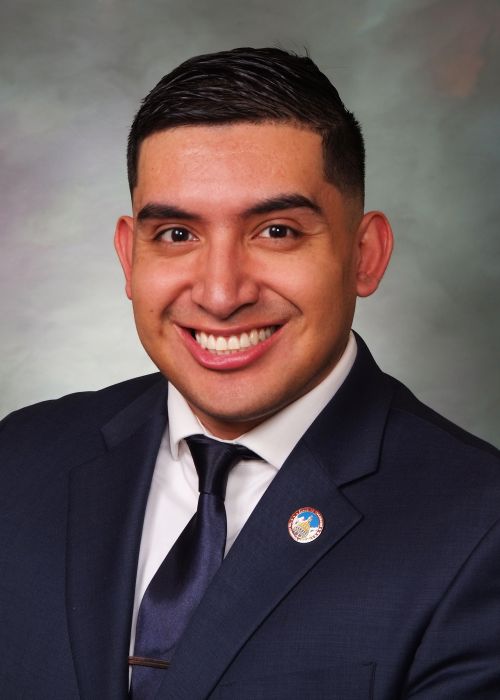
Rep. Ryan Gonzalez
Sponsored bills
The statutory definition of "clean energy" determines which energy projects are eligible for clean energy project financing at the county and city and county level. The statutory definition of "clean energy resource" determines which energy resources may be used by a qualifying retail utility to meet the 2050 clean energy target. The act updates the 2 statutory definitions to include nuclear energy; except that, for property valuations made for tax purposes, the act exempts from the definition of "clean energy resource" nuclear energy. (Note: This summary applies to this bill as enacted.)
Under current law, owners of certain large buildings (covered buildings) are required to annually collect and report each covered building's energy use to the Colorado energy office. The act clarifies that agricultural buildings are not covered buildings, and therefore, owners of agricultural buildings are exempt from the energy use collecting and reporting requirements. The act defines an agricultural building as a building or structure used to house agricultural implements, hay, unprocessed grain, poultry, livestock, or other agricultural products or inputs primarily for the purpose of maintaining or operating an agricultural process. Agricultural implements include certain agricultural equipment and do not include implements that are primarily for rent or sale. The act permits an owner of an agricultural building to submit for an affirmative exemption from any requirement to report benchmarking data and for an exemption to remain valid until there is a change in ownership or a change that renders the building no longer an agricultural building. For the duration of an exemption, the owner of an agricultural building is required to certify, upon request, the exemption status of an exempt building. (Note: This summary applies to this bill as enacted.)
The public employees' retirement association (PERA) board (board) conducts or causes to be conducted an actuarial experience study of PERA and a periodic actuarial audit of PERA. Both the actuarial experience study and the periodic actuarial audit, neither of which were referenced in law prior to passage of the act, are conducted approximately once every 5 years, but the timing of the actuarial experience study and the periodic actuarial audit is not aligned. The act requires the board to conduct or cause to be conducted the actuarial experience study every 4 years, beginning with the actuarial experience study that the board conducted in the 2024 calendar year, rather than every 5 years. In addition, the act requires the board to conduct or cause to be conducted the periodic actuarial audit of PERA in the 2026 calendar year and every 4 years thereafter , rather than every 5 years, and to ensure that each periodic actuarial audit takes into consideration the results and findings of the most recent actuarial experience study that was conducted or caused to be conducted by the board. For several years, the pension review commission has been required to commission an independent review of the economic and investment assumptions used to model PERA's financial situation. The act requires the commission to commission the independent review every 4 years, rather than every 3 years, within 3 months of the release of the periodic actuarial audit of PERA conducted or caused to be conducted by the board. (Note: This summary applies to this bill as enacted.)
The act requires the Colorado bureau of investigation (CBI) to spend $3,000,000 in specifically appropriated money from House Bill 24-1430, concerning the provision for payment of the expenses of the executive, legislative, and judicial departments of the state of Colorado, and of its agencies and institutions, for and during the fiscal year beginning July 1, 2024, except as otherwise noted, on backlogged DNA evidence and sexual assault kit tests, as well as DNA retesting related to CBI's laboratory misconduct that was discovered in 2023. Additionally, the act allows CBI to contract with external labs to perform the testing. The act requires CBI to create a dashboard on the department of public safety's website to update the public on the backlog at least every 30 days. CBI shall provide the general assembly with updates on the sexual assault kit backlog, including the number of cases pending, the number of tests CBI's lab conducted, the number of tests CBI contracted out, an update on CBI's laboratory staffing levels, the average turnaround time for a sexual assault kit test, and other relevant data points every 30 days from March 10, 2025, through June 30, 2026. (Note: This summary applies to this bill as enacted.)
Beginning July 1, 2025, the act increases by one the number of district court judges in the fourth, seventeenth, eighteenth, and twenty-third judicial districts and increases by one the number of county court judges in La Plata county. Beginning July 1, 2026, the act increases by one the number of district court judges in the fourth, seventh, thirteenth, seventeenth, eighteenth, and nineteenth judicial districts and increases by one the number of county court judges in Larimer county, Douglas county, Mesa county, and Eagle county. Current law requires district court judges regularly assigned to Arapahoe county to maintain offices within Arapahoe county. The act allows the district court judges assigned to Arapahoe county to maintain offices outside of the county seat. For the 2025-26 state fiscal year, the act appropriates $2,638,326 from the general fund to the judicial department to implement the increased number of judges and appropriates $621,337 from the general fund to the judicial department for use by the office of state public defender. (Note: This summary applies to this bill as enacted.)

Maddy summaryThis is a ceremonial resolution designating March 17, 2025, as "Colorado FFA Day." It recognizes the Future Farmers of America (FFA) organization's role in supporting agricultural education and youth development in Colorado. The resolution directly affects Colorado FFA members, educators, and supporters by formally honoring their contributions through this annual recognition. It does not create new laws or policy changes, as it is a symbolic gesture celebrating the organization's work.
Maddy summaryThis joint resolution declares February 28, 2025, as Rare Disease Day in Colorado to raise awareness about rare diseases. It directly affects Colorado residents living with rare diseases - over 500,000 people - and their families, recognizing the challenges they face, including high medical costs and limited treatments. The resolution makes no new policy changes but symbolically honors those impacted by urging the state to "show our stripes" in solidarity. It references national statistics (e.g., 1 in 10 Americans affected) and the "zebra" awareness symbol for rare conditions, without creating any legal obligations or funding.
Under current law, certain evidence of a victim's prior or subsequent sexual conduct is presumed irrelevant and inadmissible in a civil proceeding, but there is an exception for evidence of the victim's prior or subsequent sexual conduct with the defendant. The act eliminates this exception. The act prohibits the admission of evidence of the victim's manner of dress, hairstyle, mode or manner of speech, or lifestyle as evidence of the victim's consent, credibility, or the existence or extent of damages or harm. The party moving to admit evidence presumed irrelevant is required to raise the issue at a pretrial conference and make a prima facie showing that the evidence is relevant for an admissible reason and that discovery is likely to rebut the presumption of inadmissibility. The court is required to allow the nonmoving party to object. If the court allows discovery, the court must issue a protective order that limits the scope of discovery to relevant issues and protect against unwarranted, irrelevant, or overly broad discovery into the alleged victim's sexual conduct or history. (Note: This summary applies to this bill as enacted.)

The "Colorado Cottage Foods Act" (act) allows for the sale and consumption of a limited range of homemade foods that do not require refrigeration. The bill expands the act by allowing for the sale and consumption of homemade foods that require refrigeration. (Note: This summary applies to this bill as introduced.)