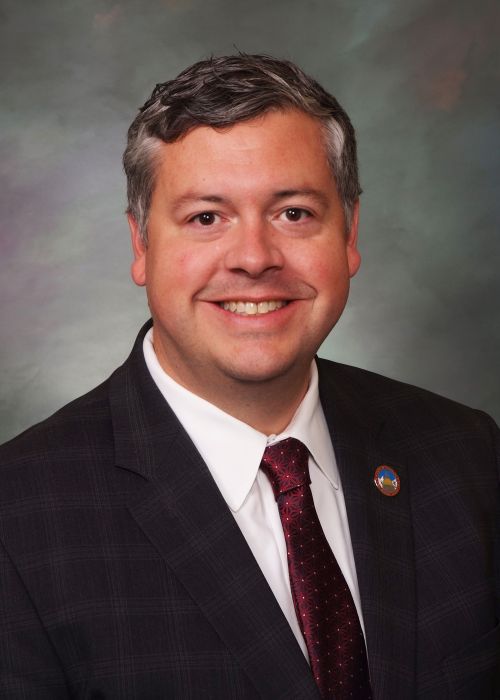
Photo of Alex Valdez
D Colorado House · District 5

Rep. Alex Valdez

Compare
Total votes
7,205
all sessions
Attendance
95%
373 missed
Among the lowest in the chamber
With party
97%
of cast votes
Near the chamber average
Bipartisan score
2%
crosses aisle rarely
Near the chamber average
Sponsored
360
bills & resolutions
Near the chamber average
Committees
2
assignments
360 bills and resolutions

Sponsored bills

Total
360
Primary
113
Co-sponsor
247
This page
360
matching current filters
Primary SB 22-228
Signed into law · Colorado Senate · Lead sponsor
Retail Establishments Accept Cash Enforcement

Colorado law requires retail establishments to accept United States currency. One of the exceptions to the requirement is for security deposits. The act: Exempts from the requirement to accept United States currency a retail establishment in which the primary method of selling goods or services is through an automatic renewal contract; and Defines "retail establishment" and "security deposit" for purposes of these exceptions. The attorney general is authorized to bring a civil and criminal action to enforce the provision. (Note: This summary applies to this bill as enacted.)

Signed into law Jun 7, 2022 0 co-sponsors
Primary HB 22-1232
Signed into law · Colorado House · Lead sponsor
Sunset Continue Regulation Of Asbestos

The act implements the recommendations of the department of regulatory agencies, as contained in the department's sunset review of the regulation of persons in connection with the control of asbestos, as follows: Continues the regulation for 5 years, until September 1, 2027; Removes limits on the ability of the air quality control commission to promulgate rules more stringent than the standards set forth in the federal "Occupational Safety and Health Act" (OSHA) and federal regulations promulgated pursuant to OSHA; and Requires a local government to add language regarding asbestos inspections on each application to renovate or demolish property. The act also: Expands the definition of "area of public access" to include any building, facility, or property that a member of the general public can enter or be exposed to asbestos; Amends the definition of "asbestos abatement" to include conducting a major spill response to prevent the escape of asbestos fibers into the atmosphere; Adds a definition of "facility"; and Expands the types of facilities for which a person must be certified before conducting asbestos inspections or asbestos abatement actions from schools or public or commercial buildings to any building, facility, or property.(Note: This summary applies to this bill as enacted.)

Signed into law Jun 3, 2022 0 co-sponsors
Primary SB 22-213
Signed into law · Colorado Senate · Lead sponsor
Child Care Support Programs

The act supports various aspects of early childhood and child care by extending current grant programs and developing new programs by making the following appropriations: $50 million from federal funds from child care development funds for the purposes of implementing the child care sustainability grant program; $16 million from the economic recovery and relief cash fund for the emerging and expanding child care grant program. $10 million from the economic recovery and relief cash fund to implement the employer-based child care facility grant program; $15 million from the economic recovery and relief cash fund to implement the early care and education recruitment and retention grant and scholarship program. Of the $15 million, $5 million must be dedicated for home visiting workforce, early childhood mental health consultants, and early intervention providers. $7.5 million from the economic recovery and relief cash fund to implement the family, friend, and neighbor training and support programs; and One million dollars from the economic recovery and relief cash fund for the purposes of implementing the home visiting grant program. The act creates the family, friend, and neighbor (FFN) support programs, which include an advisory group and a training and support program. The family, friend, and neighbor advisory group is created to advise the department on the needs of FFN providers and to make recommendations on changes to regulations, policies, funding, and procedures that would benefit the FFN community. The family, friend, and neighbor support program is created to allow community-based organizations and nonprofit organizations that have expertise working with FFN providers to provide them with information, training, materials, and technical assistance to support best practices. Subject to available appropriations, the department of early childhood shall make existing state programs available to the FFN community, including, but not limited to, home visitation, early intervention, early childhood mental health, workforce recruitment and retention, and family resource center services. The act creates the home visiting grant program, in which "home visiting" means a voluntary, evidence-based, 2-generation, and home-based prevention program for families with children from prenatal to 6 years of age. The purpose of the home visiting grant program is to support school readiness, social-emotional growth, and age-appropriate child development delivered by a trained home visitor. (Note: This summary applies to this bill as enacted.)

Signed into law Jun 3, 2022 0 co-sponsors
Primary HB 22-1362
Signed into law · Colorado House · Lead sponsor
Building Greenhouse Gas Emissions

The act requires the director of the Colorado energy office (office) and the executive director of the department of local affairs to appoint an energy code board (board) that will develop for adoption by counties, municipalities, and state agencies 2 sets of model codes. The director of the office and the executive director of the department shall also appoint an executive committee for the board. The board shall develop a model electric and solar ready code on or before June 1, 2023, and a model low energy and carbon code on or before July 1, 2025. The office shall, independent of the board, identify model green code language for adoption by counties, municipalities, and state agencies. Every element of either model code adopted by the board must be approved by two-thirds of the board. If two-thirds of the board fail to adopt an element required by statute for either model code, the executive committee must vote on that element. An element of either model code must be approved by the majority of the executive committee to be adopted. In the event of a conflict between the 2021 international energy conservation code, the 2024 international energy conservation code, the model electric ready and solar ready code, or any other model codes adopted by either a local government or divisions in the executive branch and either the Colorado plumbing code or the national electric code, the Colorado plumbing code or the national electric code prevails. The act establishes when the office of the state architect, the division of housing, and the division of fire prevention and control must adopt and enforce codes that achieve equivalent or better energy performance than the codes adopted by the board as follows: On or before January 1, 2025, the office of the state architect, the division of housing, and the division of fire prevention and control shall adopt and enforce an energy code that achieves equivalent or better energy performance than the 2021 international energy conservation code and the model electric and solar ready code developed by the board; and On or before January 1, 2030, the office of the state architect, the division of housing, and the division of fire prevention and control shall adopt and enforce an energy code that achieves equivalent or better energy and carbon emissions performance than the model low energy and carbon code developed by the board. Likewise, the act establishes when municipalities and counties must adopt and enforce codes that achieve equivalent or better energy performance than the codes adopted by the board as follows: On or after July 1, 2023, and before July 1, 2026, municipalities and counties that update a building code shall adopt and enforce an energy code that achieves equivalent or better energy performance than the 2021 international energy conservation code and the model electric and solar ready code developed by the board; and On or after July 1, 2026, municipalities and counties that update a building code shall adopt and enforce an energy code that achieves equivalent or better energy performance than the model low energy and carbon code language developed by the board. However, rather than either the model electric and solar ready code or the model low energy and carbon code, a rural county that applies for and is not awarded a grant that significantly assists in energy code adoption and enforcement training is instead required to adopt and enforce an energy code that achieves equivalent or better energy performance than one of the 3 most recent editions of the international energy conservation code. The act also creates 2 primary grant programs that will be administered by the office: The building electrification for public buildings grant program to provide grants to local governments, school districts, state agencies, and special districts for the installation of high-efficiency electric heating equipment; and The high-efficiency electric heating and appliances grant program to provide grants to local governments, utilities, nonprofit organizations, and housing developers for the installation of high-efficiency electric heating equipment in multiple structures within a neighborhood and the purchase of electrical installations and upgrades necessary to support the installation of high-efficiency electric equipment. The clean air building investments fund, a continuously appropriated cash fund, is established by the act to fund the creation, implementation, and administration of both of these grant programs. Lastly, the act also requires the following transfers from the general fund: $3 million to the energy fund created for the office to issue grants and provide training related to the 2021 international energy conservation code, electric and solar ready codes, and low energy and carbon codes; $150,000 to the energy fund created for the office for the costs associated with administering the board; $10 million to the clean air building investments fund for the creation, implementation, and administration of the building electrification for public buildings grant program; and $10,850,000 to the clean air building investments fund for the creation, implementation, and administration of the high-efficiency electric heating and appliances grant program.(Note: This summary applies to this bill as enacted.)

Signed into law Jun 2, 2022 0 co-sponsors
Primary SB 22-193
Signed into law · Colorado Senate · Lead sponsor
Air Quality Improvement Investments

Section 1 of the act creates the industrial and manufacturing operations clean air grant program (clean air grant program) through which the Colorado energy office (office) awards grant money to private entities, local governments, tribal governments, and public-private partnerships for voluntary projects to reduce air pollutants from industrial and manufacturing operations. Voluntary projects eligible for grant money include: Energy efficiency projects; Renewable energy projects; Beneficial electrification projects; Transportation electrification projects; Projects producing or utilizing clean hydrogen; Projects involving carbon capture at industrial facilities and direct air capture projects; Methane capture projects; Projects producing or utilizing sustainable aviation fuel; and Industrial process changes that reduce emissions. Starting in 2025, the office is required to report annually on the progress of the clean air grant program, submit the report to the legislative committees with jurisdiction over energy matters, and post the reports on the office's website. On June 30, 2022, the state treasurer shall transfer $25 million from the general fund to the industrial and manufacturing operations clean air grant program cash fund, which fund is created in the act. The fund may also consist of money from federal sources and from gifts, grants, and donations. The money in the fund is continuously appropriated to the office for its administration of the clean air grant program. The office may use up to 9% of the money in the fund for its administrative costs in implementing the clean air grant program. The clean air grant program is repealed on September 1, 2029. Section 1 also creates the cannabis resource optimization cash fund, which fund the office is required to administer to provide financial incentives for energy and water use conservation and sustainability practices in cannabis operations. The state treasurer is directed to transfer $1.5 million from the general fund to the cannabis resource optimization cash fund on July 1, 2022. Section 2 creates the community access to electric bicycles grant program (electric bicycles grant program) through which the office awards grant money to local governments, tribal governments, and nonprofit organizations that administer or plan to administer a bike share program or an ownership program for the provision of electric bicycles in a community. Section 2 also creates the community access to electric bicycles rebate program (rebate program) through which the office provides rebates for purchases of electric bicycles and equipment used for commuting purposes to individuals in low- and moderate-income households, businesses, or nonprofit organizations (program participants) or bicycle shops that sell electric bicycles to program participants at discounted prices. Starting in 2025, the office is required to report annually on the progress of the electric bicycles grant program and the rebate program, submit copies of the report to the legislative committees with jurisdiction over transportation matters, and post the report on the office's website. On June 30, 2022, the state treasurer shall transfer $12 million from the general fund to the community access to electric bicycles cash fund (fund), which fund is created in the act. The fund may also consist of money from federal sources and from gifts, grants, and donations. The money in the fund is continuously appropriated to the office for its administration of the electric bicycles grant program and the rebate program. The office may use up to 9% of the money in the fund for its administrative costs in implementing the electric bicycles grant program and the rebate program. The electric bicycles grant program and the rebate program are repealed on September 1, 2028. Section 3 creates the electrifying school buses grant program (school buses grant program) through which the department of public health and environment (department), with technical assistance from the office, awards grant money to school districts, including schools operated by tribal governments, and charter schools, or nonprofit partners acting on behalf of a school district or charter school, to help finance the procurement and maintenance of electric-powered school buses, the conversion of fossil-fuel-powered school buses to electric-powered school buses, charging infrastructure, and upgrades for electric charging infrastructure and the retirement of fossil-fuel-powered school buses. The department of education is authorized to provide assistance to school districts and charter schools in applying for or implementing a project funded with grant money. Starting in 2025, and every odd-numbered year thereafter, the department is required to report on the progress of the school buses grant program, submit copies of the report to the legislative committees with jurisdiction over education, energy and environment, and transportation matters, and post copies of the report on its website. On June 30, 2022, the state treasurer shall transfer $65 million from the general fund to the electrifying school buses grant program cash fund (electric school buses fund), which fund is created in the act. The electrifying school buses fund may also consist of money from federal sources and from gifts, grants, and donations. The money in the electrifying school buses fund is continuously appropriated to the department for its administration of the school buses grant program. The department may use up to 8% of the money in the electrifying school buses fund for its administrative costs in implementing the electrifying school buses grant program. The school buses grant program is repealed on September 1, 2034. Section 4 updates the definition of "federal act" regarding the reference to the federal "Clean Air Act". Section 4 also updates the definition of "issue" with respect to an order, permit, determination, or notice issued by the division of administration in the department (division), to remove certified mail and add electronic mail as options to issue such order, permit, determination, or notice. Section 5 clarifies that the statutory fee caps for fees collected by the air quality enterprise apply only to the annual stationary source emission fees. The statutory fee caps are $1 million for state fiscal year 2021-22, $3 million for state fiscal year 2022-23, $4 million for state fiscal year 2023-24, and $5 million on and after July 1, 2024. Section 6 removes the requirement that the division make the forms on which a person provides details necessary for filing an air pollution emission notice available at all of the air pollution control authority offices. Section 7 authorizes a person to seek judicial review of the division's failure to grant or deny a renewable operating permit until the division grants or denies the permit and authorizes the division to contract with third parties to perform permit application reviews, air quality monitoring reviews, or other work to support the division's air quality permit programs. Section 8 extends the time within which the air quality control commission must grant or deny a request for a hearing from within 15 days after the request was made to within 30 days after the request was made and, if granted, requires the commission to set the hearing no later than 90 days after its first regularly scheduled meeting following receipt of the hearing request. Existing law authorizes the commission to submit any additions or changes to the state implementation plan (SIP) to the administrator of the federal environmental protection agency (administrator) for conditional or temporary approval pending legislative council review of the additions or changes. Section 9 authorizes the commission to submit the changes or additions to the administrator as a provisional submission, pending possible introduction and enactment of a bill to modify or delete all or a portion of the commission's additions or changes to the SIP. Section 11 appropriates from the general fund: $750,000 to the department of personnel for the costs of issuing free annual eco passes to state employees; and $7,000,000 to the department to finance the aerial surveying of pollutants, $90,725 of which is reappropriated to the office of information technology in the governor's office to provide information technology services to the department. Section 11 also appropriates $44,365 from the electrifying school buses grant program cash fund to the department of education to provide technical assistance to school districts and charter schools applying for grant money from the school buses grant program and implementing projects awarded grant money. (Note: This summary applies to this bill as enacted.)


Signed into law Jun 2, 2022 0 co-sponsors
Primary SB 22-205
Signed into law · Colorado Senate · Lead sponsor
Intoxicating Hemp And Tetrahydrocannabinol Products

The act authorizes the department of public health and environment to prohibit the chemical modification, conversion, or synthetic derivation of intoxicating tetrahydrocannabinol isomers that originate from industrial hemp or may be synthetically derived. The act also creates a task force to study intoxicating hemp products and make legislative and rule recommendations. The task force will submit a report to the general assembly by January 1, 2023. The task force consists of 20 members including representatives of state government, experts in marijuana and industrial hemp regulation, persons licensed in the marijuana and medical marijuana fields, persons working with industrial hemp, testing laboratories, and a representative of a county or district public health agency. For the 2022-23 state fiscal year, the act appropriates $587,347 from the marijuana tax cash fund to the department of law, $4,630 of which is reappropriated to the department of personnel. (Note: This summary applies to this bill as enacted.)
Signed into law May 31, 2022 0 co-sponsors
Primary SB 22-211
Signed into law · Colorado Senate · Lead sponsor
Repurpose The Ridge View Campus

The department of human services (department) is required to transfer ownership of all or part of the Ridge View campus in Watkins, Colorado to the department of personnel for use by the division of housing (division) for a supportive residential community to provide transitional housing, a continuum of behavioral health service treatment, medical care, vocational training, and skill development for its residents and the general public. The division, in collaboration with the behavioral health administration and the department of human services, is required to develop a feasible master plan for the redevelopment and operations of the Ridge View campus into the Ridge View Supportive Residential Community, including a financial plan for start-up and ongoing operational costs. The division is required to enter into one or more contracts with public or private contractors to establish the Ridge View Supportive Residential Community at the Ridge View campus. The department, in partnership with the behavioral health administration and the department of health care policy and financing, is required to work to ensure that youth bed capacity will be created elsewhere in a manner that most appropriately serves the mental health needs of Colorado's youth. The Ridge View Supportive Residential Community is required to provide the following services and programs: A transitional housing program for individual adults with case management, care coordination, and vocational and housing placement assistance; A continuum of behavioral health services and treatment, informed by American Society of Addiction Medicine standards, available to people coming from the transitional housing program and to the general public; and A federally qualified health center or other primary care clinic at which people have access to medical treatments that help facilitate recovery, including medical and dental care and a continuum of behavioral health services. The health clinic and all behavioral health services and treatment are required to be accessible to people in the transitional housing program and the general public. For the 2022-23 state fiscal year, and to the extent not spent in that state fiscal year the 2023-24 state fiscal year as well, the act appropriates money from the economic recovery and relief cash fund to the division for the repurposing of the Ridge View campus. The division is authorized to use up to 10% of the amount appropriated for its administrative costs in connection with the repurposing of the Ridge View campus and up to 10% of the amount appropriated for its costs in connection with transportation. The act also appropriates $44,557 from the general fund to the department for use by the behavioral health administration to implement the act. (Note: This summary applies to this bill as enacted.)

Signed into law May 31, 2022 0 co-sponsors
Primary SB 22-178
Signed into law · Colorado Senate · Lead sponsor
Licensees Ability To Change Marijuana Designation

The act allows a medical marijuana cultivation facility to transfer medical marijuana, physically or virtually via the seed-to-sale tracking system, to a retail marijuana cultivation facility with at least one of the same owners, and the retail marijuana cultivation facility to receive the marijuana and change the designation of the marijuana from medical to retail. The act clarifies that the retail marijuana cultivation facility is required to pay any retail marijuana excise tax on the transferred marijuana. The act appropriates $228,510 to the department of revenue from the marijuana cash fund for use by the marijuana enforcement division. (Note: This summary applies to this bill as enacted.)

Signed into law May 26, 2022 0 co-sponsors
Primary SB 22-145
Signed into law · Colorado Senate · Lead sponsor
Resources To Increase Community Safety

The act establishes 3 new grant programs within the division of criminal justice (division) in the department of public safety: A multidisciplinary crime prevention and crisis intervention grant program to award grants to law enforcement, other local governmental agencies, federally recognized Indian tribes, community-based organizations, and third-party membership organizations or administrators to identify high-crime areas and to implement crime prevention and intervention strategies in those areas; A law enforcement workforce recruitment, retention, and tuition grant program to award grants to law enforcement agencies to address workforce shortages, improve training, and improve relationships between law enforcement and impacted communities; and A state's mission for assistance in recruitment and training (SMART) policing grant program to increase the number of P.O.S.T.-certified and non-certified law enforcement officers who are representative of the communities they police and provide training for those additional law enforcement officers. The act directs the executive director of the department of public safety to establish policies and procedures and create advisory committees consisting of diverse members to review applications and make recommendations on who should receive grants and the amount of the grants. The act requires the division to create a project management team to coordinate grant programs. The act requires the division to host a statewide forum which may be facilitated by a national criminal justice organization to solicit suggestions on crime prevention measures related to the grant programs. The act requires the general assembly to appropriate money for the grant programs in the 2022-23 and 2023-24 fiscal years, for the statewide forum in the 2022-23 fiscal year, and for the project management team in the 2022-23 and 2023-24 fiscal years. The act appropriates from the general fund: $300,000 to the division of criminal justice in the department of public safety to implement the act; $7.5 million to the multidisciplinary crime prevention and intervention grant fund; $3.75 million to the law enforcement workforce recruitment, retention, and tuition grant fund; and $3.75 million to the SMART policing grant fund.(Note: This summary applies to this bill as enacted.)

Signed into law May 20, 2022 0 co-sponsors
Primary HB 22-1030
Failed · Colorado House · Lead sponsor
Income Tax Credit For Package Anti-theft Devices

For 3 income tax years beginning in 2022, the bill creates a refundable state income tax credit of up to $75 for a resident individual who has had a package stolen from the individual's residence or place of business (eligible person) for the purchase of package anti-theft devices. The bill also creates a state income tax credit for a package delivery company that donates a package anti-theft device to an eligible person in the amount of the retail value of the device up to $75 per donation.(Note: This summary applies to this bill as introduced.)

Failed May 12, 2022 0 co-sponsors
Showing 291 to 300 of 360 bills
Previous 1 … 29 30 31 … 36 Next