

The act changes state law to reflect changes to federal law that expand the authority of states, counties, and tribal governments to enter into good neighbor agreements with the federal government to carry out recreation and improvement services on land by:Specifying that the Colorado state forest service may enter into good neighbor authority agreements with the United States department of the interior, the United States department of agriculture, or any agency of the United States department of the interior or United States department of agriculture; andClarifying that the Colorado state forest service is required to conduct, or contract with one or more entities to conduct, demonstration projects that utilize Colorado's good neighbor authority to implement forest management projects that improve forest health, resilience, wildlife habitat, or outdoor recreation opportunities.(Note: This summary applies to this bill as enacted.)
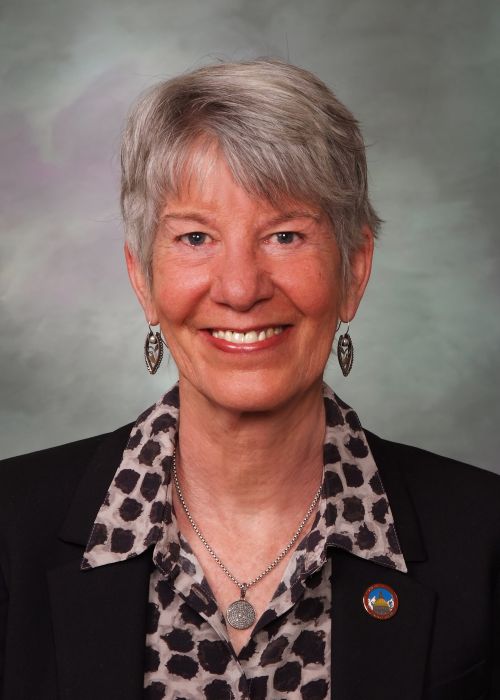
Rep. Lesley Smith
Sponsored bills
The act establishes civil immunity for a board member, staff member, or volunteer of a child advocacy center that arises from the performance of the board member's, staff member's, or volunteer's duties if the board member's, staff member's, or volunteer's acts are in good faith. The act allows certain entities to share information under certain circumstances that is relevant to the protection of a child that is the subject of a child maltreatment case.(Note: This summary applies to this bill as enacted.)
The act prohibits a person from:Identifying an agricultural product as being produced in the state when selling, marketing, advertising, or distributing the product unless the product is grown in the state; andUsing the Colorado proud designation or logo unless authorized by the department of agriculture. A violation of these prohibitions constitutes a deceptive trade practice. There is no private right of action to enforce a violation of the prohibitions.(Note: This summary applies to this bill as enacted.)
The act adds a co-responder who is part of a co-responder community response to the list of community members who may petition the court for an extreme risk protection order. Health-care facilities, behavioral health treatment facilities, school districts, the state charter school institute, K-12 charter schools, private schools, and institutions of higher education are established as institutional petitioners that may petition a court for an extreme risk protection order.(Note: This summary applies to this bill as enacted.)
Maddy summaryThis bill urges the Colorado Department of Agriculture and the Colorado Farmers Market Association to maintain and strengthen their partnership to support farmers' market managers across the state. It recognizes that most market managers are volunteers who need expertise, training, and resources to handle tasks like event planning, food safety, and vendor coordination. The resolution aims to help sustain local farmers' markets that provide fresh produce to communities and support small-scale producers who rely on these venues for sales.
Maddy summaryHJR 1017 is a joint resolution urging the federal government to fulfill its obligations under the 1986 Colorado Ute Indian Water Rights Settlement Agreement. It specifically calls for action to address infrastructure gaps affecting two tribes: the Southern Ute and Ute Mountain Ute Tribes, who have settled water rights but cannot access or use them due to missing pipelines (e.g., from Lake Nighthorse) and deteriorating irrigation systems (like the PRIIP, requiring $126 million in repairs). The resolution highlights federal failures to fund operations, maintain infrastructure, and enable tribes to utilize their legally secured water for agriculture, municipal use, and economic development. As a procedural resolution, it does not create new law but formally requests federal action to resolve these longstanding barriers.
March 31 is currently known as 'Cesar Chavez Day' and may be voluntarily observed as a state legal holiday. The act repeals 'Cesar Chavez Day' and changes this voluntary legal holiday for March 31, 2026, and March 31, 2027, to instead be known as 'Farm Workers Day'.(Note: This summary applies to this bill as enacted.)
Maddy summaryThis House Resolution establishes March 31, 2026, as Farm Workers Day in Colorado to honor the contributions of agricultural workers to the state's economy and food supply. The measure recognizes that farm workers make up a significant portion of Colorado's rural workforce, including many immigrant and Latina women who face unique challenges in the industry. The resolution acknowledges the historical efforts of farm worker organizations that fought for better pay, safety, and union rights, while celebrating the dignity and hard work of those who grow and harvest food. Copies of the resolution will be sent to state officials and the UFW Foundation to commemorate this observance.
Maddy summaryThis House Resolution recognizes Earth Day and the International Day of Zero Waste while reaffirming Colorado's commitment to environmental stewardship. It encourages citizens, businesses, and organizations to participate in sustainability events on March 30 and April 22, 2026, and to adopt waste-reducing practices in their daily lives. The resolution also calls for the state to evaluate its own operations for greater efficiency and sustainability, though it does not create new laws or funding.
The act prohibits the discharge of plastic pellets and other preproduction plastic materials through land application or into state waters, wastewater, storm water runoff, or other runoff by a facility that makes, uses, packages, or transports plastic pellets or other preproduction plastic materials in the state.(Note: This summary applies to this bill as enacted.)