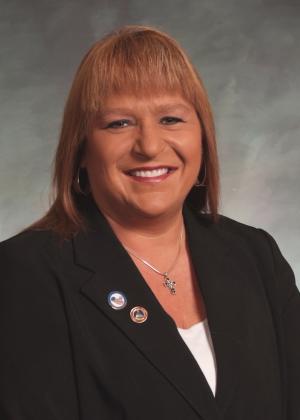
Photo of Tonya Van Beber
R Colorado House · District 48

Rep. Tonya Van Beber

Contact Email
Compare
Total votes
1,953
all sessions
Attendance
96%
80 missed
Lower than 78% of chamber peers
With party
88%
of cast votes
Lower than 87% of chamber peers
Bipartisan score
8%
crosses aisle rarely
Higher than 84% of chamber peers
Sponsored
26
bills & resolutions
Near the chamber average
Committees
0
assignments
26 bills and resolutions

Sponsored bills

Total
26
Primary
26
Co-sponsor
0
This page
26
matching current filters
Primary HB 22-1113
Signed into law · Colorado House · Lead sponsor
Appeal Procedures Dependency And Neglect Cases

A child welfare appeals workgroup was established in the state judicial department that made recommendations for changes in 2021. The act requires the child welfare appeals workgroup to monitor those changes, study changes to the child welfare appeals system, and submit reports in January 2023 and July 2024. The act requires the district court to make written orders within 35 days after a hearing. (Note: This summary applies to this bill as enacted.)

Signed into law Mar 30, 2022 0 co-sponsors
Primary HB 22-1236
In committee · Colorado House · Lead sponsor
Parent's Bill Of Rights

The bill establishes a parent's bill of rights that sets forth specific parental rights related to directing the upbringing, education, and health care of a minor child. The bill requires a board of education of a school district, board of cooperative services, charter school, or institute charter school, in consultation with parents, teachers, and administrators, to develop and adopt a policy to promote the involvement of parents of the enrolled minor child. The bill prohibits an individual, corporation, association, organization, state-supported institution, or individual employed by any of these entities from procuring, soliciting to perform, arranging for the performance of, or performing a surgical procedure upon a minor without written or verbal consent from the minor's parent. Parental consent is not required if the minor is in the custody of a county department of human or social services or the division of youth services. (Note: This summary applies to this bill as introduced.)

In committee Mar 23, 2022 0 co-sponsors
Primary HB 22-1201
In committee · Colorado House · Lead sponsor
Standards For Immunization Requirements

The bill allows individuals who are required to receive an immunization for any purpose to claim an exemption from the requirement if the: Immunization has not been approved by the federal food and drug administration (FDA); Immunization has only received emergency use authorization; Immunization manufacturer is not liable for injury or death caused by the immunization; or Pivotal clinical trial the FDA relied on to approve the immunization did not evaluate the immunization's safety, for at least one year after the immunization was first administered, against a control group. The bill requires the department of public health and environment to post on its website: The criteria that must be met for an individual to claim an exemption from an immunization requirement; and For each immunization required: The injuries or diseases caused by the immunization and the rate at which each injury or disease occurs; and Whether the risk of permanent disability or death from the required immunization has been proven to be less than the risk of permanent disability or death from the infection or disease the immunization is intended to prevent.(Note: This summary applies to this bill as introduced.)

In committee Mar 3, 2022 0 co-sponsors
Primary SB 22-071
In committee · Colorado Senate · Lead sponsor
Learning Pods For Home-school Programs

The bill allows a child who is participating in a nonpublic home-based educational program to receive the program by participating in a learning pod, which is defined as a group of children who receive educational services delivered by an adult who is selected by the parents of the participating children. If a child who receives a hope scholarship is participating in a learning pod, the child's parent may use the money received to pay the costs of participating in the learning pod.(Note: This summary applies to this bill as introduced.)

In committee Feb 17, 2022 0 co-sponsors
Primary SB 21-269
Signed into law · Colorado Senate · Lead sponsor
Licensing Of Respite Child Care Centers

The act defines "respite child care centers" and includes them in the overall definition of "child care center" for licensing purposes.For the 2021-22 state fiscal year, $14,092 is appropriated to the department of human services for use by the office of information technology services. This appropriation is from the general fund. To implement this act, the office may use this appropriation for Colorado trails.(Note: This summary applies to this bill as enacted.)

Signed into law Jul 2, 2021 0 co-sponsors
Primary HB 21-1094
Signed into law · Colorado House · Lead sponsor
Foster Youth In Transition Program

The act creates the foster youth in transition program (transition program) in the state department of human services (state department) to be implemented in county departments of human or social services (county departments) throughout the state. The purpose of the transition program is to allow foster youth who meet eligibility criteria to voluntarily continue to receive certain child welfare services (services) up until the last day of the month of the youth's twenty-first birthday, or such greater age of foster care eligibility as required by federal law. Services provided through the transition program must be client-directed and developmentally appropriate as set forth in and agreed to through a voluntary services agreement (agreement) developed and entered into between the youth and county department.The act sets forth the eligibility criteria a youth must meet in order to voluntarily participate in the transition program. A youth who is no longer under the jurisdiction of the juvenile court and thinks he or she is eligible for the transition program may make a written request to the juvenile court (court) or county department where the youth resides. The county department shall make a determination of eligibility. If the youth is eligible, the county department shall explain the requirements and benefits of the transition program to the youth and, with the youth, develop an agreement that must be provided to the juvenile court together with a petition to renew jurisdiction with the juvenile court.The act describes the services and supports that will be made available to a youth through the transition program, including assistance with enrolling in medicaid; assistance with securing appropriate housing; and providing case management services, such as developing a roadmap to success, obtaining employment, obtaining critical documents and records, and accessing information about relatives and siblings, if available and appropriate.The act sets forth the form and content required for a petition to bring the youth under the juvenile court's jurisdiction. Upon receipt of informed, written consent of the youth, a person may be named as a special respondent in a case brought pursuant to the transition program.A youth participating in the transition program must be appointed counsel from a list of attorneys approved by the office of the child's representative. If the youth is 18 years of age or older and, due to diminished capacity, needs a guardian ad litem, one may also be appointed.Procedures for emancipation discharge and transition hearings (hearing) are described in the act, including a requirement to have a personalized emancipation transition plan finalized for the youth no more than 90 days prior to a hearing. The county department shall file a report with the court at least 7 days prior to a transition hearing that includes relevant details concerning a youth's status and plans to either emancipate or enter the youth in transition program. With the youth's consent and in certain circumstances, the court may continue a transition hearing for up to 119 days.The court shall hold periodic reviews of the youth's case at least every 6 months to ensure that the transition program is providing the youth with the necessary services to help the youth move toward permanency and a successful transition to adulthood. The act sets forth procedures for the periodic reviews. The act grants continuing jurisdiction in a youth's case to the juvenile court under certain situations.The act creates the foster youth successful transition to adulthood grant program (grant program) and associated advisory board (advisory board). The purpose of the grant program is to support eligible youth to successful transition into adulthood. Youth are eligible for services from recipients of grants from the grant program if they are between the ages of 18 and 23, were in foster care or adjudicated dependent and neglected, and are participating voluntarily. The advisory board shall meet at least 2 times per year, and the act outlines membership.The state department is directed to promulgate rules for the implementation of the transition program.For the 2021-22 state fiscal year, the act appropriates $510,623 to the department of human services for use by the division of child welfare. This appropriation consists of $408,498 from the general fund and $102,125 from cash funds from local funds. To implement this act, the division may use this appropriation for child welfare services.For the 2021-22 state fiscal year, the act appropriates $52,392 to the judicial department for use by the office of the child's representative. This appropriation is from the general fund.(Note: This summary applies to this bill as enacted.)

Signed into law Jun 25, 2021 0 co-sponsors
Primary HB 21-1073
Signed into law · Colorado House · Lead sponsor
Support Foster Families License Plate

The act creates the "support foster families" license plate for vehicles. A person is qualified to be issued the plate if the person makes a donation to a designated nonprofit organization that meets the act's qualifications. In addition to the normal fees for a license plate, a person must pay 2 additional one-time fees for the issuance of the plate. The fees are credited to the highway users tax fund and the licensing services cash fund, respectively.The act appropriates $14,145 for use by the division of motor vehicles to implement the act.(Note: This summary applies to this bill as enacted.)

Signed into law Jun 25, 2021 0 co-sponsors
Primary SB 21-236
Signed into law · Colorado Senate · Lead sponsor
Increase Capacity Early Childhood Care & Education

The act creates 4 new grant programs to increase capacity for early childhood care and education, improve recruitment and retention rates for early childhood educators (educators), and improve salaries for educators. The act makes an appropriation.Specifically, the act creates the following programs:The employer-based child care facility grant program; The early care and education recruitment and retention grant and scholarship program; The child care teacher salary grant program; and The community innovation and resilience for care and learning equity (CIRCLE) grant program. The act also eliminates the repeal dates for the child care sustainability grant program and the emerging and expanding child care grant program.The act appropriates money for the grant programs from the general fund as well as from federal funds from the child care development fund.The act makes the following appropriations:During the 2020 special session, the general assembly appropriated money for early childhood education. The act states that any of that money not expended prior to July 1, 2021, is further appropriated to the department of human services for the next fiscal year for the same purpose. For the 2020-21 state fiscal year, $8,800,000 is appropriated to the department of human services for use by the office of early childhood. This appropriation is from the general fund. To implement this act, the office of early childhood may use this appropriation as follows: $100,000 for administration, which amount is based on an assumption that the office will require an additional 1.0 FTE; and $8,700,000 for the employer-based child care facility grant program. Any money appropriated but not expended prior to July 1, 2021, is further appropriated to the department of human services for use by the office of early childhood for the 2021-22 state fiscal year for the same purposes. For the 2021-22 state fiscal year, $320,241,576 is appropriated to the department of human services for use by the office of early childhood. This appropriation is from federal funds from child care development funds. To implement this act, the office of early childhood may use this appropriation as follows: $292,700,664 for the child care sustainability grant program, which amount is based on an assumption that the office will require an additional 3.0 FTE. Any money appropriated for the child care sustainability grant program but not expended prior to July 1, 2022, is further appropriated for use by the office of early childhood for the 2022-23 state fiscal year for the same purposes; $16,800,000 for the community innovation and resilience for care and learning equity (CIRCLE) grant program, which amount is based on an assumption that the office will require an additional 1.0 FTE. Any money appropriated to the community innovation and resilience for care and learning equity (CIRCLE) grant program but not expended prior to July 1, 2022, is further appropriated for use by the office of early childhood for the 2022-23 state fiscal year for the same purposes; $7,200,000 for the early care and education recruitment and retention grant and scholarship program, which amount is based on an assumption that the office will require an additional 4.0 FTE; $3,000,000 for the child care teacher salary grant program, which amount is based on an assumption that the office will require an additional 1.0 FTE; and $540,912 for the administration, monitoring, compliance, and reporting requirements associated with the money appropriated in this subsection (3), which amount is based on an assumption that the office will require an additional 4.0 FTE. For the 2021-22 state fiscal year, $58,622,936 is appropriated to the department of human services for use by the office of early childhood. This appropriation is from federal funds from child care development funds. The office of early childhood may use this appropriation as follows: $23,845,252 for the child care assistance program; $32,455,511 for child care grants for quality and availability and federal targeted funds requirements, which amount is based on an assumption that the office will require an additional 6.0 FTE; $2,150,000 for the early childhood mental health consultation program, which amount is based on an assumption that the office will require an additional 1.0 FTE; and $172,173 for the administration, monitoring, compliance, and reporting requirements associated with the money appropriated in this subsection (4), which amount is based on an assumption that the office will require an additional 2.0 FTE.(Note: This summary applies to this bill as enacted.)


Signed into law Jun 16, 2021 0 co-sponsors
Primary SB 21-204
Signed into law · Colorado Senate · Lead sponsor
Rural Economic Development Initiative Grant Program Funding

The act appropriates $5 million to the department of local affairs (department) to use for the rural economic development initiative (REDI) grant program, and permits the department to use up to 3.75% of the appropriation for any direct and indirect administrative expenses related to the grants awarded from the appropriation.If the department determines that a rural community needs resources or assistance because it has been impacted by a significant economic event or an anticipated event that has been announced, the department may use all or a portion of the money appropriated for the REDI grant program for the purposes of the "Rural Economic Advancement of Colorado Towns (REACT) Act". The act repeals the sunset of the REACT Act.(Note: This summary applies to this bill as enacted.)
Signed into law Jun 15, 2021 0 co-sponsors
Primary HB 21-1191
In committee · Colorado House · Lead sponsor
Prohibit Discrimination COVID-19 Vaccine Status

The bill prohibits an employer, including a licensed health facility, from taking adverse action against an employee or an applicant for employment based on the employee's or applicant's COVID-19 immunization status. The bill allows an aggrieved employee or applicant for employment to file a civil action for injunctive, affirmative, and equitable relief and, if the employer or health facility acted with malice or wanton or willful misconduct or has repeatedly violated the law, the court may also award punitive damages and attorney fees and costs. Additionally, the bill specifies that the COVID-19 vaccine is not mandatory, that the state cannot require any individual to obtain a COVID-19 vaccine, and that government agencies and private businesses, including health insurers, cannot discriminate against clients, patrons, or customers based on their COVID-19 vaccination status. A person aggrieved by a violation of these prohibitions may file a civil action for injunctive and other appropriate relief and may be awarded punitive damages and attorney fees and costs for wanton, willful, or repeated violations. (Note: This summary applies to this bill as introduced.)

In committee May 12, 2021 0 co-sponsors
Showing 11 to 20 of 26 bills