Maddy summarySJR 11 is a commemorative resolution designating a specific segment of U.S. Highway 34 (between Wilson Ave. and North County Rd. 23H) as the "Sgt. John 'Jack' Thurman Memorial Highway" in honor of a World War II Marine Corps veteran. The bill, which has no policy or funding provisions, simply names the highway section to recognize Sergeant Thurman's service at Iwo Jima, his military awards, and his post-war contributions as an architect and community leader in Colorado. It authorizes the Colorado Department of Transportation to accept donations for signage and explore maintenance agreements with local governments. This is a ceremonial designation with no direct impact on residents or new laws.
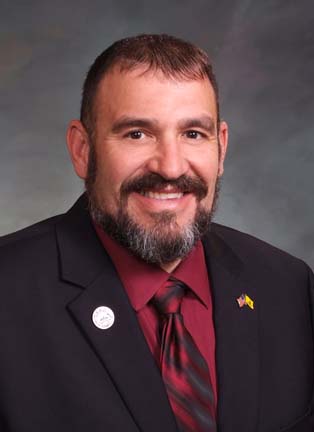
Rep. Ty Winter
Sponsored bills
The bill requires that an investor-owned electric utility receive a certificate of public convenience and necessity (certificate) from the public utilities commission and obtain all necessary local government land use approvals and permits prior to initiating any condemnation proceedings related to a high-voltage transmission infrastructure project requiring the certificate.The bill does not change existing application and review processes related to the development of transmission projects that have been established by the public utilities commission or a relevant local government.(Note: This summary applies to this bill as introduced.)
Maddy summaryThis House Memorial (HM 1001) is a formal tribute passed by the Colorado General Assembly honoring former State Representative Dan Williams, who died in October 2025. It recognizes his 1984-1992 service in the Colorado House, his leadership as chair of key committees (including Agriculture and Transportation), and his lifelong advocacy for Colorado ranching and farming communities. The resolution expresses the legislature's condolences to his family and sends copies of the memorial to his partner and children. It has no policy impact, as it is purely a commemorative gesture with no new laws or funding.
Maddy summaryHJR 1018 designates the 61-mile stretch of State Highway 86 through Elbert County, Colorado, as the "Plains-to-Pines Scenic Corridor." The resolution authorizes the Colorado Department of Transportation (CDOT) to accept donations for signage, markers, and landscaping to promote this scenic route connecting the eastern plains to the Rocky Mountain foothills. It specifically enables CDOT to collaborate with Elbert County and the towns of Kiowa and Elizabeth for maintenance of these promotional elements. This is a commemorative designation without new regulatory requirements, focusing on tourism and regional identity.
Maddy summarySJR 14 is a symbolic resolution declaring February 28, 2026, as "Rare Disease Day" in Colorado. It recognizes over 500,000 Coloradans living with rare diseases - conditions affecting fewer than 200,000 people - and highlights challenges like limited treatments and high costs. The resolution encourages public awareness through events (like lighting Denver's City and County Building) and acknowledges the resilience of affected individuals. It does not create new laws, funding, or services, but formally supports the rare disease community through recognition.
Maddy summarySJR 13 is a symbolic resolution recognizing February 26, 2026, as "Youth Mental Health Action Day" in Colorado. It does not create new laws or allocate funding but formally honors pediatric health-care providers working to support youth mental health. The resolution cites Colorado's high rates of youth mental health challenges (including suicide being a leading cause of death for children under 18) and emphasizes collaboration with providers, agencies, and communities. It commits the General Assembly to "promoting child and youth well-being" through existing mental health system efforts. This is a non-binding recognition, not a policy change.
Maddy summaryThis is a commemorative resolution, not a bill with policy changes. It designates February 20, 2026, as "Colorado FFA Day" to honor the Colorado Future Farmers of America (FFA) program. The resolution recognizes FFA's role in developing student leadership, career skills, and agricultural education across Colorado. It directly celebrates FFA members, educators, and supporters but does not create new laws or affect any legal obligations. The resolution was introduced in both chambers of the Colorado legislature in February 2026.
The bill requires a person testifying before a legislative committee to provide the testimony under oath.(Note: This summary applies to this bill as introduced.)
The bill creates the Colorado clean energy permitting coordination office (office) in the Colorado energy office to provide coordination and technical assistance to owners or operators, local governments, and state permitting authorities regarding permitting for the construction, expansion, repowering, or material modification of a clean energy resource facility project (covered clean energy project).At the request of the owner or operator of a covered clean energy project (owner or operator) or a local government with jurisdiction over the covered clean energy project or that the owner or operator determines is likely to experience direct and significant impacts from the covered clean energy project (host community), the office must convene a meeting (application coordination meeting) to coordinate the filing of permit applications for the covered clean energy project that includes certain interested parties. Following an application coordination meeting, the office must prepare a coordinated permitting schedule for the covered clean energy project that identifies the permits and approvals likely to be required for the covered clean energy project and certain other information (coordinated permitting schedule).The office is required to develop and maintain a public dashboard (public dashboard) on the office's website for an owner or operator that receives a coordinated permitting schedule or that receives state technical assistance from the office.Effective July 1, 2027, at least 90 days before the owner or operator submits the first state permit application for a covered clean energy project, the owner or operator must submit a community engagement plan to the office and relevant state permitting authorities. A community engagement plan must identify host communities for the project and describe certain other community engagement efforts regarding the project.Effective July 1, 2027, an owner or operator must prepare a community benefit agreement and submit the community benefit agreement to the office and the parties participating in the covered clean energy project's application coordination meeting. The office is required to develop model community benefit agreement terms for a covered clean energy project and post the terms on the covered clean energy project's public dashboard or the office's website.The office is required to prioritize technical assistance and permitting readiness support for covered clean energy projects that repower or reuse retired or retiring fossil fuel generation sites, are located in coal transition communities, or are located on brownfield sites. On or before December 1, 2027, the office shall publish and update annually an inventory identifying coal plant and industrial sites and brownfield sites suitable for redevelopment for clean energy resource facilities and other key infrastructure considerations.Effective July 1, 2027, an owner or operator must develop and submit to the office a safety and emergency preparedness plan and coordinate with relevant local emergency management agencies and the Colorado division of homeland security and emergency management in implementing the safety and emergency preparedness plan. The office shall post a safety and emergency preparedness plan on the covered clean energy project's public dashboard or the office's website.Effective November 1, 2027, an owner or operator of a covered clean energy project must submit to the office a grid reliability and security statement. The office must coordinate with the public utilities commission and utilities as appropriate to align permitting readiness with grid reliability needs.On or before December 1, 2027, and on or before each December 1 thereafter, the office must submit a report to certain committees of the general assembly summarizing certain information about the functions of the office.(Note: This summary applies to this bill as introduced.)

Maddy summarySJR 10 is a symbolic resolution celebrating Lunar New Year 2026 in Colorado, not a new law. It formally recognizes the cultural significance of Lunar New Year and honors Asian American contributions to the state, building on Colorado’s existing 2024 observed holiday (established by HB 23-1271). The resolution urges Coloradans to attend community events and acknowledges the holiday’s historical roots and global celebration by over two billion people. It has no direct policy impact or legal effect, as it serves purely ceremonial and commemorative purposes.