

The "Child Fatality Prevention Act" establishes state and local or regional child fatality prevention review teams to conduct multidisciplinary reviews of child abuse, neglect, and fatalities. The bill: Repeals the requirement that a local or regional review team conduct reviews of child fatalities related to motor vehicle incidents; Requires that members of a local or regional review team be appointed by a board of county commissioners; Repeals the requirement that a local or regional review team review the cause and manner of a child fatality, as determined by the local coroner, pathologist, or medical examiner; Requires a local or regional review team to provide the parent or guardian of a deceased child with written notice of a review, an opportunity to be heard, and an opportunity to obtain legal representation during the review process; and Repeals the requirement that a state review team review a child fatality case that has not been reviewed by a local or regional review team.(Note: This summary applies to this bill as introduced.)
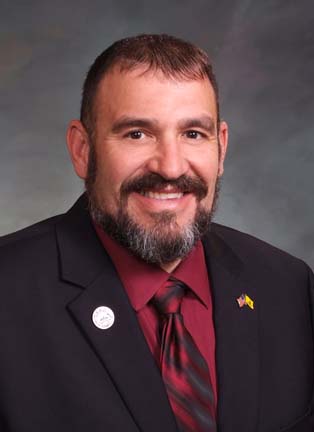
Rep. Ty Winter
Sponsored bills
The act requires the Colorado commission on criminal and juvenile justice (commission) to report to the general assembly about its study of sentencing reform by June 30, 2023. The report must include a summary of the commission's work and an update on the status of the commission's and any task force's efforts to address clarity and certainty in the current criminal sentencing scheme regarding the amount of time that must be served on each sentence imposed by the court prior to a defendant's parole eligibility. APPROVED by Governor June 6, 2023 EFFECTIVE June 6, 2023 (Note: This summary applies to this bill as enacted.)
The act updates the veterinary education loan repayment program in the following ways: Increases the number of qualified applicants per year from 4 to 6; Eliminates the requirement that an applicant must have graduated from an accredited veterinary school in 2017 or later; Increases the total amount an applicant is eligible for over a 4-year period from $70,000 to $90,000; Increases the yearly repayment amounts for successful applicants; and Requires the state treasurer to transfer $540,000 from the general fund to the veterinary education loan repayment fund on September 1, 2023. APPROVED by Governor June 2, 2023 EFFECTIVE August 7, 2023 NOTE: This act was passed without a safety clause and takes effect 90 days after sine die. (Note: This summary applies to this bill as enacted.)
The act requires the Colorado oil and gas conservation commission (commission) and the water quality control division (division) in the department of public health and environment, in consultation with local governments, to perform a study that: Identifies best management practices for capturing methane seepage in the Raton basin; Evaluates the quality of water resulting from such methane capture operations; and Evaluates the potential to preserve and make beneficial use of such water. The primary objectives of the study are to: Proactively and systematically locate and survey methane gas seepage in the Raton basin; Document previous areas of seepage; Calculate any differences in seepage amounts; and Assess the potential for methane to create hazardous conditions. The study must include: A survey to identify suspected seepage areas, previous seepage areas, and increases or decreases in seepage; Detailed mapping of suspected seepage areas; Sampling and analysis of gas collected from selected seepage areas; and Sampling and analysis of water from selected water wells and methane capture wells in the Raton basin. In performing the study, the commission and the division shall coordinate with: The Colorado energy office; The division of water resources in the department of natural resources; The division of mining, reclamation, and safety in the department of natural resources; The division of parks and wildlife created in the department of natural resources; and The boards of county commissioners in Las Animas and Huerfano counties. The commission must complete the study and submit it to legislative committees of reference by June 30, 2025. For the 2023-2024 state fiscal year, the act appropriates $558,500 from the oil and gas conservation and environmental response fund to the department of natural resources, for use by the commission, and $85,361 from the general fund to the department of public health and environment. APPROVED by Governor June 2, 2023 EFFECTIVE August 7, 2023 NOTE: This act was passed without a safety clause and takes effect 90 days after sine die. (Note: This summary applies to this bill as enacted.)
The act requires the department of health care policy and financing (state department) to provide certain behavioral health services for medicaid recipients who are under 21 years of age. The act requires the state department to begin providing the services no later than July 1, 2024. On or before November 1, 2025, and each November 1 thereafter, the act requires the state department to report to the house of representatives public and behavioral health and human services committee and the senate health and human services committee, or their successor committees, on the utilization of the services provided for in the act and any feedback received from stakeholders in implementing coverage for those services. APPROVED by Governor May 20, 2023 EFFECTIVE August 7, 2023 NOTE: This act was passed without a safety clause and takes effect 90 days after sine die. (Note: This summary applies to this bill as enacted.)
The director of the Colorado energy office or the director's designee (director) is required to conduct studies of electric transmission and advanced energy solutions technologies in rural Colorado. One study must consider ways to assist northwestern and west end of Montrose county, Colorado as it transitions to producing advanced firm dispatchable energy resources. The other study must consider the potential for the development of new energy resources in southeastern Colorado. The act specifies information that the director is required to consider in the studies. On or before July 1, 2025, the director is required to submit the director's findings and conclusions of both studies to the legislative committees of reference with jurisdiction over energy matters and to the just transition office. The act appropriates $50,000 from the just transition cash fund to the office of the governor for use by the Colorado energy office to implement the act. APPROVED by Governor May 20, 2023 EFFECTIVE August 7, 2023 NOTE: This act was passed without a safety clause and takes effect 90 days after sine die. (Note: This summary applies to this bill as enacted.)
The act modifies the relationship between a physician assistant and a physician or podiatrist by removing the requirement that a physician assistant be supervised by a physician or podiatrist except in certain circumstances. Instead, a physician assistant must enter into a collaborative agreement with a physician or podiatrist or physician group. The physician or podiatrist must be licensed in good standing in Colorado and be actively practicing with a regular and reliable physical presence in the state. The collaborative agreement must include: The physician assistant's name, license number, and primary location of practice; The signature of the physician assistant and the physician or physician group with whom the physician assistant has entered into the collaborative agreement; A description of the physician assistant's process for collaboration; A description of the performance evaluation process, which may be completed by the physician assistant's employer in accordance with a performance evaluation and review process established by the employer; and Any additional requirements specific to the physician assistant's practice required by the physician or physician group entering into the collaborative agreement, including additional levels of oversight, limitations on autonomous judgment, and the designation of a primary contact for collaboration. For a physician assistant with fewer than 5,000 practice hours, or a physician assistant changing practice areas with fewer than 3,000 practice hours in the new practice area, the collaborative agreement is a supervisory agreement that must include required elements and must also: Require that collaboration during the first 160 practice hours be completed in person or through technology, as permitted by the physician or physician group with whom the physician assistant is collaborating; Incorporate elements defining the expected nature of collaboration; and Require a performance evaluation and discussion of the performance evaluation with the physician assistant. For a physician assistant entering into a collaborative agreement with a physician or physician group in the emergency department of a hospital with a level I or level II trauma center, the collaborative agreement remains a supervisory agreement and continues indefinitely. For a physician assistant changing practice areas to practice in an emergency department of a hospital that is not a level I or level II trauma center, the supervising physician or physician group may increase the number of hours for which the collaborative agreement is a supervisory agreement. The act also eliminates the 3-year time limit for physician assistants to satisfy certain financial responsibility requirements from which such physician assistants are exempt under current law. APPROVED by Governor April 26, 2023 EFFECTIVE August 7, 2023 NOTE: This act was passed without a safety clause and takes effect 90 days after sine die. (Note: This summary applies to this bill as enacted.)
Colorado law limits the amount of uncommitted money that may remain in a cash fund at the end of a state fiscal year to 16.5% of the amount spent during the fiscal year. The act exempts the agricultural products inspection cash fund from the 16.5% uncommitted balance limit and instead imposes a limit of 50% of the amount spent from the fund during the fiscal year. APPROVED by Governor April 20, 2023 EFFECTIVE August 7, 2023 NOTE: This act was passed without a safety clause and takes effect 90 days after sine die.(Note: This summary applies to this bill as enacted.)
Current law requires that the owner of a groundwater well (well) permit file any change in name or contact information with the state engineer in person, by mail, or by fax. The act removes the requirement that the filing be in person, by mail, or by fax. Current law requires the buyers of certain wells to complete a change in owner name form before the closing of the transaction. The act removes the requirement that the form be submitted before the closing of the transaction. The act clarifies that if an existing well being sold has not been registered with the division of water resources (division), the buyer of the well must submit a registration of existing well form to the division within 63 days after closing the transaction. Current law states that the division is responsible for obtaining the necessary well registration information from the buyer after the purchase of a well. The act removes this requirement and clarifies that a person who provides a closing service in connection with the purchase of a well must submit a change in owner name form for the well to the division, even if the well has not yet been registered with the division. If a change in owner name form does not include a well permit number, the act requires the division to instruct the buyer of a well to complete a new change in owner name form or registration of existing well form and requires the buyer to submit the applicable form to the division. APPROVED by Governor March 31, 2023 EFFECTIVE August 7, 2023 NOTE: This act was passed without a safety clause and takes effect 90 days after sine die. (Note: This summary applies to this bill as enacted.)