Maddy summaryHJR 25-1026 designates Colorado State Highway 402, from United States Highway 287 to Interstate 25, as the "Rep. Hugh McKean Memorial Highway." It also authorizes the Colorado Department of Transportation (CDOT) to accept donations for the initial placement of signs and to explore agreements with Larimer County for sign maintenance.
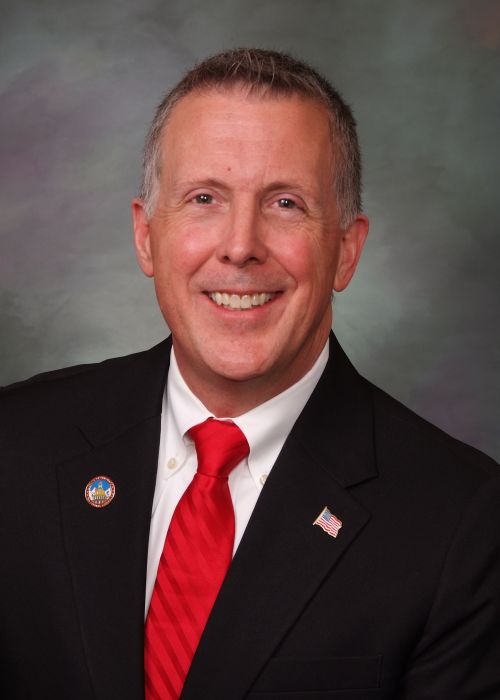
Rep. Max Brooks
Sponsored bills
Maddy summarySenate Joint Resolution 25-015 designates a specific portion of Colorado State Highway 58 as the "Officer Evan A. Dunn Memorial Highway." This action honors Officer Evan A. Dunn, a Golden Police Department officer who died in the line of duty. The bill authorizes the Colorado Department of Transportation to accept donations for the initial placement of memorial signs and to explore a cooperative agreement with the City of Golden for their maintenance.
The bill enacts the "Swipe Fee Fairness and Consumer Safeguards Act" (act), which prohibits a payment card network from: Fixing or conspiring to fix an interchange fee with, or on behalf of, a covered credit card issuer or another payment card network; Establishing, putting forward, or implementing a fee schedule that the payment card network knows, or reasonably should know, has been used by a covered credit card issuer other than the payment card network to determine the amount of an interchange fee charged or received by the covered credit card issuer in the current or previous calendar year; Establishing, charging, or putting forward on a fee schedule an interchange fee if the fee includes a percentage multiplied by the amount of a transaction and the fee does not exclude any amount attributable to a tax or gratuity on the transaction, or increasing fees in an attempt to or in a manner that would circumvent such interchange fee prohibition; Requiring a merchant that accepts credit cards that are enabled for processing over the payment card network to accept all credit cards issued by a covered credit card issuer that are enabled for processing over the payment card network; Distributing, publishing, or otherwise using data from an electronic payment transaction, except in certain circumstances; Charging a fee to a consumer or merchant related to a disputed credit card transaction until the dispute has been resolved and the consumer or merchant has been provided written notice of the determination; or Imposing a penalty on a merchant for setting prices in a manner that complies with state and federal law. The bill prohibits a payment card network from establishing, putting forward, or implementing a fee schedule that the payment card network knows or reasonably should know has been used by one or more issuers other than the payment card network to determine the amount of an interchange fee received or charged in respect to a charitable contribution, unless the interchange fee does not exceed: 0.2% of the amount of a charitable contribution made by means of a debit card; or 0.3% of the amount of a charitable contribution made by means of a credit card. If a payment card network violates the act, a merchant, consumer, or other individual or entity that is injured as a result may bring a civil action. A payment card network that is found to have violated the act as a result of a civil action other than a certified class action is liable in an amount equal to the sum of: The greater of: The amount of actual damages sustained plus interest; or $500; or 3 times the amount of actual damages sustained if the payment card network engaged in bad faith conduct; plus The costs of the action plus reasonable attorney fees. If a payment card network is found liable in a certified class action, a successful plaintiff may recover actual damages, injunctive relief allowed by law, and reasonable attorney fees and costs. (Note: This summary applies to the reengrossed version of this bill as introduced in the second house.)

Starting on July 1, 2028, the bill creates a process and establishes a public online forum for a member of the general assembly to publish drafts or titles of the bills that the member is considering introducing during the next legislative session. The bill allows each member to post multiple bill titles, drafts, or a combination of titles and drafts on the online forum and establishes a timeline for a member to publish up to 3 versions of each bill title or draft. The bill also requires each bill title or draft published to include a disclaimer stating that the bill is subject to change and may or may not be introduced based on the discretion of the prime sponsor. The web page on which the bill titles and drafts are published must be taken down on the day before the first day of the legislative session. Legislative council staff shall begin to implement the changes necessary to create the public online forum upon passage of the bill so that a member may publish bill titles and drafts by July 1, 2028. (Note: Italicized words indicate new material added to the original summary; dashes through words indicate deletions from the original summary.) (Note: This summary applies to the reengrossed version of this bill as introduced in the second house.)

Maddy summarySenate Joint Resolution 25-022 is a commemorative resolution concerning the remembrance of the Holocaust. It declares the General Assembly's commitment to remembering the Holocaust and encourages school districts and universities to promote antibias, bullying prevention, and Holocaust and genocide education programs to prevent antisemitic incidents, particularly those targeting Jewish students.
Maddy summaryHouse Joint Memorial 25-1001 serves to memorialize former Representative Rodney Bockenfeld, who passed away on February 13, 2025, at the age of 69. The resolution pays tribute to his years of dedicated public service as both an Arapahoe County Commissioner and a State Representative and extends sympathy to his family.
Maddy summarySenate Joint Resolution 25-017 designates the North Academy Bridge spanning Interstate 25 in Colorado Springs as the "Naval Aviation Pilot and Aviation Machinist Mate Petty Officer First Class Daniel T. Griffin Bridge." This resolution honors Daniel T. Griffin, recognized as the first Coloradan killed during the attack on Pearl Harbor. It also allows the Colorado Department of Transportation to explore a cooperative agreement with the Colorado Springs City Council for the maintenance of the bridge's signs.
The concurrent resolution submits a constitutional amendment to the voters of the state at the 2026 general election that will, if approved, add to the nonexclusive list of inalienable rights of all persons the right to direct the upbringing, education, and care of their children.(Note: This summary applies to this concurrent resolution as introduced.)
The act requires each institution of higher education (institution) in Colorado to create and adopt a policy and a process to support the ability of an admitted or enrolled student with a disability (student) to voluntarily self-disclose the student's disability and to engage in an interactive process with the institution to receive an academic adjustment. The adopted policy must, at a minimum, include information that: Describes the institution's process to determine whether a student is eligible for an academic adjustment; Outlines documentation that the institution may request to determine whether a student is eligible for an academic adjustment; Provides information on the available disability resources and academic adjustments provided to students with disabilities; and Describes an appeals process for academic adjustment decisions that focuses on documentary review. Each institution shall publish the policy on the institution's website in an accessible format. The act describes the type of documentation that an institution may request to determine whether a student is eligible for an academic adjustment. (Note: This summary applies to this bill as enacted.)
The act prohibits food processing plants from selling or offering for sale cell-cultivated meat that is misbranded as a meat product. The act also requires food processing plants to clearly label cell-cultivated meat as cell-cultivated meat. The department of public health and environment (department) is required to inspect food at a food processing plant if the department has reasonable cause to believe that: Cell-cultivated meat sold or offered for sale by the plant is misbranded as a meat product; or The plant is failing to label cell-cultivated meat as required. If, after an inspection, the department has reasonable cause to believe that a food processing plant is selling or offering for sale cell-cultivated meat that is misbranded as a meat product, or is failing to label cell-cultivated meat as required, the department may issue a stop order. Upon being issued the stop order, the food processing plant shall not sell the product or offer it for sale until the department determines whether it is misbranded or unlabeled in violation of the act. If the department determines that a food processing plant is selling or offering for sale cell-cultivated meat that is misbranded as a meat product, or is failing to label cell-cultivated meat as required, the department may issue an embargo order requiring the food processing plant to dispose of the cell-cultivated meat by means other than by sale to purchasers in Colorado. The department, the attorney general, or the district attorney in the district where cell-cultivated meat is being offered for sale or sold may petition the district court to enforce a stop order or an embargo order. The department may adopt rules as necessary to implement the act. (Note: This summary applies to this bill as enacted.)