

Maddy summaryThis House Joint Resolution formally asks the people of Colorado to remember the Holocaust and acknowledges specific survivors, including Fred Bryner, Samuel Weinberg, and Silvia Weinberg. It encourages schools and universities to promote antibias and bullying prevention programs to stop antisemitic incidents targeting Jewish students. The resolution also declares that citizens should understand the power of words and commit to preventing future atrocities, and it directs copies of the document to various local and national organizations focused on Holocaust education and remembrance.
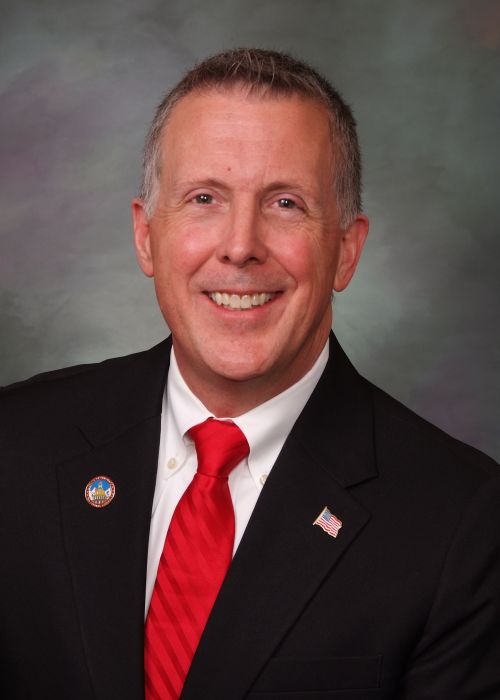
Rep. Max Brooks
Sponsored bills
Under current law, there are statewide standards for noise level limits for various time periods and areas, and noise in excess of those limits is a public nuisance. The statewide noise level limits do not apply to the use of property for certain purposes. The bill states that the statewide noise level limits also do not apply to the following:The use of property owned or controlled by the state or a political subdivision of the state;The use of property pursuant to a permit or license that addresses sound emitted and that is issued by a local government; andThe use of property owned or controlled by a nonprofit entity for a cultural, entertainment, athletic, or patriotic event.(Note: This summary applies to the reengrossed version of this bill as introduced in the second house.)
The act authorizes the state auditor, in the state auditor's discretion, to audit the records of a school district that received state education fund money (school district) for capital construction projects for qualified charter schools in the district to determine the amount of state education fund money expended by each school district in the state for capital construction and to identify the schools and projects on which school districts expended the money.(Note: This summary applies to this bill as enacted.)
The act prohibits a person from:Identifying an agricultural product as being produced in the state when selling, marketing, advertising, or distributing the product unless the product is grown in the state; andUsing the Colorado proud designation or logo unless authorized by the department of agriculture. A violation of these prohibitions constitutes a deceptive trade practice. There is no private right of action to enforce a violation of the prohibitions.(Note: This summary applies to this bill as enacted.)
The act authorizes an occupational therapist to perform dry needling on and after September 1, 2027, if the occupational therapist:Has the knowledge, skill, ability, and documented competency to perform the act;Has successfully completed a dry needling course of study that meets supervisorial, educational, and clinical prerequisites to be established by rule; andObtains a written informed consent from each patient for dry needling, including information concerning the potential benefits and risks of dry needling and a statement that the occupational therapist performing dry needling is not an acupuncturist. The act requires the director of the division of professions and occupations within the department of regulatory agencies to adopt rules to implement the authorization for an occupational therapist to perform dry needling. At a minimum, the rules must establish requirements for dry needling performed by an occupational therapist that are equivalent to the requirements in rules adopted by the state physical therapy board for dry needling performed by a physical therapist.(Note: This summary applies to this bill as enacted.)
Maddy summaryThis bill urges the Colorado Department of Agriculture and the Colorado Farmers Market Association to maintain and strengthen their partnership to support farmers' market managers across the state. It recognizes that most market managers are volunteers who need expertise, training, and resources to handle tasks like event planning, food safety, and vendor coordination. The resolution aims to help sustain local farmers' markets that provide fresh produce to communities and support small-scale producers who rely on these venues for sales.
March 31 is currently known as 'Cesar Chavez Day' and may be voluntarily observed as a state legal holiday. The act repeals 'Cesar Chavez Day' and changes this voluntary legal holiday for March 31, 2026, and March 31, 2027, to instead be known as 'Farm Workers Day'.(Note: This summary applies to this bill as enacted.)
The bill creates a targeted allocation priority within Colorado's administration of federal and state affordable housing tax credits to support development of integrated, community-based housing for persons with intellectual and developmental disabilities. The bill requires a set aside of at least 10% of the state's annual allocation of competitive federal low-income housing tax credits (federal tax credits) for "community integration housing". To qualify, a development must comply with federal tax credit requirements, meet federal home- and community-based services settings standards, reserve at least 20% of its units for persons with intellectual and developmental disabilities, and partner with a community-centered board or certified case-management agency. The bill authorizes the Colorado housing and finance authority (authority) to reallocate unused credits from the set aside at the end of a calendar year for allocation to any eligible project.The bill amends the state affordable housing tax credit (state tax credit) to require the authority to provide priority scoring or preference to qualified developments that have received a federal tax credit as a qualified community integration housing development and that continue to meet all requirements for community integration housing. The requirement for priority scoring or preference does not waive or otherwise limit the authority's ability to enforce all applicable eligibility requirements or to determine the amount of the state tax credit to be allocated to any qualified development.(Note: This summary applies to this bill as introduced.)
The bill prohibits a public health facility from denying, restricting, or conditioning the granting, use, or exercise of full medical staff privileges to a certified nurse midwife or a certified midwife (licensee) engaged in independent practice within their scope of practice solely on the basis of their licensure. If granted, privileges extended to a licensee must include admitting and discharge privileges, be consistent with those of other medical staff, and permit a licensee to exercise the same voting rights as other members of the medical staff.(Note: This summary applies to this bill as introduced.)
Maddy summaryThis bill reappoints Kerri L. Hunter as Colorado's State Auditor for a five-year term from July 1, 2026, to June 30, 2031. The reappointment follows a unanimous recommendation from the Legislative Audit Committee, which reviews candidates for the position based on qualifications and experience. Under Colorado law, the General Assembly appoints the State Auditor, and this resolution formally approves Hunter's continued service after her initial term ended in 2026. The measure directly affects the State Auditor's office by extending its leadership while maintaining the existing appointment process.