

The act allows the division of fire prevention and control to seek, accept, and expend gifts, grants, or donations to implement the requirements of the firefighter behavioral health benefits program.(Note: This summary applies to this bill as enacted.)
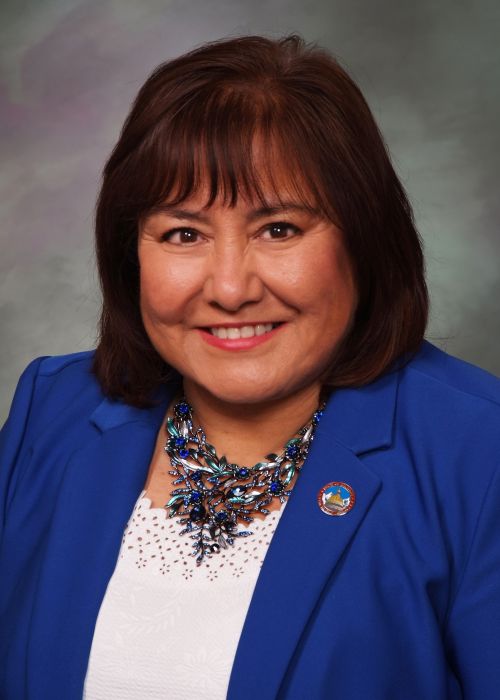
Rep. Cecelia Espenoza
Sponsored bills
In current law, a person who is a member of the Colorado National Guard who is accepted for enrollment at a designated institution of higher education (member) has all their tuition costs waived. All tuition waiver costs are currently funded by the state from money in the Colorado National Guard tuition fund. The act changes the funding mechanism of the Colorado National Guard tuition waiver program by requiring each designated institution of higher education to waive the remaining balance of a member's tuition cost in excess of the amount of any private, state, or federal financial assistance received. The act requires the department of military and veterans affairs to reimburse each institution for 50% of the cost of tuition waived by the institution and requires the general assembly to appropriate money to the Colorado National Guard tuition fund to cover the reimbursement.(Note: This summary applies to this bill as enacted.)
Risk assessments assess a parolee's criminogenic needs and risk of recidivism and are used to guide parole supervision planning, identify appropriate interventions, and establish parole supervision levels or categories. The act requires the department of corrections (department) to establish a risk assessment quality review team to develop policies and implement practices that determine whether risk assessments are completed accurately and consistently and to ensure a sustained process of review and training. For its 'SMART Act' hearing beginning in 2027, and each year thereafter, the department is required to include information concerning reviewed risk assessments, including findings and measures implemented to mitigate recent high error rates in risk assessments. The act clarifies that risk assessment outputs are criminal justice records for purposes of public inspection. The act prohibits an agreement that prohibits the disclosure of information in a risk assessment output that is subject to disclosure under the law.(Note: This summary applies to this bill as enacted.)
The act establishes a bill of rights for adults subject to guardianship (ward) and details what decisions a court may authorize a guardian to make on behalf of a ward. The act updates the duties of a guardian to include a duty to notify the ward at least 30 days before the ward is permanently moved to a nursing home, mental health institution, or other facility that restricts the ward's ability to leave the facility or have visitors. On or before November 1, 2027, and November 1, 2028, the act requires the state court administrator's office to submit a report detailing the fiscal impact of this act on the judicial department to the joint budget committee, the senate judiciary committee, and the house of representatives judiciary committee, or their successor committees, and requires the state court administrator's office to create the report using existing data sources.(Note: This summary applies to this bill as enacted.)
The act allows persons who are indigenous to receive compensation for traditional Native American healing ceremonies and practices and related expenses under the 'Colorado Crime Victim Compensation Act', which includes:Traditional counseling and healing from an elder or spiritual healer;Traditional ceremonial practices;Ceremonial burials, including clothing for the deceased, meals, and other related expenses;Child care during burial ceremonies;Reimbursement for honoraria provided in connection with ceremonial services; andReasonable travel expenses related to the traditional Native American healing ceremonies and practices.(Note: This summary applies to this bill as enacted.)
In 2022, the general assembly enacted, and the governor subsequently signed into law, House Bill 22-1358 ('Concerning measures to eliminate the presence of lead in the drinking water of certain facilities where children are present, and, in connection therewith, making an appropriation'), which required child care centers, family child care homes, and each public school that serves any of grades preschool through eighth grade to:Test its drinking water sources by having a state-certified laboratory measure the lead content of water drawn from each drinking water source; andSatisfy other requirements concerning the provision of safe drinking water. House Bill 22-1358 also created the school and child care clean drinking water fund (fund) to help schools, child care centers, and family child care homes comply with House Bill 22-1358. House Bill 22-1358 included a repeal date of June 30, 2026, for its provisions. The act extends the provisions, with amendments, until June 30, 2029. The act also adds high schools (i.e., schools that serve grades 9 to 12) to the scope of House Bill 22-1358, which means that high schools may receive grants from the fund and must satisfy certain requirements on or before dates specified in the act. The act requires the department to adopt rules establishing how a child care center shall demonstrate compliance with the requirements concerning the testing for the presence of lead in drinking water.(Note: This summary applies to this bill as enacted.)
The act exempts pilates and barre teacher training courses, programs, and schools from regulation under the 'Private Occupational Education Act of 1981'.(Note: This summary applies to this bill as enacted.)
The act prohibits using an automated driving system to drive a commercial motor vehicle unless an individual who holds a commercial driver's license is in the vehicle, monitors the vehicle's driving, and intervenes, if necessary, to avoid illegal or unsafe driving. The individual must be in the driver's seat if hazardous materials are being transported. The penalty is $1,000 for a first offense, is $2,000 for a second offense, and doubles for each subsequent offense. The act does not apply to a light-duty vehicle or a truck-mounted attenuator. The prohibition is repealed September 1, 2031. The chief of the Colorado state patrol will analyze the act's effects on commercial vehicle safety on highways. By November 1, 2030, the chief of the Colorado state patrol will issue a report to the relevant committees of the house of representatives and senate. The report must make recommendations as whether to continue the prohibition and, if continued, any recommended legislation to improve the prohibition. For the 2026-27 state fiscal year, $14,357 is appropriated to the department of revenue from the Colorado DRIVES vehicle services account in the highway users tax fund to implement the act.(Note: This summary applies to this bill as enacted.)
The act makes the following changes to the 'Labor Peace Act':Specifies that employees' right to bargain collectively includes the right to bargain collectively concerning any mandatory subject of bargaining;Eliminates the requirement for a second election to negotiate a union security agreement clause in the collective bargaining process;Declares that it is not an unfair labor practice for an employer to refuse to agree to a lawful proposal made by the exclusive representative of the employees, or for the exclusive representative of the employees to refuse to agree to a lawful proposal made by the employer, concerning a mandatory subject of bargaining if the refusing party has bargained in good faith with the other party; andRequires employers and employees, through their exclusive representative, to bargain in good faith.(Note: This summary applies to this bill as enacted.)
The act clarifies the conduct by which a person can commit criminally negligent homicide to include proximately causing the death of another person while operating or driving a motor vehicle with criminal negligence. The act repeals the class 1 misdemeanor traffic offense of a person being the proximate cause of death to another person while driving a motor vehicle, while clarifying it can be charged as a class 5 felony elsewhere in statute.(Note: This summary applies to this bill as enacted.)