

Current law requires a person or entity that acquires an automated external defibrillator (AED) to develop written plans for the placement, use, and maintenance of the AED (written plans). The act eliminates the requirements that the written plans: Identify personnel authorized to use the AED; and Be reviewed and approved by a licensed physician. The act imposes requirements for cardiac emergency preparedness for public and nonpublic schools. Beginning on or before January 1, 2026, a local education provider shall require each public school that acquires or has acquired an AED to place and maintain the AED in accordance with nationally recognized, evidence-based standards for emergency cardiovascular care, and the governing authority of a nonpublic school shall require each nonpublic school that acquires or has acquired an AED to place and maintain the AED in accordance with the same standards. (Note: This summary applies to this bill as enacted.)
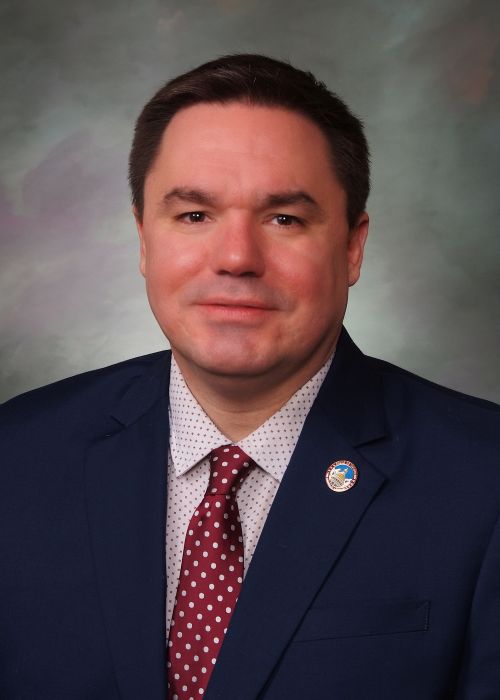
Rep. Chad Clifford
Sponsored bills
Maddy summarySenate Joint Resolution 25-015 designates a specific portion of Colorado State Highway 58 as the "Officer Evan A. Dunn Memorial Highway." This action honors Officer Evan A. Dunn, a Golden Police Department officer who died in the line of duty. The bill authorizes the Colorado Department of Transportation to accept donations for the initial placement of memorial signs and to explore a cooperative agreement with the City of Golden for their maintenance.
The act changes the tuition assistance program for eligible members of the Colorado National Guard (member) to a tuition waiver program (program). The act allows a member, upon being accepted for enrollment at a designated institution of higher education (institution), to pursue studies that lead to a postgraduate degree, a bachelor's degree, an associate degree, or a certificate of completion with all tuition waived. For a member, the tuition waiver must not exceed more than 65 credit hours at a designated 2-year institution of higher education and no more than 130 credit hours at a designated 4-year institution of higher education; except that the total credit hours for a member who attends both a 2-year institution and a 4-year institution must not exceed more than 145 credit hours. The department of military and veterans affairs (department) shall administer the program. In order to qualify for the program, a member must: Be accepted by an institution; Be in good standing with the Colorado National Guard; and Complete a Colorado application for state financial aid or a free application for federal student aid. Each institution shall determine if a member enrolled with the institution remains in satisfactory academic standing in accordance with the academic policies of the institution and is making progress toward the completion of the requirements of the education program in which the member is enrolled. If the institution finds that the member is not in satisfactory academic standing in accordance with the academic policies of the institution or is not making progress toward the completion of a degree, the member must reimburse the department for the amount of the tuition waived for that academic term. The act makes an appropriation of $562,787 to the department. (Note: This summary applies to this bill as enacted.)
Under current law, a parent who wants to relinquish their child must satisfy certain requirements. If the parent who wants to relinquish their child is a victim of sexual assault that resulted in the conception of the child to be relinquished, the act: Allows the relinquishment petitioner (petitioner) to provide the juvenile court with documentation concerning the sexual assault or conception, including a sworn affidavit; Exempts the petitioner from having to satisfy certain relinquishment requirements if the court finds that the petitioner is a victim of sexual assault that resulted in the conception of the child to be relinquished; and Exempts the petitioner of all legal obligations they may have with respect to the child if the court grants a final order of relinquishment. On or before January 1, 2026, the state court administrator shall develop a, or modify an existing, standardized form for a petitioner to file to terminate another person's parent-child legal relationship because the child was conceived as a result of sexual assault. (Note: This summary applies to this bill as enacted.)
The act defines an electronic fence detection system, which is a security system that is used in conjunction with a fence and is not located on real property that has been designated by a local government as exclusively for residential use. An electronic fence detection system includes a detector that, when contacted, causes an alarm system to transmit a signal to the business, a monitoring company authorized by the business owner, or law enforcement. The act allows a local government to impose installation or operational requirements for an electronic fence detection system within the local government's adopted process for the permitting of alarm systems. In addition, the act allows a local government to require a permit for the installation or use of an electronic fence detection system if the permit is not in addition to any permit generally required for the installation or use of any other alarm system. Lastly, the act allows a local government to inspect an electronic fence detection system. A local government may impose less stringent or more stringent requirements for or prohibit the installation or operation of an electronic fence detection system that is located in a residential area. (Note: This summary applies to this bill as enacted.)
The act requires the department of corrections (department) to search all information available to the department to determine whether an offender held at a correctional facility is subject to an outstanding warrant or if the offender has a pending case in a Colorado court. The department is required to conduct the search when the department conducts the initial comprehensive evaluation of the offender's sentence and 3 to 8 months prior to the offender's community correction eligibility date. The act requires the department to establish guidelines and policies that address requests for additional searches as may be needed by the public defender liaison to the department. If the department determines that an offender is subject to a warrant or has a pending case in a Colorado court, the department shall notify the offender, the public defender liaison to the department, and the court that issued the warrant or in which the case is pending, as applicable. The general assembly encourages a court to ensure the offender appears before the court, is assigned counsel if the defendant is eligible for court-appointed counsel, allows the offender to resolve the warrant in a timely manner, and facilitates virtual appearance for the offender. The act does not prohibit the department from searching for outstanding warrants at any other time. The act requires the office of state public defender to designate an email address for the public defender liaisons to the department of corrections to receive notifications from the department. (Note: This summary applies to this bill as enacted.)
The act repeals the existing nursing facility provider fee and intermediate care facility service fee, effective May 1, 2025, and provides that, beginning on May 1, 2025, and for each state fiscal year thereafter, the Colorado healthcare affordability and sustainability enterprise (CHASE) within the department of health care policy and financing (HCPF) will charge and collect a new healthcare affordability and sustainability nursing facility provider fee and a new healthcare affordability and sustainability intermediate care facility fee that function similarly to the repealed fees. The act creates a facility provider fee enterprise support board within CHASE for the purpose of supporting the existing enterprise with the implementation of the healthcare affordability and sustainability nursing facility provider fee and the healthcare affordability and sustainability intermediate care facility fee. In exchange for payment of the healthcare affordability and sustainability nursing facility provider fee, CHASE will provide certain business services to nursing facility providers to sustain or increase reimbursement rates and make supplemental medicaid payments to nursing facility providers. In exchange for payment of the healthcare affordability and sustainability intermediate care facility fee, CHASE will provide certain business services to intermediate care facility providers for individuals with intellectual disabilities for the purposes of maintaining the quality and continuity of services provided by intermediate care facilities for individuals with intellectual disabilities. Because CHASE is an enterprise for purposes of the Taxpayer's Act of Rights, its revenue does not count against the state fiscal year spending limit. The act also makes conforming amendments and, for clarity, renames the existing healthcare affordability and sustainability fee and healthcare affordability and sustainability fund to be the healthcare affordability and sustainability hospital provider fee and the healthcare affordability and sustainability hospital provider fee cash fund. For the 2025-26 state fiscal year, $62,986,221 is appropriated from the healthcare affordability and sustainability nursing facility provider fee cash fund to HCPF and $2,150,281 is appropriated from the healthcare affordability and sustainability intermediate care facility fee cash fund to HCPF. The act also decreases in corresponding amounts appropriations to HCPF from other cash funds and modifies appropriations to HCPF for the 2024-25 state fiscal year. (Note: This summary applies to this bill as enacted.)
The bill designates Colorado American Indian Recognition Day as an observed, but not a legal, state holiday. (Note: This summary applies to the reengrossed version of this bill as introduced in the second house.)
Provides for the payment of expenses of the executive, legislative, and judicial departments of the state of Colorado, and of its agencies and institutions, for and during the fiscal year beginning July 1, 2025, except as otherwise noted. (Note: This summary applies to this bill as enacted.)
Starting on July 1, 2028, the bill creates a process and establishes a public online forum for a member of the general assembly to publish drafts or titles of the bills that the member is considering introducing during the next legislative session. The bill allows each member to post multiple bill titles, drafts, or a combination of titles and drafts on the online forum and establishes a timeline for a member to publish up to 3 versions of each bill title or draft. The bill also requires each bill title or draft published to include a disclaimer stating that the bill is subject to change and may or may not be introduced based on the discretion of the prime sponsor. The web page on which the bill titles and drafts are published must be taken down on the day before the first day of the legislative session. Legislative council staff shall begin to implement the changes necessary to create the public online forum upon passage of the bill so that a member may publish bill titles and drafts by July 1, 2028. (Note: Italicized words indicate new material added to the original summary; dashes through words indicate deletions from the original summary.) (Note: This summary applies to the reengrossed version of this bill as introduced in the second house.)