Maddy summaryThis bill proposes that Colorado lawmakers consider adding guaranteed lifetime income options to the state public employees' retirement defined contribution plan and voluntary savings plans. The measure aims to ensure public employees have access to a reliable income stream in retirement, similar to what is already available in the state's traditional defined benefit plan. By allowing workers to choose options that provide lifetime payouts, the bill seeks to improve retirement security and financial confidence for over 226,000 active public employees. The resolution encourages the General Assembly to study how these new options could help workers retire with dignity while maintaining the portability of their savings.
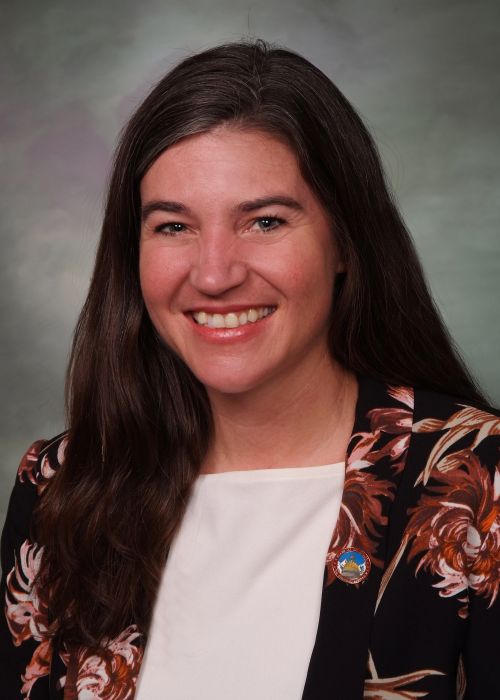
Rep. Rebekah Stewart
Sponsored bills
The bill modifies the definition for an 'eligible nonprofit organization' that may receive a disbursement from the school security disbursement program. The modified definition requires that the nonprofit be based in Colorado. and provide school safety incident response, violence prevention, and behavioral health training and expertise at no cost to local education providers, law enforcement agencies, and other first responders from Colorado. The bill requires the department of public safety to disburse all grant money awarded pursuant to the disbursement program for use in the upcoming school year no later than August 1 of that same calendar year. The bill directs the department to give priority to applicants that commit to providing their training to local education providers, local law enforcement agencies, and other local first responders at no charge.(Note: Italicized words indicate new material added to the original summary; dashes through words indicate deletions from the original summary.)(Note: This summary applies to the reengrossed version of this bill as introduced in the second house.)

If a mental health provider, substance use disorder provider, or psychiatric nurse (provider) has not submitted a claim for a period of at least 12 months, the act requires a commercial insurance carrier (carrier) to contact the provider to confirm the provider's participation in the carrier's provider network and to determine whether the provider is accepting new patients. The act includes mental health providers, substance use disorder providers, and psychiatric nurses as providers who may participate in a carrier's provider network. The act requires carriers to admit prelicensed providers into the carrier's network and to reimburse prelicensed providers for services rendered when provided under the supervision of a mental health provider, substance use disorder provider, or psychiatric nurse. The act requires a clinical social worker to complete 3,000 hours of practice prior to licensure.(Note: This summary applies to this bill as enacted.)
The bill requires that, on or after October 1, 2031, a subject jurisdiction shall not require:That a parcel lot have an area larger than 2,000 square feet if the parcel's lot's residential use is limited to a single family home; or Minimum lot frontage, setbacks, open space, or maximum lot coverage dimensions that have the practical effect of preventing the construction of a single family home on a lot that has an area of 2,000 square feet and that has a residential use limited to a single family home.The bill exempts certain types of parcels lots from this requirement.(Note: Italicized words indicate new material added to the original summary; dashes through words indicate deletions from the original summary.)(Note: This summary applies to the reengrossed version of this bill as introduced in the second house.)

Under current law, a special district is required to conform to its approved service plan and must petition the governing body of the county or municipality that approved the formation of the special district for approval of any material modifications of its approved service plan. Material modifications include a change in services provided by the special district, a decrease in the financial ability of the district to discharge existing or proposed indebtedness, and a decrease in the existing or projected need for organized service in the district's service area. The court that approved the organization of the special district may enjoin any material departure from the district's service plan as originally approved or from the district's service plan as modified. In the case of a health service district, a change in service by the district is not a material modification to or departure from the district's approved service plan, unless the change affects the license or certificate of compliance issued to the district by the department of public health and environment. The bill expands this provision to provide that the addition or termination of affordable housing services to a health service district's service plan is not a material modification to or departure from the district's approved service plan so long as a majority of the board of directors of the district affirmatively votes to approve the addition or termination of affordable housing services and any affordable housing services are carried out in coordination with local public housing entities . With this change, a health service district is able to provide affordable housing services, which are defined as the planning, financing, acquisition, construction, reconstruction or repair, maintenance, management, and operation of affordable housing-related projects or programs rehabilitation of affordable housing, or the provision of related supportive services , without needing to seek approval for a material modification to or departure from the district's approved service plan. The bill also makes conforming amendments.(Note: Italicized words indicate new material added to the original summary; dashes through words indicate deletions from the original summary.)(Note: This summary applies to the reengrossed version of this bill as introduced in the second house.)
Maddy summaryThis Senate Joint Resolution formally recognizes the 43rd anniversary of the sister-state relationship between Colorado and Taiwan while expressing support for their ongoing trade and academic exchanges. The bill highlights recent cooperation in emerging technologies such as quantum computing and semiconductors, and it advocates for Taiwan's participation in international organizations like the World Health Organization and the United Nations. Additionally, the resolution commends Taiwan's democratic system and supports the signing of a U.S.-Taiwan agreement on avoiding double taxation. As a non-binding legislative statement, it does not alter laws or budgets but serves to publicly endorse these diplomatic and economic ties.
Maddy summarySJM 1 is a joint memorial resolution honoring Senator Faith Winter, who died in November 2025. It recognizes her career as a Colorado legislator representing Adams, Broomfield, and Weld Counties, her work on environmental justice, women's leadership initiatives, and legislative achievements like the Paid Family and Medical Leave Act. The resolution expresses the legislature's condolences to her family and commemorates her legacy of advocacy for climate action, healthcare access, and community-centered policies. This procedural resolution does not create new laws or affect any policies.
The act authorizes the clean fleet enterprise (enterprise) to incentivize, support, and accelerate the replacement of a truck that is part of a fleet and that is powered by a diesel-fueled internal combustion engine, is a model year of 2009 or earlier, and is registered, operable, and capable of independent roadway operation (aging diesel truck) with a diesel truck that is a model year of 2018 or later (new diesel truck) until December 31, 2031. The act also allows the enterprise to provide funding or financing through grant programs, rebate programs, revolving loan funds, or other strategies to help owners and operators of aging diesel truck fleets finance the replacement of aging diesel trucks with new diesel trucks to reduce the up-front costs of acquiring new diesel trucks until December 31, 2031. The enterprise may use the clean fleet enterprise fund to provide money to support the replacement of aging diesel trucks with new diesel trucks, but the enterprise is required to ensure that it does not expend more than 20% of the fund's income during a state fiscal year for the support. To qualify for any money provided by the enterprise for the replacement of aging diesel trucks with new diesel trucks, the act requires a purchaser of the new diesel truck to surrender an aging diesel truck to the seller of the new truck. The seller of the new diesel truck must decommission the aging diesel truck by drilling a hole in the engine's block and cutting the chassis rails in half. The seller must be an authorized dealer of new diesel trucks who must certify that the new diesel truck meets all state and federal emissions and safety standards for its model year. The enterprise must prioritize applications to replace aging diesel trucks from businesses that are privately owned, independently owned, or have limited access to capital. The enterprise is not allowed to accept an application from the owner or operator of a motor vehicle fleet that owns, leases, or operates more than 50 heavy-duty motor vehicles or from a business entity with annual gross revenue exceeding $100 million. The enterprise is required to prioritize the replacement of an aging diesel truck that has a model year of no later than 2006. The act expands the business purpose of the enterprise to include providing incentives and support for refrigerated transport units powered by zero emission technology. The act allows the enterprise to exercise its rights and powers without regard to the state 'Procurement Code'. The act requires the enterprise to annually prepare a report that includes the estimated pollution reduction benefits of the enterprise. The enterprise must seek to ensure that all projects funded by the enterprise achieve measurable results and outcomes.(Note: This summary applies to this bill as enacted.)
The act requires that, beginning July 1, 2027, a death certification professional ensure that they are aware of the most recent epilepsy-related death certification recommendations from a nationally recognized and reputable organization. On or before June 1, 2027, the department of public health and environment (department) must electronically notify all registered medical certifier users of the Colorado vital events system of this requirement. If a death certification professional determines that the cause of an individual's death is consistent with known or suspected sudden unexpected death in epilepsy, the act requires the professional to ensure that the individual's death certificate identifies epilepsy as a contributing cause or a suspected cause of death. The act allows the department to provide online guidelines for clinicians and medical certifiers for death certificates regarding epilepsy-related deaths, including sudden unexpected death in epilepsy.(Note: This summary applies to this bill as enacted.)
The act exempts from schedule I a prescription drug product containing a schedule I controlled substance (product) if the product is:Approved for prescription use by the United States food and drug administration;Designated or rescheduled by the United States drug enforcement agency (DEA); Dispensed by a pharmacy or prescription drug outlet, or administered by an authorized practitioner; andPossessed by a person who is authorized to possess a controlled substance. The exemption applies upon the DEA's designation or rescheduling. The act requires that the product be controlled in Colorado in the same manner as the product is controlled by the DEA and state law. The act clarifies that its provisions do not apply to or affect the regulation of or lawful actions or conduct concerning natural medicine, natural medicine product, marijuana, or marijuana concentrate.(Note: This summary applies to this bill as enacted.)