The act authorizes an occupational therapist to directly recommend or prescribe durable medical equipment to a patient without requesting the prescription from a licensed physician and requires that the occupational therapist consult with the patient concerning payment options. (Note: This summary applies to this bill as enacted.)
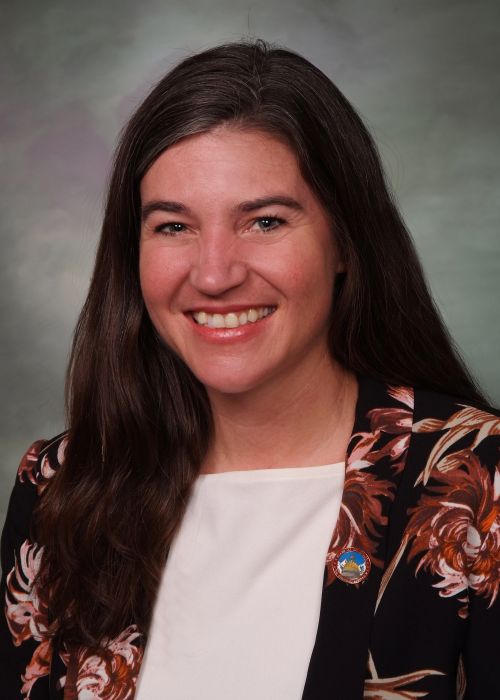
Rep. Rebekah Stewart
Sponsored bills
Maddy summarySJR 25-013 is a symbolic resolution recognizing Thursday, March 20, 2025, as Nowruz Day in Colorado. It honors the ancient Persian New Year celebration observed by Iranian, Kurdish, Afghan, and Central Asian communities, acknowledging its cultural significance and the contributions of Colorado's Iranian-American residents. The resolution has no legal effect but formally extends recognition to the traditions of Nowruz, including its themes of renewal and community. It directly affects Colorado's Iranian-American community by affirming their cultural heritage through state acknowledgment.
Maddy summaryThis resolution (SJR 25-009) expresses Colorado's support for federal management of national public lands, including parks, forests, and monuments. It formally opposes efforts to sell, transfer, or dispose of these lands and urges Colorado's governor, attorney general, and congressional delegation to take action against such proposals. The resolution is non-binding but directs state officials to advocate for continued public stewardship by federal agencies like the National Park Service and Bureau of Land Management. It was passed by the Colorado Senate and referred to the House for consideration.
Under existing law, the department of corrections is required to develop and implement initiatives specifically designed to assist each offender's transition from a correctional facility into the community. The act adds peer support behavioral health services that are provided by credentialed peer support professionals or other researched-based programs as a component listed in state law that may be included in an initiative. (Note: This summary applies to this bill as enacted.)
The act clarifies that the health benefits coverage for the prevention of, screening for, and treatment of behavioral, mental health, and substance use disorders must be no less extensive than the coverage provided for any physical illness. The act requires that every health benefit plan provide coverage for medically necessary treatment of covered behavioral, mental health, and substance use disorder benefits, consistent with specified criteria. The act also specifies criteria to be used for conducting utilization review, service intensity, and the level of care for covered persons. In addition, the act prohibits: A health benefit plan from limiting coverage for chronic behavioral, mental health, or substance use disorders to short-term symptom reduction; and A health insurance carrier from reversing or altering a determination of medical necessity except in the case of fraud. The act requires carriers that provide benefits for mental health conditions or substance use disorders to offer meaningful benefits for mental health conditions and substance use disorders. The act describes how to determine whether the benefits provided are meaningful benefits. The commissioner of insurance is authorized to adopt rules to: Establish carrier utilization review compliance; Specify data testing requirements for plan design and application of parity compliance; Set standard definition for coverage requirements; Establish timelines for carriers to provide comparative analysis information to the division of insurance; and Establish time periods for visits with a provider for treatment of a behavioral, mental health, or substance use disorder after an initial visit with a provider.(Note: This summary applies to this bill as enacted.)
Maddy summarySJR 25-011 is a symbolic resolution passed by the Colorado General Assembly to recognize the 19th annual Latino/a Advocacy Day 2025. It honors the contributions of Latinas and Latinos to Colorado's political engagement and their advocacy for equitable policies addressing systemic inequities in health, housing, education, and economic opportunity. The resolution directs copies to the event organizers, the Colorado Organization for Latina Opportunity and Reproductive Rights (COLOR) and Voces Unidas de las Montañas, and expresses the legislature's commitment to creating a Colorado that works for all residents regardless of immigration status. As a commemorative resolution, it has no legal effect but serves as a formal acknowledgment of community advocacy efforts.
Maddy summaryThis joint resolution declares February 28, 2025, as Rare Disease Day in Colorado to raise awareness about rare diseases. It directly affects Colorado residents living with rare diseases - over 500,000 people - and their families, recognizing the challenges they face, including high medical costs and limited treatments. The resolution makes no new policy changes but symbolically honors those impacted by urging the state to "show our stripes" in solidarity. It references national statistics (e.g., 1 in 10 Americans affected) and the "zebra" awareness symbol for rare conditions, without creating any legal obligations or funding.
Under current law, certain evidence of a victim's prior or subsequent sexual conduct is presumed irrelevant and inadmissible in a civil proceeding, but there is an exception for evidence of the victim's prior or subsequent sexual conduct with the defendant. The act eliminates this exception. The act prohibits the admission of evidence of the victim's manner of dress, hairstyle, mode or manner of speech, or lifestyle as evidence of the victim's consent, credibility, or the existence or extent of damages or harm. The party moving to admit evidence presumed irrelevant is required to raise the issue at a pretrial conference and make a prima facie showing that the evidence is relevant for an admissible reason and that discovery is likely to rebut the presumption of inadmissibility. The court is required to allow the nonmoving party to object. If the court allows discovery, the court must issue a protective order that limits the scope of discovery to relevant issues and protect against unwarranted, irrelevant, or overly broad discovery into the alleged victim's sexual conduct or history. (Note: This summary applies to this bill as enacted.)
The act requires a board of county commissioners, a governing body of a municipality, or a regional building department operating through an intergovernmental agreement with a board of county commissioners or governing body of a municipality that adopts or substantially amends a building code or updates a building code with a succeeding version of the international building code to ensure that the building code meets or exceeds the accessibility standards in the International Building Code, and the adopted accessibility standards cannot provide less protection than what is required by the federal "Americans with Disabilities Act of 1990". However, this requirement does not apply when energy-efficient building codes are adopted, nor does it apply to one- and 2-family dwellings and townhomes that comply with either the International Residential Code or a local building code whose accessibility standards are equivalent to the standards in the International Residential Code. The act requires the division of fire prevention and control within the department of public safety to ensure that, when certain building codes pertaining to public school and health facilities are substantially amended, the codes meet or exceed accessibility standards in the International Building Code. The act also requires the state housing board to ensure that, when the uniform construction and maintenance standards for hotels, motels, and multiple dwellings in jurisdictions with no local building code are substantially amended, the standards meet or exceed the accessibility standards in the International Building Code. The act also requires the state housing board to ensure that, when the recommendations for uniform housing standards and building codes to the general assembly and local governments are substantially amended, the codes meet or exceed the accessibility standards in the International Building Code. (Note: This summary applies to this bill as enacted.)

The act specifies that a third-party contractor or grantee may administer a program in the division of housing in the department of local affairs (division) for persons experiencing homelessness that is funded from the affordable housing support fund. The division may negotiate reasonable administrative or project delivery costs for contractors or grantees to administer the program to be paid from the fund in addition to the up to 5% of the fund that the division is authorized to retain for program administration and oversight. The division must consider the past performance history of a contractor or grantee when selecting a contractor or grantee to administer the program. (Note: This summary applies to this bill as enacted.)