The act repeals the existing requirement that a paper certificate of title be used for specific vehicle transactions, thereby allowing the use of a certificate of title in an electronic format in all circumstances. Any party to a vehicle transaction may request either a paper or electronic version of a certificate of title.(Note: This summary applies to this bill as enacted.)
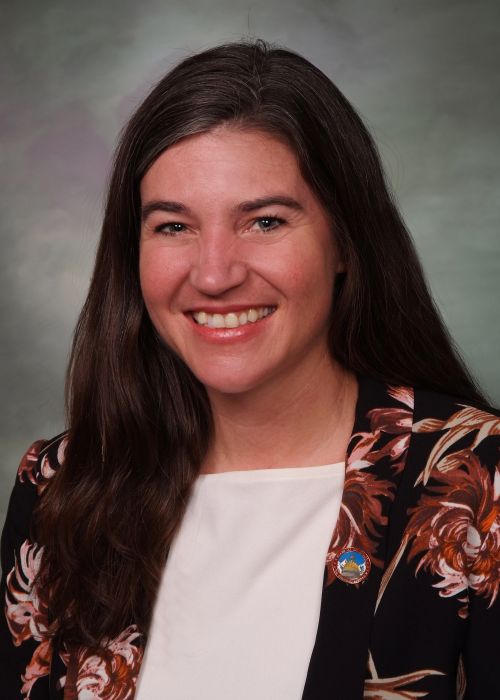
Rep. Rebekah Stewart
Sponsored bills
Maddy summaryThis House Memorial honors the life and service of former Colorado Representative Carl Miller, who passed away in August 2025. The document formally recognizes his contributions to Colorado through his work in local government, the mining industry, and public service, including his role in establishing the National Mining Hall of Fame and Museum. It extends condolences to Miller's family and pays tribute to his dedication to his community and state during his career as a state representative and public utility commissioner.
The act requires a subject jurisdiction to, on or after December 31, 2027, subject to an administrative approval process, allow the construction of a residential development on a qualifying property that does not contain an exempt parcel; except that, if on December 31, 2027, a subject jurisdiction is actively in the process of updating the subject jurisdiction's zoning or development code to comply with the act, the subject jurisdiction is required to complete the updates and allow the construction of a residential development on a qualifying property that does not contain an exempt parcel by June 30, 2028. A qualifying property is real property that contains no more than 5 acres of land and is owned by:A school district;A state college or university;A board of cooperative services;A housing authority;A local or regional transit district or a regional transportation authority serving one or more counties;A nonprofit organization with a demonstrated history of providing affordable housing; orA nonprofit organization that has entered into an agreement with another nonprofit organization with a demonstrated history of providing affordable housing, provided that the agreement requires the nonprofit organization with a demonstrated history of providing affordable housing to develop a residential development on the property. If a subject jurisdiction requests, as part of an initial development application, that a nonprofit organization with a demonstrated history of providing affordable housing provide documentation that the nonprofit meets required criteria, the nonprofit organization shall provide the documentation. A subject jurisdiction is not required to allow a residential development on a qualifying property if the subject jurisdiction implements a transferable development rights program on the qualifying property and if the transferable development rights program includes a policy for affordable resident housing that is restricted in ownership and occupancy in perpetuity. A subject jurisdiction shall not:Disallow construction of a residential development on a qualifying property on the basis of height if the tallest structure in the residential development is no more than 3 stories or 38 feet tall, except in certain circumstances;Disallow construction of a residential development on a qualifying property on the basis of height if the tallest structure in the residential development complies with the height requirements of the zoning district in which the residential development will be built or the height requirements that apply to any parcel zoned to allow for residential development that is contiguous to the qualifying property on which the residential development will be built;Disallow construction of a residential development on a qualifying property based on the number of dwelling units the residential development will contain, except in accordance with standards listed in the act; orApply site design standards to a residential development on a qualifying property that are more restrictive than the site design standards the subject jurisdiction applies to similar housing constructed within the subject jurisdiction, including standards related to structure setbacks from property lines; lot coverage or open space; on-site parking requirements; numbers of bedrooms in a multifamily residential development; on-site landscaping, screening, and buffering requirements; solar access; minimum dwelling units per acre; or other objective setback standards that apply to residential dwellings, including setbacks from oil and gas facilities, oil and gas operations, stream corridors, riparian areas, wetlands, and sensitive wildlife habitats. Provided that the uses are allowed conditionally or by right within the zoning district in which a qualifying property is located, a subject jurisdiction shall allow the following uses in a residential development on a qualifying property:Child care; andThe provision of recreational, social, or educational services provided by community organizations for use by the residents of the residential development and the surrounding community. On or before December 31, 2027, the department of local affairs is required to publish guidance to assist subject jurisdictions in verifying the status of a nonprofit organization with a demonstrated history of providing affordable housing.(Note: This summary applies to this bill as enacted.)

The act allows a board of county commissioners and the governing body of a municipality to sell and dispose of property owned by the county or municipality, as applicable, to provide for affordable housing and allows a municipality to enter into a long-term rental or lease agreement for the development of affordable housing. The act allows for the approval of a mutijurisdictional housing authority at a biennial local election instead of only during a general election or an election held on the first Tuesday in November of an odd-numbered year. The ballot question about establishing the authority may be combined with a question about a tax, impact fee, multiple-fiscal year debt, or other financial obligation. The act allows a board of county commissioners to use ad valorem tax revenue for housing authorities, housing programs, and workforce housing. The act entitles an entity subject to income tax to which a middle-income housing tax credit is transferred by a governmental entity or quasi-governmental entity to claim the credit without owning an interest in a qualified project. The sale and use of construction materials by contractors is exempt from taxation if the materials are used by the state in its governmental capacity only. The act provides that 'governmental capacity' includes the construction of workforce housing projects undertaken by counties.(Note: This summary applies to this bill as enacted.)

Maddy summaryThis bill designates March 8, 2026, as International Women's Day in Colorado and acknowledges the historical and ongoing contributions of women to society. It recognizes women's achievements across various fields, including politics, business, and social movements, while highlighting Colorado's early history of women's suffrage and female leadership in state government. The resolution encourages continued celebration of this day and commits the legislature to supporting policies that promote gender equality and women's empowerment.
Maddy summaryThis Senate Joint Resolution expresses Colorado's legislative support for maintaining national public lands under federal stewardship and opposes efforts that would reduce public access or weaken environmental review laws. The resolution specifically targets potential erosion of bedrock federal laws like NEPA and FLPMA, which require public input and balanced resource management. It calls on state and federal officials to defend statutory safeguards that ensure public lands serve broad public benefits rather than narrow special interests. This non-binding resolution does not change any laws but serves as a formal statement of legislative intent and values regarding public land management.
Maddy summaryThis House Resolution honors Bob Holder, a wildlife manager from Colorado who has dedicated 50 years to protecting wildlife resources in southern Colorado. The measure formally recognizes his contributions to conservation efforts, including his work with black bear education, wildlife enforcement, and habitat preservation through land acquisitions and conservation easements. The resolution expresses gratitude for his service and directs that a copy be sent to Holder as a token of appreciation upon his retirement.
The bill requires the statewide decriminalization of commercial sexual activity among consenting adults. It declares that decriminalizing commercial sexual activity among consenting adults is a matter of statewide concern and expressly preempts statutory or home rule city, town, city and county, or county ordinances, resolutions, regulations, or codes criminalizing commercial sexual activity.The bill repeals the state criminal offenses of prostitution, soliciting for prostitution, keeping a place of prostitution, patronizing a prostitute, and prostitute making display. It also repeals the offense of pandering when it involves knowingly arranging or offering to arrange a situation that permits a person to practice prostitution. The bill maintains current state criminal penalties for pandering that involves menacing or criminal intimidation and for pimping, but it changes terminology in those offenses by replacing "prostitution" with "commercial sexual activity".The bill makes various conforming amendments, including those related to: Reporting requirements, immunity, affirmative defenses, and criminal conviction records in human trafficking cases; public nuisances; certification by the peace officers standards and training board; and the regulation of escort bureaus and massage parlors. The bill eliminates a court program for persons charged with certain prostitution-related offenses.(Note: This summary applies to this bill as introduced.)
Maddy summarySJR 11 is a commemorative resolution designating a specific segment of U.S. Highway 34 (between Wilson Ave. and North County Rd. 23H) as the "Sgt. John 'Jack' Thurman Memorial Highway" in honor of a World War II Marine Corps veteran. The bill, which has no policy or funding provisions, simply names the highway section to recognize Sergeant Thurman's service at Iwo Jima, his military awards, and his post-war contributions as an architect and community leader in Colorado. It authorizes the Colorado Department of Transportation to accept donations for signage and explore maintenance agreements with local governments. This is a ceremonial designation with no direct impact on residents or new laws.
Maddy summarySJR 4 designates September 20-26, 2026, as "Frontotemporal Degeneration (FTD) Awareness Week" in Colorado. This symbolic resolution recognizes FTD - a terminal, incurable neurodegenerative disease affecting speech, behavior, and motor skills - and aims to increase public awareness of the condition. It directly supports Coloradans living with FTD, their families, and advocacy groups like the Association for Frontotemporal Degeneration, which focuses on research and care. The bill has no funding or regulatory provisions, as it is purely a recognition measure.