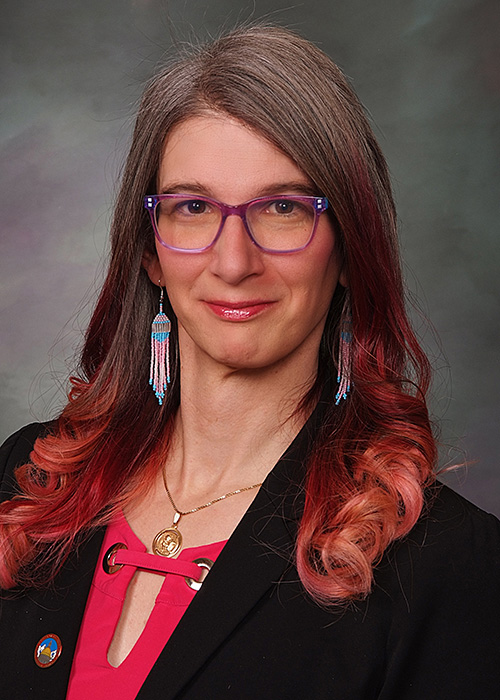
Photo of Brianna Titone
D Colorado House · District 27

Rep. Brianna Titone

Compare
Total votes
7,519
all sessions
Attendance
98%
151 missed
Near the chamber average
With party
96%
of cast votes
Near the chamber average
Bipartisan score
2%
crosses aisle rarely
Near the chamber average
Sponsored
517
bills & resolutions
Near the chamber average
Committees
5
assignments
517 bills and resolutions

Sponsored bills

Total
517
Primary
159
Co-sponsor
358
This page
517
matching current filters
Co-sponsor HJR 25-1030
Passed · Colorado House · Co-sponsor
Products with Forced Labor Components

Maddy summaryHouse Joint Resolution 25-1030 expresses the State of Colorado's strong opposition to the use of forced labor in the production of goods. The resolution states that Colorado will use its purchasing power to support businesses that ethically source or manufacture products without forced labor. It also encourages state and local economic development offices to attract businesses that avoid these labor practices. This joint resolution aims to influence state and local government purchasing decisions and promote ethical business standards.

Passed May 6, 2025 1 co-sponsor
Co-sponsor HJR 25-1026
Passed · Colorado House · Co-sponsor
Designate Representative Hugh McKean Memorial Highway

Maddy summaryHJR 25-1026 designates Colorado State Highway 402, from United States Highway 287 to Interstate 25, as the "Rep. Hugh McKean Memorial Highway." It also authorizes the Colorado Department of Transportation (CDOT) to accept donations for the initial placement of signs and to explore agreements with Larimer County for sign maintenance.

Passed May 6, 2025 1 co-sponsor
Co-sponsor HB 25-1302
Passed · Colorado House · Co-sponsor
Increase Access Homeowner's Insurance Enterprises

The bill creates 2 enterprises in the division of insurance (division) in the department of regulatory agencies. The bill creates the strengthen Colorado homes enterprise (strengthen homes enterprise), which is a state-owned business that imposes and collects a fee from insurance companies (insurers), including the FAIR plan association, that offer on policyholders of homeowner's insurance policies issued by insurance companies (insurers) and the fair access to insurance requirements (FAIR) plan association in the admitted market covering property located in or risks in Colorado. which The fee is collected on a per-policy basis and is equal to 1.5% of one-half percent on the dollar amount percentage of the total premiums that the insurer collects in the immediately preceding calendar year from homeowners for issuing homeowner's insurance policies ( insurer fee); except that an insurer shall not collect the fee on policyholders that have resilient roof systems. With the insurer fee revenue, the strengthen homes enterprise board administers a grant program (grant program) to strengthen homes against the risk of future damage claims caused by high winds, wildfire, hail, and other extreme weather events (extreme weather events) by allowing a homeowner to use grant money to upgrade their roof system with certain resilient roof materials. By paying the insurer fee to support the grant program to retrofit homes with resilient roofs, policyholders may defray the cost of retrofitting their property to resist losses due to common perils, including windstorms, wildfire, and other extreme weather events, and insurers reduce their overall risk in the market due to hail and other extreme weather events, in order to promote insurance market stability throughout the state. The bill also creates the wildfire catastrophe reinsurance enterprise (reinsurance enterprise), which is a state-owned business implementing and administering the wildfire catastrophe reinsurance program (reinsurance program). The reinsurance program makes reinsurance payments to insurers that offer homeowner's insurance on properties located in the state to partially mitigate losses in the event of a state or federally declared wildfire-related disaster (wildfire-related disaster). The purpose of the reinsurance program is to stabilize the homeowner's insurance market in the state and to attract and retain homeowner's insurers. In exchange for access to the reinsurance program, the reinsurance program requires insurers to sell homeowner's insurance in areas of the state that are at high risk for wildfires. To pay for the reinsurance program, the reinsurance enterprise: Issues revenue bonds secured by the reinsurance enterprise; Issues a catastrophe bond to a person that purchases the bond but pays the principal to cover costs of a wildfire-related disaster if it occurs; May impose and collect an insurer fee on insurers to cover a shortfall if a wildfire-related disaster does not occur during the bond term and the reinsurance enterprise has insufficient money to redeem the bonds at maturity; and Beginning in the 2026 calendar year, impose and collect a fee on a per-policy basis on each policyholder of a homeowner's insurance policy issued in the admitted market covering property in or risks in the state. The amount of the fee is equal to one-half percent on the percentage of total premiums collected by each insurer in the immediately preceding calendar year. Invests the revenue from the revenue bonds and insurer fees. In addition, the bill sets the loss ratio for homeowner's insurance by presuming that the rates charged to purchasers are excessive if the insurer's loss ratio is less than 75% over a 3-year period and, if rates are in excess of the loss ratio, requires insurers in the admitted market participating in the reinsurance program to submit rates that are at least 5% less than the previous year one set of rates taking into consideration the reinsurance program and one set without. In addition to offering a replacement-cost policy in accordance with current law, an insurer may offer a replacement-cost policy that has a reasonable coverage limit or percentage cap for additional living expenses if the insurer provides a premium decrease for the coverage limit or replacement cap that is approved by the division. For the 2025-26 state fiscal year, the bill appropriates $7,410,037 to the department of regulatory agencies from the strengthen homes enterprise and also appropriates money to the department of law for legal services to implement the reinsurance program. (Note: Italicized words indicate new material added to the original summary; dashes through words indicate deletions from the original summary.) (Note: This summary applies to the reengrossed version of this bill as introduced in the second house.)


Passed May 6, 2025 1 co-sponsor
Co-sponsor SB 25-194
Signed into law · Colorado Senate · Co-sponsor
Sunset Dental Practice Act

The act makes changes to the "Dental Practice Act" (act) by: Continuing the act for 9 years, until 2034; Updating and adding definitions; Changing the membership of the Colorado dental board (board); Adding to and updating the grounds for which the board may take disciplinary action against an applicant for licensure or a licensee; Allowing a licensee's submission to a mental or physical examination to satisfy the requirement to notify the board of a condition that may impair the licensee's ability to practice; Adding as exemptions to the act the volunteer practice of dental therapy and dental hygiene under specific conditions; Subjecting dentistry practiced by a professional service corporation to certain limits and requirements; Repealing exceptions that allow a dental therapist, dental hygienist, or dental assistant to perform certain dentistry practices and including additional tasks in the practice of dentistry; Clarifying that a dental assistant, dental hygienist, or dental therapist may perform tasks consistent with rules adopted by the board; Requiring a provider who performs itinerant surgery to develop and maintain protocols for emergency follow-up care; Clarifying the authority of a licensed dentist to prescribe orders electronically; Requiring a peer health assistance program selected as a designated provider for the dentist peer health assistance program to provide training to dentists who practice monitoring services; Authorizing a dentist to self-refer to participate in a peer health assistance program or be referred by the board; Removing a requirement that dental therapy education schools and programs must be accredited or approved by a specific entity; Requiring the board to adopt rules that allow for expedited, temporary licensure during a declared disaster emergency; Regulating anesthesia inspectors and requiring the board to design and implement expedited permitting of dentists with certain anesthesia or sedation training; Updating the business information a licensee must provide to the board and the circumstances under which providing the information is required; Repealing specific tasks that are currently authorized to be performed by a dental hygienist; Updating procedures for the construction of dental devices by an unlicensed technician; Updating the list of practices that are considered to be the practice of unsupervised dental hygiene; Repealing the specific dosages of certain drugs that a dental hygienist may prescribe; Authorizing the board to adopt rules that identify safe prescribing alternatives to silver diamine fluoride as a treatment for strengthening teeth and preventing tooth decay; Identifying tasks that constitute practicing supervised dental hygiene; Requiring a dental hygienist performing an interim therapeutic restoration to confirm a referral for follow-up care with a dentist; Limiting the number of dental hygienists or dental therapists that a dentist may supervise; and Authorizing a dental therapist to perform specific tasks.(Note: This summary applies to this bill as enacted.)

Signed into law May 5, 2025 1 co-sponsor
Primary SB 25-318
In committee · Colorado Senate · Lead sponsor
Artificial Intelligence Consumer Protections

Maddy summaryThis bill, SB 25-318, aims to establish consumer protections in interactions with artificial intelligence (AI) systems in Colorado. It defines "algorithmic discrimination" as unlawful differential treatment by AI systems based on protected characteristics such as age, race, or disability. The bill specifies "consequential decisions" as those made by AI that significantly impact a consumer's access to or terms of education, employment, financial services, healthcare, housing, and other essential services. It also defines the responsibilities of "deployers" (users) and "developers" of high-risk AI systems that make these consequential decisions, outlining when certain AI systems are not considered high-risk.

In committee May 5, 2025 0 co-sponsors
Primary SJR 25-015
Passed · Colorado Senate · Lead sponsor
Officer Evan A. Dunn Memorial Highway

Maddy summarySenate Joint Resolution 25-015 designates a specific portion of Colorado State Highway 58 as the "Officer Evan A. Dunn Memorial Highway." This action honors Officer Evan A. Dunn, a Golden Police Department officer who died in the line of duty. The bill authorizes the Colorado Department of Transportation to accept donations for the initial placement of memorial signs and to explore a cooperative agreement with the City of Golden for their maintenance.

Passed May 2, 2025 0 co-sponsors
Primary SB 25-132
Passed · Colorado Senate · Lead sponsor
Spirituous Liquor Manufacturer Tastings Conducted

Under current law, a licensed manufacturer of spirituous liquor (manufacturer) may conduct tastings of the manufacturer's own spirituous liquors at the manufacturer's licensed premises or at one other approved sales room location. The bill authorizes the manufacturer to also conduct tastings: Of other alcohol beverages acquired from a wholesaler licensed in the state; and At up to 5 2 approved sales room locations. A manufacturer must apply for a permit from the state licensing authority to serve and sell alcohol beverages acquired from a wholesaler licensed in the state at the manufacturer's premises or a sales room location. A copy of the permit application must be posted for 30 days in a conspicuous place at the location that is the subject of the application and must be published in a local newspaper of general circulation. If the permit application is approved, the manufacturer must serve sandwiches and light snacks if selling and serving alcohol beverages acquired from a wholesaler licensed in the state and must not have the proceeds from the sale of alcohol beverages acquired from wholesalers account for more than 50% of the total proceeds for alcohol beverage sales. (Note: Italicized words indicate new material added to the original summary; dashes through words indicate deletions from the original summary.) (Note: This summary applies to the reengrossed version of this bill as introduced in the second house.)
Passed May 1, 2025 0 co-sponsors
Co-sponsor HB 25-1185
Signed into law · Colorado House · Co-sponsor
Child Conceived from Sex Assault Court Proceedings

Under current law, a parent who wants to relinquish their child must satisfy certain requirements. If the parent who wants to relinquish their child is a victim of sexual assault that resulted in the conception of the child to be relinquished, the act: Allows the relinquishment petitioner (petitioner) to provide the juvenile court with documentation concerning the sexual assault or conception, including a sworn affidavit; Exempts the petitioner from having to satisfy certain relinquishment requirements if the court finds that the petitioner is a victim of sexual assault that resulted in the conception of the child to be relinquished; and Exempts the petitioner of all legal obligations they may have with respect to the child if the court grants a final order of relinquishment. On or before January 1, 2026, the state court administrator shall develop a, or modify an existing, standardized form for a petitioner to file to terminate another person's parent-child legal relationship because the child was conceived as a result of sexual assault. (Note: This summary applies to this bill as enacted.)

Signed into law May 1, 2025 1 co-sponsor
Co-sponsor HB 25-1123
Passed · Colorado House · Co-sponsor
Homeowners' Association Alternative Dispute Resolution

Under current law, common interest communities are encouraged to use mediation prior to filing a complaint with the court. The bill requires permits a dispute between a unit owner and a unit owners' association to go through an internal dispute resolution process participate in an informal negotiation and mediation to resolve the dispute before the parties can file a complaint with the court. If the parties are unable to reach a mediation agreement, the bill allows the parties to undergo arbitration or commence a legal proceeding. If the parties are unable to reach an agreement during the informal negotiation, either party may file a complaint with the court and the court must order the parties to participate in mediation, if mediation has not already taken place. (Note: Italicized words indicate new material added to the original summary; dashes through words indicate deletions from the original summary.) (Note: This summary applies to the reengrossed version of this bill as introduced in the second house.)

Passed May 1, 2025 1 co-sponsor
Co-sponsor SB 25-063
Signed into law · Colorado Senate · Co-sponsor
Library Resource Decision Standards for Public Schools

Each school district, board of cooperative services that operates a school, district charter school, and institute charter school (local education provider) is required to establish written policies for the acquisition, retention, display, and use of library resources and for the reconsideration of a library resource (policies). A local education provider is required to comply with specified standards in establishing the policies and is required to establish the policies by September 1, 2025. If a local education provider has already established policies that comply with the requirements of the act, the local education provider is not required to establish new policies. A public school library may remove a library resource from its permanent collection only if the library resource has been reviewed in accordance with an established policy for the reconsideration of library resources that complies with the standards established in the act. These requirements do not apply to routine collection maintenance and deaccession in accordance with a public school library's established collection development and maintenance policy. Before a local education provider reconsiders a library resource, the local education provider is required to make its policies available to the public. After reviewing a library resource that is the subject of a request for reconsideration and making a final determination regarding the library resource, the local education provider is required to make the determination available to the public. A written request for reconsideration of a library resource in a public school library is an open record under the "Colorado Open Records Act". A public school library staff member is not subject to termination, demotion, discipline, or retaliation for refusing to remove a library resource before it has been reviewed in accordance with the local education provider's policy for the reconsideration of library resources or for making decisions that the public school library staff member believes, in good faith, are in accordance with the policies of the local education provider. (Note: This summary applies to this bill as enacted.)

Signed into law May 1, 2025 1 co-sponsor
Showing 301 to 310 of 517 bills
Previous 1 … 30 31 32 … 52 Next