

The act adds statutory protections for in vitro fertilization and other assisted reproductive health-care procedures. Current law requires gamete banks and fertility clinics (donor banks) to maintain donor identifying information and update it every 3 years. The act requires donor banks to encourage donors to inform the donor banks of significant updates to the donor's medical history after the donor made a donation. The donor bank is then required to document that significant medical history update. Current law prohibits donor banks from interfering with an adult donor-conceived person communicating about the gamete donor with the donor-conceived person's friends, family, or other third parties. The act encourages donor banks to provide information to donor-conceived persons regarding the physical and emotional risks associated with releasing a donor's private information to outside parties. The act repeals certain provisions relating to gamete donor record stewardship in the event of donor bank dissolution, bankruptcy, or insolvency and eliminates the requirement that donor banks inform a recipient parent about future implications about a gamete donor's medical history or other persons conceived using the same gamete donor. Current law requires the department of public health and environment (department) to draft written materials that must be provided to individuals prior to donating or receiving gametes. The act maintains that requirement, but does not require donor banks to use the department's written material. Donor banks are permitted to develop their own written materials to meet the statutory requirement of providing certain information to an individual prior to donating or receiving gametes. The act eliminates the department's ability to perform on-site inspections or perform in-person investigations on donor banks located outside the state. (Note: This summary applies to this bill as enacted.)
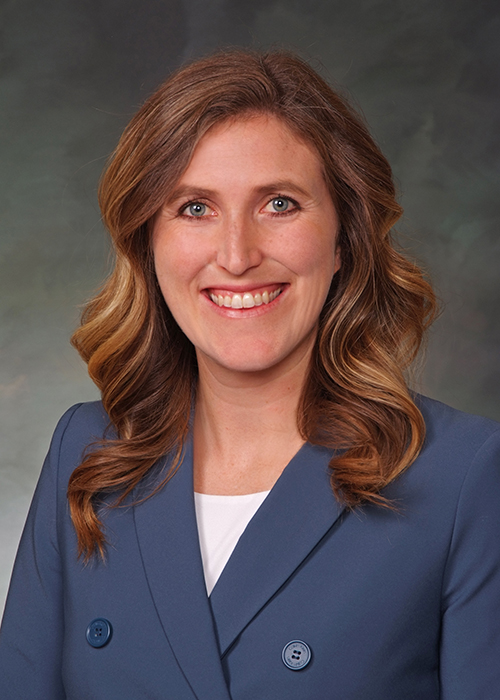
Rep. Meghan Lukens
Sponsored bills
The act removes the term "homosexuality" from the definition of sexual conduct in the sexually explicit materials harmful to children part of the "Colorado Criminal Code". (Note: This summary applies to this bill as enacted.)
The act creates the work-based learning consortium pilot program (pilot program) in the department of higher education (department). The purpose of the 3-year pilot program is to: Demonstrate the value of work-based learning in postsecondary curricula by studying the impact of industry-sponsored projects on course objectives and learning outcomes; Promote the adoption of work-based learning in higher education by working with faculty at institutions of higher education (institutions) that participate in the pilot program (participating institutions) to embed project-based learning opportunities into credit-bearing programs; Provide broader access to collegiate work-based learning for students; Measure the impact of work-based learning on participating students; and Learn how institutions can increase the value of postsecondary education through career exposure and preparedness. Pending the receipt of sufficient funds, the department shall convene a consortium (consortium) of representatives from participating institutions, the commission on higher education (commission), the department of labor and employment, the department of education, and a subject matter expert with experience implementing work-based learning. The consortium shall: Work with each participating institution's faculty to embed industry-sponsored projects in course curriculum that meet the work-based learning quality standards; Work with the department to determine the impact of industry-sponsored projects; Work with a third-party platform to connect faculty from participating institutions to employers for the purpose of developing high-quality, project-based learning opportunities for classroom instruction; Advise the commission on strategies to improve student access to high-quality, work-based learning opportunities for students based on participating faculty members' experience embedding industry-sponsored projects into curriculum; Develop best practices for institutions to expand access to work-based learning in the classroom through industry-sponsored projects; and Develop findings and recommendations. Subject to available appropriations, at the end of the pilot program, the act requires the consortium to complete and submit a report to the education committees of the house of representatives and the senate, or their successor committees. The report must include: A description of the consortium's findings and recommendations; Details on the consortium's impacts on participating institutions and the effects of creating additional work-based learning activities on students, faculty, and employers; and Recommendations for statutory changes, financial resources, department policy changes, and policy changes in institutions that are necessary to improve successful work-based learning opportunities for students in institutions. The department may seek, accept, and expend gifts, grants, or donations from private or public sources for the pilot program. The department shall transmit all gifts, grants, or donations to the state treasurer, who shall credit the money to the higher education work-based learning consortium fund (fund). If, by June 30, 2028, the money in the fund has never reached or exceeded $2 million dollars, the state treasurer shall return each grantor's or donor's gift, grant, or donation. On or before November 1, 2026, the commission shall recommend a list of terms used by institutions related to work-based learning to the Colorado workforce development council for inclusion in the talent development glossary (glossary). The purpose of the list of terms is to: Augment the glossary so that collegiate work-based learning activities are accurately reflected in statewide efforts to promote work-based learning; and Demonstrate to institutions relevant opportunities to participate in statewide efforts to promote work-based learning. On or before July 1, 2026, the commission shall work with institutions, the Colorado workforce development council, the department of education, the consortium, nonprofit organizations, industry associations, and businesses to develop recommendations on how to best embed work-based learning opportunities into current degree pathways. On or before December 31, 2026, the department shall work with institutions to identify which work-based learning activities are measurable and how to best report work-based learning activities. Institutions that are eligible for the work-study program may use work-study program money to cover the costs of work-based learning credits for students who are required to complete credit-bearing work-based learning requirements to graduate from an institution. The office of economic development (office) administers the universal high school scholarship program (program). The act allows the office to spend unexpended or unencumbered money appropriated in the 2023-24 state fiscal year through the 2025-26 state fiscal year without further appropriation. The act requires that expenditures for the administrative costs of the program not exceed $1.5 million. The act extends the date for the state treasurer to transfer all unexpended and unencumbered money in the universal high school scholarship cash fund from December 30, 2026, to June 30, 2027. (Note: This summary applies to this bill as enacted.)
The act updates the ongoing schedule of annual fees imposed on retail food establishments, which fees are imposed to cover the cost of required health and safety inspections under current law. (Note: This summary applies to this bill as enacted.)
The act changes the term "epinephrine auto-injector" to "emergency-use epinephrine" in order to encompass alternatives to injecting epinephrine as a means to treat anaphylaxis in school settings. (Note: This summary applies to this bill as enacted.)
The act requires that, for health insurance policies providing maternity coverage, policies issued or renewed on or after January 1, 2027, must include prenatal care coverage without cost sharing for up to 3 office visits. (Note: This summary applies to this bill as enacted.)
For ground ambulance services (ambulance services), the act: Allows a political subdivision or an ambulance service providing ambulance services on behalf of the political subdivision to submit to the division of insurance (division) the established rates for the ambulance services, if the rates meet specified conditions; Requires the division to publish reimbursement rates on the division's public-facing website; Establishes reimbursement rates for ambulance services that are out of network; and Prohibits an out-of-network ambulance service from billing an individual covered under a health insurance coverage plan (covered person) any outstanding balance for a covered service not paid for by an insurance carrier, except for any coinsurance, deductible, or copayment amount required to be paid by the covered person. If a covered person makes a payment for an out-of-network ambulance service, the payment must be applied to the covered person's in-network deductibles and in-network out-of-pocket maximum amounts. For the 2025-26 state fiscal year, $38,149 is appropriated from the division of insurance cash fund to the department of regulatory agencies for use by the division to implement the act. VETOED by Governor 5/29/2025(Note: This summary applies to this bill as enacted.)
The act allows enrolled members of the Southern Ute Indian Tribe and enrolled members of the Ute Mountain Ute Tribe to enter state parks without having to pay an entrance fee. By June 1, 2026, the division of parks and wildlife (division) in the department of natural resources (department) shall build on existing efforts to conduct outreach to and engagement with the Southern Ute Indian Tribe, the Ute Mountain Ute Tribe, other tribal governments, American Indian communities, and Indigenous communities about opportunities related to state parks that are managed by the division. In January 2026 and January 2027, the department shall include, as part of its presentation during its "SMART Act" hearing, information concerning the division's outreach and engagement about opportunities related to state parks. (Note: This summary applies to this bill as enacted.)
The act allows a health-care provider to, under certain circumstances, adjust the dose or frequency of a chronic maintenance drug without needing prior authorization from an insurance carrier. (Note: This summary applies to this bill as enacted.)
The act makes changes to requirements for preventive care coverage by health insurers for breast cancer screening, including: Relocating in statute the high-risk breast cancer screening requirements; Defining and specifying criteria for the use of diagnostic breast examinations and supplemental breast examinations; and Clarifying that, in addition to regular breast cancer screening, diagnostic and supplemental breast examinations that are medically necessary and conducted within nationally recognized screening guidelines do not require cost sharing by the patient.(Note: This summary applies to this bill as enacted.)