Section 1 of the bill makes legislative findings regarding the minimal negative effects of carbon dioxide in the atmosphere as a contributor to greenhouse gases in comparison to other, more harmful emissions. Section 2 prohibits the classification of carbon dioxide as a pollutant in the state and establishes that, notwithstanding any other law to the contrary, state statute, executive agency rules, and any regulations of local governments or other political subdivisions of the state must not include the regulation of carbon dioxide emissions as a pollutant. Any portion of an executive agency rule that treats carbon dioxide emissions as a pollutant is void.(Note: This summary applies to this bill as introduced.)

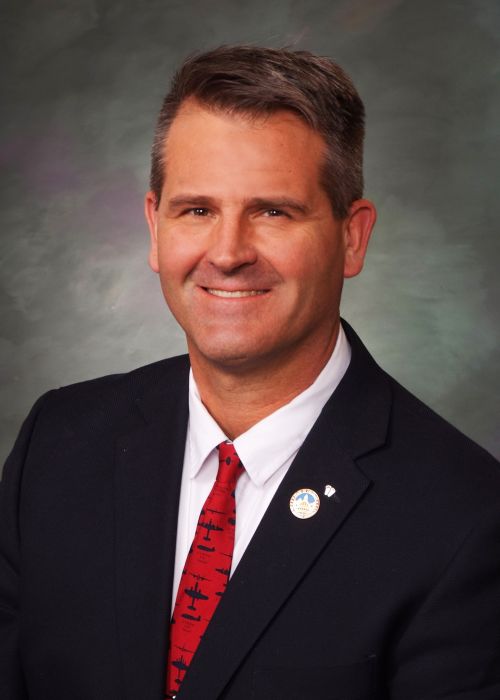
Rep. Ken DeGraaf
Sponsored bills
The bill establishes a private school tuition income tax credit for income tax years commencing on or after January 1, 2024, that allows any taxpayer to claim a credit when the taxpayer enrolls a qualified child in a private school or the taxpayer provides a scholarship to a qualified child for enrollment in a private school. The private school issues the taxpayer a credit certificate and the amount of the credit is: For full-time attendance, an amount equal to either the tuition paid or the scholarship provided to a qualified child, as applicable, or 60% of the previous year's state average per pupil revenues, whichever is less; and For half-time attendance, an amount equal to either the tuition paid or the scholarship provided to a qualified child, as applicable, or 30% of the previous year's state average per pupil revenues, whichever is less. The bill also establishes an income tax credit for income tax years commencing on or after January 1, 2024, that allows any taxpayer who uses home-based education for a qualified child to claim an income tax credit in an amount equal to: 40% of the previous year's state average per pupil revenues for a taxpayer who uses home-based education for a qualified child who was enrolled on a full-time basis in a public school in the state prior to being taught at home; and 20% of the previous year's state average per pupil revenues for a taxpayer who uses home-based education for a qualified child who was enrolled on a half-time basis in a public school in the state prior to being taught at home. Both credits may be carried forward for 3 years but may not be refunded. In addition, the credits may be transferred, subject to certain limitations. (Note: This summary applies to this bill as introduced.)

The bill states that any federal act, law, executive order, administrative order, rule, and regulation (federal laws) that is, or accomplishes, any of the following is an infringement on the right to bear arms in Colorado: A tax, levy, fee, or stamp not common to all other goods and services that is imposed on a firearm, firearm accessory, or ammunition and that might reasonably be expected to create a "chilling effect" on the purchase or ownership of those items by law-abiding citizens; Any registration or tracking of firearms, firearm accessories, or ammunition; Any registration or tracking of the ownership of firearms, firearm accessories, or ammunition; A prohibition on the possession, ownership, use, or transfer of a firearm, firearm accessory, or ammunition by law-abiding citizens; and Any order to confiscate firearms, firearm accessories, or ammunition from law-abiding citizens. The bill prohibits any entity or person from enforcing or attempting to enforce any federal law that infringes on the right to keep and bear arms. The state or a political subdivision that enforces or attempts to enforce a federal law that infringes on the right to keep and bear arms is liable to the injured party and subject to a civil penalty of up to $50,000 per occurrence. The bill prohibits the state or a political subdivision, including a law enforcement agency, from employing a person who, while acting as a federal agent or under color of federal law, knowingly enforced, attempted to enforce, or gave material aid and support to the efforts of another who enforced or attempted to enforce a federal law that infringes on the right to keep and bear arms. The state or a political subdivision who employs the person is subject to a civil penalty of up to $50,000 per employee. (Note: This summary applies to this bill as introduced.)