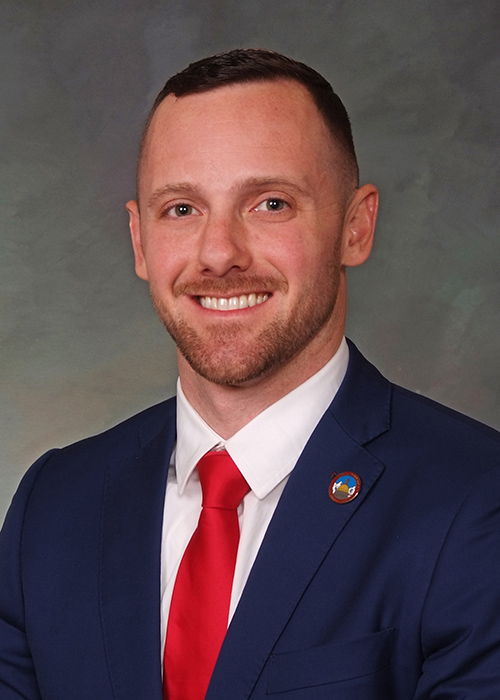
Photo of Jarvis Caldwell
R Colorado House · District 20 On the 2026 ballot

Rep. Jarvis Caldwell

Compare
Total votes
1,592
all sessions
Attendance
98%
37 missed
Higher than 83% of chamber peers
With party
93%
of cast votes
Lower than 84% of chamber peers
Bipartisan score
5%
crosses aisle rarely
Higher than 83% of chamber peers
Sponsored
239
bills & resolutions
Near the chamber average
Committees
2
assignments
239 bills and resolutions

Sponsored bills

Total
239
Primary
33
Co-sponsor
206
This page
239
matching current filters
Co-sponsor HB 1297
Signed into law · Colorado House · Co-sponsor
Uniform Language for Misdemeanor Traffic Offense

In existing law, both 'misdemeanor traffic offense' and 'traffic misdemeanor' are used to describe the same type of traffic offense. The act amends instances of 'traffic misdemeanor' to make 'misdemeanor traffic offense' the uniform term used throughout statute.(Note: This summary applies to this bill as enacted.)

Signed into law May 5, 2026 1 co-sponsor
Co-sponsor HB 1296
Signed into law · Colorado House · Co-sponsor
Revision to Nurse & Nurse Aide Practice Act

In 2025, House Bill 25-1082 added physician assistants and advanced practice registered nurses to the professions subject to discipline for a failure to timely complete a medical certification for a certificate of death. The act adds the repeated or willful failure, without reasonable cause, to comply with the requirements of completing a medical certification for a certificate of death to the grounds for discipline in the 'Nurse and Nurse Aide Practice Act'.(Note: This summary applies to this bill as enacted.)

Signed into law May 5, 2026 1 co-sponsor
Co-sponsor HB 1238
Signed into law · Colorado House · Co-sponsor
Designating Emergency Medical Services Essential Services

The act declares emergency medical services as an essential service in the state and an integral part of the state's health-care infrastructure.      The act also declares that emergency medical service providers, whether responding on duty or as a volunteer and regardless of location, provide essential services when providing emergency ambulance services and nonemergency ambulance services.      The act also updates certain definitions related to emergency medical services, including the addition of a definition of 'out-of-hospital services', which term is defined to mean the furnishing of necessary health-care goods and services outside of a hospital setting but does not include prehospital setting transports.     The act clarifies that an off-duty emergency medical service provider is not obligated to respond to the scene of a medical emergency or provide emergency medical services.(Note: This summary applies to this bill as enacted.)

Signed into law May 5, 2026 1 co-sponsor
Primary HB 1333
Signed into law · Colorado House · Lead sponsor
Fiscal Year 2026-27 Legislative Appropriation Bill

The bill makes appropriations for matters related to the legislative department for the 2026-27 state fiscal year.(Note: This summary applies to this bill as enacted.)

Signed into law May 4, 2026 0 co-sponsors
Co-sponsor SB 121
Signed into law · Colorado Senate · Co-sponsor
Overtime Threshold for Agricultural Employees

Beginning January 1, 2027, the act requires an agricultural employer to pay certain agricultural employees overtime pay for time worked in excess of 56 hours in a workweek. The act also increases penalties for an agricultural employer who commits wage theft and repeals the authority of the director of the division of labor standards and statistics to adopt rules concerning overtime pay for agricultural employees.(Note: This summary applies to this bill as enacted.)

Signed into law May 4, 2026 1 co-sponsor
Co-sponsor HB 1198
Signed into law · Colorado House · Co-sponsor
Access to Veterinary Care

The act requires the state board of veterinary medicine (board) to review and update the existing process by which an individual who has a license to practice veterinary medicine in another state may be licensed by endorsement to practice veterinary medicine in Colorado. The board shall adopt rules with the intent to expedite the licensure by endorsement process, including eliminating duplicative requirements and streamlining the pathway to licensure.     The act clarifies that a veterinarian who administers, dispenses, distributes, or prescribes medicine to a patient in an emergency situation is not acting as a pharmacist or conducting the practice of pharmacy, and, as such, is not subject to discipline by the state board of pharmacy.     The act relocates certain provisions specific to the practice of veterinary medicine from regulation by the state board of pharmacy to regulation under Colorado's veterinary practice act.     Under current law, the board must approve a credentialing organization for the purpose of credentialing veterinary technicians, which credentialing organization must require the completion of an American Veterinary Medical Association accredited program for veterinary technicians. The act updates the requirement to require the completion of an accredited program for veterinary technicians offered by other associations.     The act also establishes a veterinary prescription drug donation program. An owner of an animal may donate unused veterinary drugs that have been prescribed to the owner to a licensed veterinarian or an animal shelter. A licensed veterinarian may use any drugs accepted through donation if the veterinarian and drugs meet certain conditions.(Note: This summary applies to this bill as enacted.)

Signed into law Apr 29, 2026 1 co-sponsor
Primary SB 22
In committee · Colorado Senate · Lead sponsor
Challenges Meeting 2030 Emissions Reduction Goals

Current law requires certain entities to file a clean energy plan (plan) to achieve an 80% decrease of greenhouse gas emissions caused by the entity's electricity sales in Colorado by 2030 relative to 2005 levels. Other entities may voluntarily choose to file a plan.Under current law, no later than March 31, 2026, an entity required to submit a plan may inform the division of administration (division) in the department of public health and environment in writing of challenges the entity is encountering or expects to encounter in achieving the 80% reduction of greenhouse gas emissions by 2030. The bill clarifies that an entity that has voluntarily submitted a plan may also inform the division of challenges the entity is encountering or expects to encounter in achieving the 80% reduction of greenhouse gas emissions by 2030. The bill also extends the deadline by which an entity must inform the division of challenges from March 31, 2026, to May 31, 2026.A cooperative electric association (association) exempted from regulation by the public utilities commission or a municipal utility (utility) that informs the division of challenges the association or utility is encountering or expects to encounter has until December 31, 2026, to submit to the division an updated plan with the earliest year, not later than 2040, that the association or utility expects to be able to achieve the 80% decrease of greenhouse gas emissions, relative to 2005 levels, without impairing the association's or utility's ability to maintain applicable electric reliability standards and without increasing the association's or utility's average annual electric rates greater than 1.5%.The bill prohibits the air quality control commission and the division from undertaking any action that impairs the association's or utility's ability to maintain applicable electric reliability standards or that increases the association's or utility's average annual electric rates greater than 1.5%.(Note: This summary applies to this bill as introduced.)


In committee Apr 29, 2026 0 co-sponsors
Co-sponsor HB 1023
Signed into law · Colorado House · Co-sponsor
Political Party Liability for Accessibility Requirements

Under current law, a political party must ensure that any person, upon request, is able to participate in a precinct caucus or a party assembly with the use of a video conferencing platform or alternative means of participation. The failure of any political party to make a reasonable effort to comply with these accessibility requirements constitutes discrimination on the basis of disability in a place of public accommodation.     The act clarifies that only a person who is otherwise eligible pursuant to statute to participate in a precinct caucus or a party assembly may request video conferencing or another alternative means of participation. The act also clarifies that a person who is subjected to a violation of a political party's duties regarding these accessibility requirements may file suit only against the central committee of the political party holding the caucus or assembly. An individual, including a member of the central committee of the political party or a volunteer for a political party, may not be held liable for a violation of these accessibility requirements. Upon a finding of a violation of these accessibility requirements, a court may require compliance with the applicable accessibility requirement and either actual monetary damages or a statutory fine of $3,500 for each violation.(Note: This summary applies to this bill as enacted.)

Signed into law Apr 27, 2026 1 co-sponsor
Co-sponsor HB 1024
Signed into law · Colorado House · Co-sponsor
Raising Age of Voluntary Relinquishment of Child

Under current law, a parent can voluntarily relinquish their child to a firefighter or hospital or community clinic emergency center staff member if the child is less than 72 hours old. The act allows a parent to voluntarily relinquish their child if the child is 30 days old or younger and requires the department of human services to adopt rules establishing a process for either parent of child who was relinquished to reunify with the child.(Note: This summary applies to this bill as enacted.)

Signed into law Apr 27, 2026 1 co-sponsor
Co-sponsor SJR 20
Passed · Colorado Senate · Co-sponsor
Recognize Home Education Day

Maddy summaryThis bill designates April 9, 2026, as "Home Education Day" in Colorado to honor parents who educate their children at home. It does not change any laws or affect how education is administered but serves as a symbolic recognition of home schooling within the state. The resolution highlights the number of home-educated students in Colorado and the estimated financial savings to taxpayers associated with this educational choice. Ultimately, the measure is a ceremonial gesture that celebrates home educators without altering existing policies or regulations.

Passed Apr 22, 2026 1 co-sponsor
Showing 51 to 60 of 239 bills
Previous 1 … 5 6 7 … 24 Next