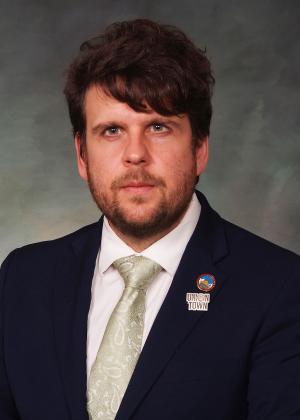
Photo of Javier Mabrey
D Colorado House · District 1 On the 2026 ballot

Rep. Javier Mabrey

Compare
Total votes
3,604
all sessions
Attendance
98%
67 missed
Near the chamber average
With party
96%
of cast votes
Higher than 78% of chamber peers
Bipartisan score
2%
crosses aisle rarely
Near the chamber average
Sponsored
374
bills & resolutions
Near the chamber average
Committees
4
assignments
374 bills and resolutions

Sponsored bills

Total
374
Primary
94
Co-sponsor
280
This page
374
matching current filters
Co-sponsor SB 13
Signed into law · Colorado Senate · Co-sponsor
Exclude Cohabitation from Elements of Bigamy

Maddy summarySB 13 removes cohabitation (living together as a couple) from the legal definition of bigamy in Colorado. It changes the law so that merely living with someone else without a formal marriage or civil union no longer constitutes bigamy. The bill specifically amends Colorado's bigamy statute to delete "cohabits" as a potential element and repeals the definition of "cohabitation" in the law. This change directly affects individuals living together without marriage, ensuring they cannot be charged with bigamy solely based on their living arrangement.

Signed into law Mar 26, 2026 1 co-sponsor
Co-sponsor HB 1035
Signed into law · Colorado House · Co-sponsor
Enactment of Colorado Revised Statutes 2025

The bill enacts the softbound volumes of the Colorado Revised Statutes 2025, the subsequent changes approved by the voters at the statewide election on November 4, 2025, and the 2025 Colorado First Extraordinary Session Supplement as the positive and statutory law of the state of Colorado and establishes the effective date of said publication.(Note: This summary applies to this bill as enacted.)

Signed into law Mar 26, 2026 1 co-sponsor
Co-sponsor HB 1068
Signed into law · Colorado House · Co-sponsor
Remote Participation Policies for Joint Committees

The executive committee of the legislative council (executive committee) is authorized to adopt policies regarding the ability of members of the general assembly to remotely participate in interim committee meetings and in legislative proceedings during a disaster emergency. The act expands the executive committee's authority to adopt policies to allow remote participation in meetings of any joint committees comprised of members from both chambers that are held at any time of the year.(Note: This summary applies to this bill as enacted.)

Signed into law Mar 26, 2026 1 co-sponsor
Co-sponsor HM 1002
Passed · Colorado House · Co-sponsor
Memorializing Former Representative Carl Miller

Maddy summaryThis House Memorial honors the life and service of former Colorado Representative Carl Miller, who passed away in August 2025. The document formally recognizes his contributions to Colorado through his work in local government, the mining industry, and public service, including his role in establishing the National Mining Hall of Fame and Museum. It extends condolences to Miller's family and pays tribute to his dedication to his community and state during his career as a state representative and public utility commissioner.

Passed Mar 25, 2026 1 co-sponsor
Primary HB 1001
Signed into law · Colorado House · Lead sponsor
Housing Developments on Qualifying Properties

The act requires a subject jurisdiction to, on or after December 31, 2027, subject to an administrative approval process, allow the construction of a residential development on a qualifying property that does not contain an exempt parcel; except that, if on December 31, 2027, a subject jurisdiction is actively in the process of updating the subject jurisdiction's zoning or development code to comply with the act, the subject jurisdiction is required to complete the updates and allow the construction of a residential development on a qualifying property that does not contain an exempt parcel by June 30, 2028. A qualifying property is real property that contains no more than 5 acres of land and is owned by:A school district;A state college or university;A board of cooperative services;A housing authority;A local or regional transit district or a regional transportation authority serving one or more counties;A nonprofit organization with a demonstrated history of providing affordable housing; orA nonprofit organization that has entered into an agreement with another nonprofit organization with a demonstrated history of providing affordable housing, provided that the agreement requires the nonprofit organization with a demonstrated history of providing affordable housing to develop a residential development on the property.     If a subject jurisdiction requests, as part of an initial development application, that a nonprofit organization with a demonstrated history of providing affordable housing provide documentation that the nonprofit meets required criteria, the nonprofit organization shall provide the documentation. A subject jurisdiction is not required to allow a residential development on a qualifying property if the subject jurisdiction implements a transferable development rights program on the qualifying property and if the transferable development rights program includes a policy for affordable resident housing that is restricted in ownership and occupancy in perpetuity.     A subject jurisdiction shall not:Disallow construction of a residential development on a qualifying property on the basis of height if the tallest structure in the residential development is no more than 3 stories or 38 feet tall, except in certain circumstances;Disallow construction of a residential development on a qualifying property on the basis of height if the tallest structure in the residential development complies with the height requirements of the zoning district in which the residential development will be built or the height requirements that apply to any parcel zoned to allow for residential development that is contiguous to the qualifying property on which the residential development will be built;Disallow construction of a residential development on a qualifying property based on the number of dwelling units the residential development will contain, except in accordance with standards listed in the act; orApply site design standards to a residential development on a qualifying property that are more restrictive than the site design standards the subject jurisdiction applies to similar housing constructed within the subject jurisdiction, including standards related to structure setbacks from property lines; lot coverage or open space; on-site parking requirements; numbers of bedrooms in a multifamily residential development; on-site landscaping, screening, and buffering requirements; solar access; minimum dwelling units per acre; or other objective setback standards that apply to residential dwellings, including setbacks from oil and gas facilities, oil and gas operations, stream corridors, riparian areas, wetlands, and sensitive wildlife habitats.     Provided that the uses are allowed conditionally or by right within the zoning district in which a qualifying property is located, a subject jurisdiction shall allow the following uses in a residential development on a qualifying property:Child care; andThe provision of recreational, social, or educational services provided by community organizations for use by the residents of the residential development and the surrounding community.     On or before December 31, 2027, the department of local affairs is required to publish guidance to assist subject jurisdictions in verifying the status of a nonprofit organization with a demonstrated history of providing affordable housing.(Note: This summary applies to this bill as enacted.)


Signed into law Mar 25, 2026 0 co-sponsors
Co-sponsor SB 1
Signed into law · Colorado Senate · Co-sponsor
Workforce Housing & Housing Tax Credit

The act allows a board of county commissioners and the governing body of a municipality to sell and dispose of property owned by the county or municipality, as applicable, to provide for affordable housing and allows a municipality to enter into a long-term rental or lease agreement for the development of affordable housing.     The act allows for the approval of a mutijurisdictional housing authority at a biennial local election instead of only during a general election or an election held on the first Tuesday in November of an odd-numbered year. The ballot question about establishing the authority may be combined with a question about a tax, impact fee, multiple-fiscal year debt, or other financial obligation.     The act allows a board of county commissioners to use ad valorem tax revenue for housing authorities, housing programs, and workforce housing.     The act entitles an entity subject to income tax to which a middle-income housing tax credit is transferred by a governmental entity or quasi-governmental entity to claim the credit without owning an interest in a qualified project.     The sale and use of construction materials by contractors is exempt from taxation if the materials are used by the state in its governmental capacity only. The act provides that 'governmental capacity' includes the construction of workforce housing projects undertaken by counties.(Note: This summary applies to this bill as enacted.)
Signed into law Mar 25, 2026 1 co-sponsor
Co-sponsor SJR 17
Passed · Colorado Senate · Co-sponsor
Reappoint Kerri L. Hunter as State Auditor

Maddy summaryThis bill reappoints Kerri L. Hunter as Colorado's State Auditor for a five-year term from July 1, 2026, to June 30, 2031. The reappointment follows a unanimous recommendation from the Legislative Audit Committee, which reviews candidates for the position based on qualifications and experience. Under Colorado law, the General Assembly appoints the State Auditor, and this resolution formally approves Hunter's continued service after her initial term ended in 2026. The measure directly affects the State Auditor's office by extending its leadership while maintaining the existing appointment process.

Passed Mar 20, 2026 1 co-sponsor
Co-sponsor HJR 1020
Passed · Colorado House · Co-sponsor
International Women's Day

Maddy summaryThis bill designates March 8, 2026, as International Women's Day in Colorado and acknowledges the historical and ongoing contributions of women to society. It recognizes women's achievements across various fields, including politics, business, and social movements, while highlighting Colorado's early history of women's suffrage and female leadership in state government. The resolution encourages continued celebration of this day and commits the legislature to supporting policies that promote gender equality and women's empowerment.

Passed Mar 17, 2026 1 co-sponsor
Primary HB 1275
In committee · Colorado House · Lead sponsor
Law Enforcement Identification & Immigration Training Requirements

The bill prohibits local and state law enforcement officers from concealing their identity while interacting with the public, with certain exceptions.The bill clarifies state criminal jurisdiction to cover criminal conduct committed by a federal law enforcement officer in the state, even if the officer was acting under color of federal authority. Federal criminal immunity or defense from prosecution does not prohibit state criminal prosecution of a federal law enforcement officer.The bill requires the peace officer standards and training board (P.O.S.T. board) to deny certification to an individual who has previously been employed or who is currently employed by the United States immigration and customs enforcement agency or the United States customs and border protection agency.The bill requires the P.O.S.T. board to prescribe a training for all current and future peace officers regarding immigration law, a peace officer's duty to intervene, excessive force policies, and a peace officer's jurisdictional limit.A peace officer is required to intervene to prevent a federal law enforcement officer from using excessive force.The bill expands the conduct that can constitute the crime of impersonating a peace officer to include a person performing a law enforcement act while concealing the person's identity.(Note: This summary applies to this bill as introduced.)

In committee Mar 17, 2026 0 co-sponsors
Co-sponsor SJR 1
Signed into law · Colorado Senate · Co-sponsor
Water Projects Eligibility Lists

Maddy summaryThis bill approves specific updates to eligibility lists for two Colorado water funding programs. It adds new drinking water projects (like Delta County's distribution system) and modifies existing entries (such as adding "green infrastructure" to Loveland's project), while deleting completed projects (like Kiowa's). These changes determine which local water districts, municipalities, and property associations can access financial assistance from the Drinking Water Revolving Fund and Water Pollution Control Revolving Fund. The bill does not create new funding rules but formally adopts the Commission's proposed list adjustments.

Signed into law Mar 13, 2026 1 co-sponsor
Showing 101 to 110 of 374 bills
Previous 1 … 10 11 12 … 38 Next