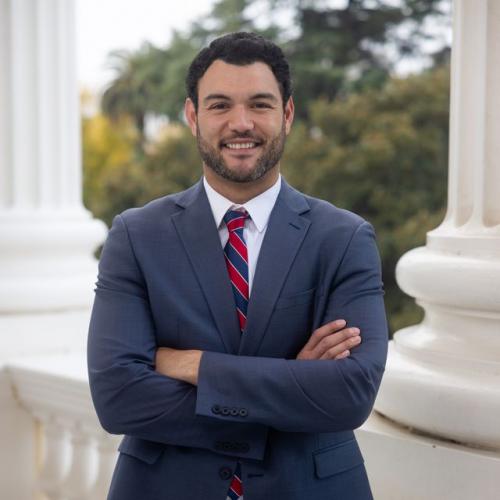
This measure would urge President Donald J. Trump and Congress to protect and maintain the historic investments made possible by the Bipartisan Infrastructure Law, the CHIPS and Science Act, and the Inflation Reduction Act of 2022.
Existing law, the California Integrated Waste Management Act of 1989, administered by the Department of Resources Recycling and Recovery, establishes an integrated waste management program and requires the department to adopt rules and regulations, as necessary, to carry out the act. Existing law requires each city, county, and regional agency, if any, to develop a source reduction and recycling element, household hazardous waste element, and nondisposal facility element of an integrated waste management plan. The act requires the source reduction and recycling element to divert from disposal 50% of all solid waste subject to the element through source reduction, recycling, and composting activities, with specified exceptions. This bill would require a city or county that requires a refundable deposit, performance security, or similar financial guarantee as a condition of issuing a construction, demolition, or building permit for the purpose of ensuring compliance with a construction or demolition debris requirement to return the full amount of the deposit if documentation demonstrating compliance with the terms of the deposit is provided, as specified.
Existing law, the Administrative Procedure Act, sets forth the requirements for the adoption, publication, review, and implementation of regulations by state agencies. The Safe Drinking Water, Wildfire Prevention, Drought Preparedness, and Clean Air Bond Act of 2024 (act) , approved by the voters as Proposition 4 at the November 5, 2024, statewide general election, authorized the issuance of bonds in the amount of $10,000,000,000 pursuant to the State General Obligation Bond Law to finance projects for safe drinking water, drought, flood, and water resilience, wildfire and forest resilience, coastal resilience, extreme heat mitigation, biodiversity and nature-based climate solutions, climate-smart, sustainable, and resilient farms, ranches, and working lands, park creation and outdoor access, and clean air programs. Existing law authorizes certain regulations needed to effectuate or implement programs of the act to be adopted as emergency regulations in accordance with the Administrative Procedure Act, as provided. Existing law requires the emergency regulations to be filed with the Office of Administrative Law and requires the emergency regulations to remain in effect until repealed or amended by the adopting state agency. This bill, notwithstanding the above, would exempt the adoption of regulations for purposes of developing and adopting program guidelines and selection criteria needed to effectuate or implement programs of the act from the requirements of the Administrative Procedure Act, as provided. The bill would require a state entity that receives funding to administer a competitive grant program established using the Administrative Procedure Act exemption to do certain things, including, among other things, to develop draft project solicitation and evaluation guidelines, to transmit copies of the draft guidelines to the fiscal committees and to the appropriate policy committees of the Legislature, to hold a noticed public meeting on the draft guidelines, and to submit the final guidelines to the Secretary of the Natural Resources Agency, except as provided. The bill would require the Secretary of the Natural Resources Agency to post an electronic form of the guidelines submitted by a state entity and the subsequent verifications on the Natural Resources Agency's internet website. The bill would authorize the use of certain previously developed program guidelines and selection criteria for these purposes, as provided. This bill would declare that it is to take effect immediately as an urgency statute.
This measure would request the United States, at the 2026 joint review of the United States-Mexico-Canada Agreement (USMCA) , to secure and publicly adopt measurable and sustained commitments from the parties to eliminate chronic transboundary sewage discharges into the Tijuana River watershed and the flow of untreated sewage, industrial effluent, and toxic pollutants through the New River from Mexicali into the County of Imperial. The measure would further request that the United States commit to automatic nonrenewal of the USMCA should there be a failure of establishing commitments, benchmarks, and timelines relating to specific numeric discharge-reduction benchmarks for both the Tijuana River watershed and the New River, investment into and enforceable timelines for completion of wastewater infrastructure projects, and annual public reporting on compliance.
Existing law defines a "renewable electrical generation facility" as a facility that uses biomass, solar thermal, photovoltaic, wind, geothermal, fuel cells or linear generators that use specified fuels, small hydroelectric generation of 30 megawatts or less, digester gas, municipal solid waste conversion, landfill gas, ocean wave, ocean thermal, or tidal current, and that meets other specified requirements. Existing law incorporates that definition into various programs, including the California Renewables Portfolio Standard Program, which requires the Public Utilities Commission to establish a renewables portfolio standard requiring all retail sellers, as defined, to procure a minimum quantity of electricity products from electrical generating facilities that meet that definition of "renewable electrical generation facility," and the net energy metering program, in which residential customers, small commercial customers, and commercial, industrial, or agricultural customers of an electrical utility, who use renewable electrical generation facilities, are eligible to participate, as specified. This bill would expand the definition of "renewable electrical generation facility" to include a facility that converts hydrogen gas to electricity in a turbine and meets specified criteria, including that the hydrogen used in the turbine is solely derived from an eligible renewable resource, as specified, or through the electrolysis of water, and exclusively uses electricity generated from another renewable electrical generation facility, and that the manufacturing of the hydrogen does not result in resource shuffling or use unbundled renewable energy credits, as specified. Under existing law, a violation of any order, decision, rule, direction, demand, or requirement of the commission is a crime. Because a violation of a commission action implementing this bill's requirements would be a crime, the bill would impose a state-mandated local program. The California Constitution requires the state to reimburse local agencies and school districts for certain costs mandated by the state. Statutory provisions establish procedures for making that reimbursement. This bill would provide that no reimbursement is required by this act for a specified reason. This bill would declare that it is to take effect immediately as an urgency statute.
This bill designates the week of May 4 to May 10, 2026, as California Wildflower Week to celebrate the state's diverse native flora and its ecological importance. The resolution encourages all Californians to appreciate the beauty of wildflowers, which support pollinators and healthy ecosystems, and highlights the recent opening of Dos Rios State Park as a model for conservation. By formally recognizing this period, the Assembly aims to foster public engagement with outdoor recreation and environmental preservation without imposing new regulations or costs.
Existing law, the Knox-Keene Health Care Service Plan Act of 1975, provides for the licensure and regulation of health care service plans by the Department of Managed Health Care, and makes a willful violation of the act a crime. Existing law provides for the regulation of health insurers by the Department of Insurance. Existing law generally requires a health care service plan contract or a health insurance policy issued, amended, or renewed on or after January 1, 2022, to provide coverage without cost sharing for a colorectal cancer screening test assigned either a grade of A or a grade of B by the United States Preventive Services Task Force and for a required colonoscopy for a positive result on a test with those grades. This bill would additionally require that coverage if the screening test is approved by the United States Food and Drug Administration and either meets requirements for coverage established by the federal Centers for Medicare and Medicaid Services, as specified, or is included in the most recently published guidelines from the American Cancer Society. Because a violation of the bill by a health care service plan would be a crime, the bill would impose a state-mandated local program. The California Constitution requires the state to reimburse local agencies and school districts for certain costs mandated by the state. Statutory provisions establish procedures for making that reimbursement. This bill would provide that no reimbursement is required by this act for a specified reason.
This bill designates the week of May 3 to May 9, 2026, as Compost Awareness Week. It affects the general public and organizations by officially recognizing this specific time period for promoting composting. The measure is a commemorative resolution that does not create new laws or change existing regulations. Instead, it serves to raise awareness about composting through an official state declaration.
This bill designates May 1st of each year as Wildland-Urban Interface Preparedness and Resilience Day. It does not change laws or allocate funding but serves to officially recognize a specific date for awareness. The measure affects the public by encouraging communities to focus on safety and readiness for wildfires in areas where they meet developed land.
Existing law requires the State Energy Resources Conservation and Development Commission (Energy Commission) , in consultation with the Public Utilities Commission (PUC) , the Independent System Operator, and the State Air Resources Board, on or before December 31, 2023, to submit to the Legislature an assessment of the firm zero-carbon resources that support a clean, reliable, and resilient electrical grid in the state and will achieve the policy of the state that eligible renewable energy resources and zero-carbon resources supply 100% of all retail sales of electricity to the state's end-use customers and 100% of electricity procured to serve all state agencies by December 31, 2045, as specified. This bill would require the Energy Commission, working with the PUC, to prepare and submit to the Legislature, on or before January 1, 2028, a statewide assessment of the role and necessity of firm zero-carbon resources in meeting the state's clean energy and reliability objectives, potential technologies and strategies for integrating firm zero-carbon resources into the state's energy mix, recommendations on procurement, policy, and planning actions to deploy and support firm zero-carbon resources, and current and projected renewable and firm zero-carbon generation capacity, reliability requirements under varying system conditions, and the cost and emission implications of firm zero-carbon resources.