

Affordable Insulin Now Act This bill limits cost-sharing for insulin under private health insurance and the Medicare prescription drug benefit. Specifically, the bill caps cost-sharing under private health insurance for a month's supply of selected insulin products at $35 or 25% of a plan's negotiated price (after any price concessions), whichever is less, beginning in 2023. The bill caps cost-sharing under the Medicare prescription drug benefit for a month's supply of covered insulin products at (1) $35 between October 1, 2022, and January 1, 2024; and (2) $35 or 25% of a plan's negotiated price, whichever is less, beginning in 2024. The bill provides funds for FY2022 for the Centers for Medicare & Medicaid Services (CMS) to implement the bill. Currently, the CMS is testing a voluntary model under the Medicare prescription drug benefit (the Part D Senior Savings Model) in which the copayment for a month's supply of insulin is capped at $35 through participating plans. The model is set to expire on December 31, 2025.
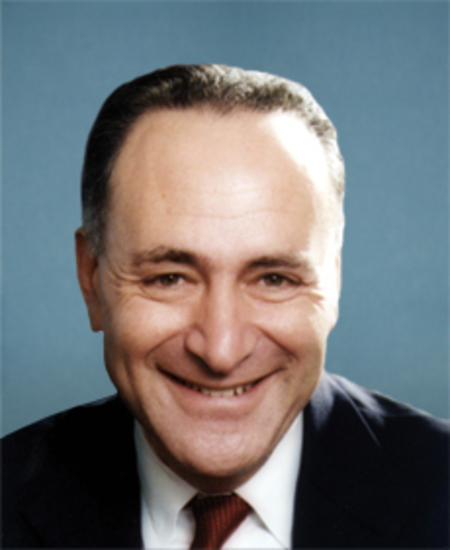
Sen. Charles E. Schumer
Sponsored bills
Northern Border Regional Commission Reauthorization Act of 2022 This bill makes various changes to the authorities and programs of regional economic and infrastructure development commissions. Specifically, the bill reauthorizes the Southwest Border Regional Commission, the Southeast Crescent Regional Commission, and the Northern Border Regional Commission (NBRC) and establishes and expands NBRC grant programs. The NBRC must establish a state capacity building program to provide grants to commission states (Maine, New Hampshire, New York, and Vermont) to better support business retention and expansion in eligible counties and for other specified purposes. Each commission state shall provide to the NBRC an annual work plan that includes the proposed use of the grant. Additionally, the NBRC may make grants for the planning, construction, equipment, and operation of demonstration health, nutrition, and child care projects. Such grants must give special emphasis to projects and activities to address substance use disorders, including opioid and methamphetamine use. The bill authorizes these regional commissions (as part of economic and infrastructure development grants) to (1) design, build, implement, or upgrade transportation or basic public infrastructure or workforce capacity to support the adaptation to and mitigation of climate challenges; and (2) promote the production of housing to meet economic development and workforce needs.
This resolution authorizes (1) Daniel Schwager, a former employee of the Office of the Secretary of the Senate, to provide testimony in the case of United States v. Reffitt (except concerning matters for which a privilege should be asserted); and (2) the Senate Legal Counsel to represent Mr. Schwager and any current or former employee of his office in connection with the production of evidence in that case.
Schedules That Work Act This bill provides employees with the right to request changes to their work schedules related to the number of hours they are required to work or be on call, the location of the work, the amount of notification about work schedule assignments, and fluctuations in work hours. Employers must negotiate in good faith with employees who make such requests and comply with certain work schedule notice and split shift pay requirements for retail, food service, cleaning, hospitality, or warehouse employees.
Violence Against Women Act Reauthorization Act of 2022 This bill modifies and reauthorizes through FY2027 programs and activities under the Violence Against Women Act that seek to prevent and respond to domestic violence, sexual assault, dating violence, and stalking. The bill also authorizes new programs, makes changes to federal criminal laws, and establishes new protections to promote housing stability and economic security for victims of domestic violence, sexual assault, dating violence, and stalking.
Rural Outdoor Investment Act This bill directs the Department of Commerce to make grants to eligible recipients for outdoor recreation projects to spur economic development, with a focus on rural communities. Commerce shall develop a partnership agreement to provide for the development of, among other things, basic training, including in-person or modular training sessions, for small businesses and rural communities.
Fluke Fairness Act of 20 21 This bill directs the Mid-Atlantic Fishery Management Council to submit a modified fishery management plan for the commercial and recreational management of summer flounder (commonly known as fluke), or an amendment to the plan, to the Department of Commerce. The plan must establish commercial quotas in direct proportion to the distribution, abundance, and location of summer flounder as reflected by fishery independent surveys conducted by the National Marine Fisheries Service and state agencies; consider regional, coastwide, or other management measures that comply with national standards under the Magnuson-Stevens Fishery Conservation and Management Act; and prohibit the establishment of commercial catch quotas on a state-by-state basis using historical landings data that does not reflect the status of the summer flounder stock, based on the most recent scientific information. Commerce must prepare and consider a plan if the council fails to submit the modifications or amendments. The Government Accountability Office must assess and report on whether the subsequent implementation of the approved plan or amendment complies with national standards.
Ghost Army Congressional Gold Medal Act This bill provides for the award of a Congressional Gold Medal to the 23rd Headquarters Special Troops and the 3133rd Signal Services Company, known collectively as the Ghost Army , in recognition of unique and highly distinguished service during World War II.
Willie O'Ree Congressional Gold Medal Act This bill provides for the award of a Congressional Gold Medal to Willie O'Ree or, if unavailable, to a member of his family, in recognition of his contributions and commitment to hockey, inclusion, and recreational opportunity. The amounts received from the sale of duplicate medals shall be deposited in the U.S. Mint Public Enterprise Fund.
Defending Ukraine Sovereignty Act of 2022 This bill authorizes security assistance for Ukraine, requires sanctions against Russia if it escalates hostilities in or against Ukraine, and addresses related issues. The bill (1) authorizes the Department of Defense to use various authorities to provide and expedite the delivery of defense articles to support Ukraine's armed forces, (2) allows the President to exercise drawdown authority to provide defense articles to Ukraine, and (3) authorizes the Department of State to provide International Military Education and Training assistance to Ukraine. The President must periodically determine whether Russia's government is significantly escalating hostilities in or against Ukraine and whether such an escalation has the aim or effect of undermining Ukraine's government or interfering with Ukraine's sovereignty or territorial integrity. If the President determines that Russia's government has engaged in such escalation, the President must impose sanctions on (1) certain government officials, including Russia's president and prime minister; (2) certain Russian financial institutions; (3) entities involved in certain transactions involving Russian debt; (4) entities (and corporate officers of such entities) involved in constructing or operating Russia's Nord Stream 2 natural gas pipeline; and (5) certain entities involved in Russian resource extraction industries. The President may terminate such sanctions after certifying to Congress that Russia's government has taken certain actions, such as entering into an agreed settlement with Ukraine's legitimate democratic government. The bill also authorizes Radio Free Europe/Radio Liberty to explore opening new bureaus to reach new audiences on Russia's periphery. The State Department must establish an initiative to deepen and foster ties with the Baltic states.