

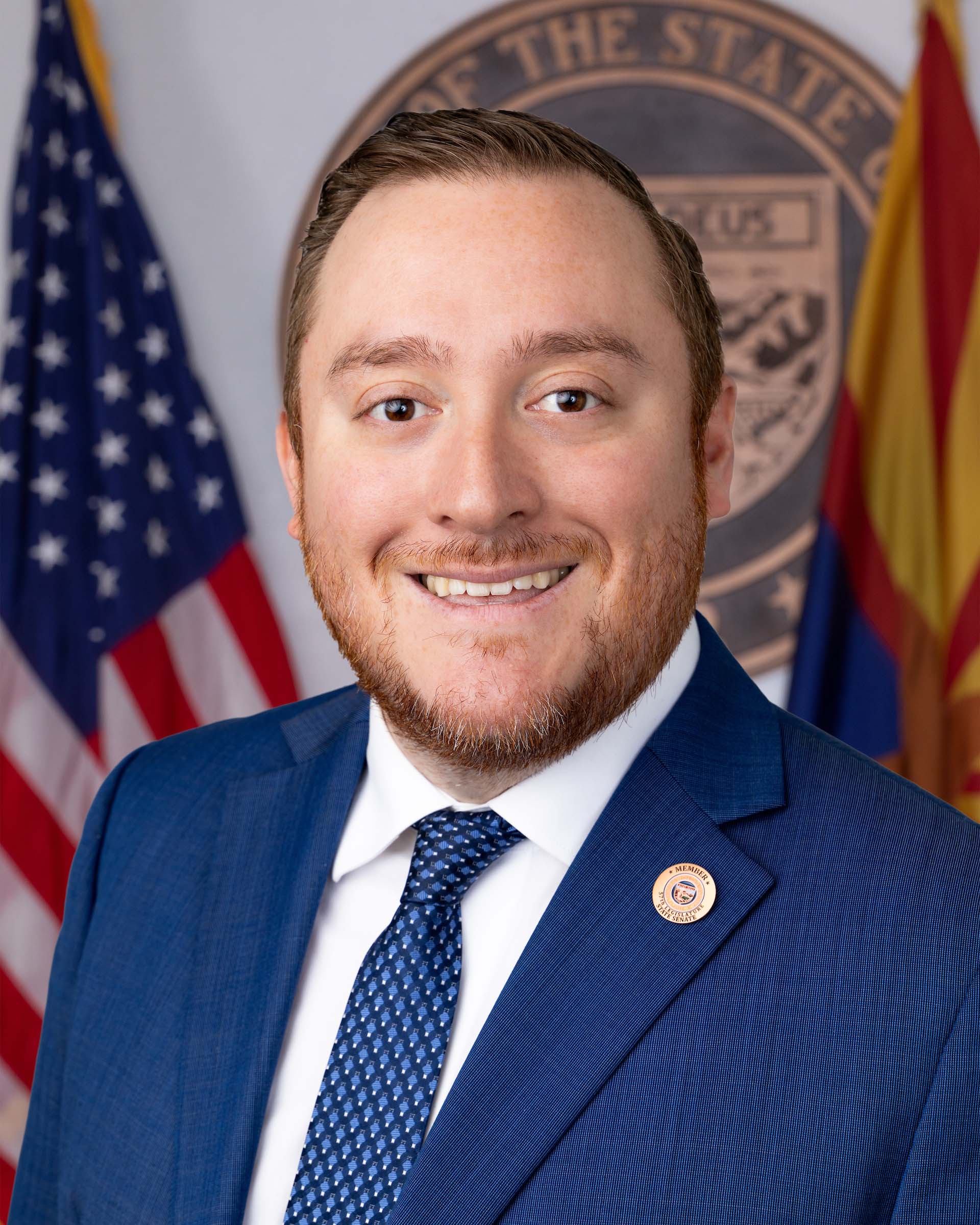
Photo of Flavio Bravo
D Arizona Senate · District 26 On the 2026 ballot

Sen. Flavio Bravo

Compare
Total votes
2,934
all sessions
Attendance
87%
373 missed
Lower than 82% of chamber peers
With party
94%
of cast votes
Near the chamber average
Bipartisan score
5%
crosses aisle rarely
Near the chamber average
Sponsored
306
bills & resolutions
Near the chamber average
Committees
5
assignments
306 bills and resolutions

Sponsored bills

Total
306
Primary
18
Co-sponsor
288
This page
306
matching current filters
Co-sponsor SB 1461
Failed · Arizona Senate · Co-sponsor
allied health care workforce; appropriation

Maddy summarySB 1461 allocates $15 million from Arizona's general fund for a new allied health workforce development program targeting roles like medical technicians and therapists (requiring specialized training beyond high school but less than a bachelor's degree). The program will fund a nonprofit meeting strict criteria, including prior training of 7,000+ students, partnerships with employers and schools, and operating in at least eight states. The nonprofit must commit to graduating 1,000 students annually through this initiative. This direct funding aims to expand training capacity for non-physician, non-nurse healthcare roles across Arizona.

Failed Mar 31, 2026 1 co-sponsor
Co-sponsor SB 1776
Passed · Arizona Senate · Co-sponsor
traditional healing services; AHCCCS

Maddy summarySB 1776 adds "traditional healing services" to the list of covered health services under Arizona's AHCCCS (Medicaid) program. It specifically covers these services only for AHCCCS members who qualify through the Indian Health Service or tribal facilities, as defined by federal regulations. The services must be delivered by or through an Indian Health Service, urban Indian organization, or tribal facility. This is a targeted addition to existing coverage, not a broad expansion, and does not change funding or eligibility outside these specific tribal partnerships.

Passed Mar 25, 2026 1 co-sponsor
Co-sponsor SB 1602
Passed · Arizona Senate · Co-sponsor
kinship foster care stipend; increase

Maddy summaryArizona's SB 1602 increases monthly stipends for kinship foster parents caring for children in state custody. The bill raises the stipend to $400 per child monthly for 2026-2027, $500 for 2027-2028, and $600 starting in 2029. This directly affects relatives or individuals with significant relationships who provide foster care for children removed from their homes. The increase applies to the existing stipend program under Arizona law, supplementing other financial benefits like full foster care payments or Temporary Assistance for Needy Families. The bill amends Section 8-514.03 of Arizona Revised Statutes to implement these specific, time-bound payment amounts.

Passed Mar 25, 2026 1 co-sponsor
Co-sponsor HCR 2064
Passed · Arizona House · Co-sponsor
Barbara Leff; death resolution

Maddy summaryThis is a ceremonial resolution (HCR 2064) expressing the Arizona Legislature's condolences upon the passing of former state legislator Barbara Leff. It honors her 1996-2006 service representing Paradise Valley, her work on HMO reform and economic development, and her contributions to voter information systems. The resolution extends sympathy to her surviving family members (husband, children, grandchildren) and acknowledges her community leadership. It has no policy impact or legislative effect beyond this expression of respect.

Passed Mar 9, 2026 1 co-sponsor
Primary SB 1535
Introduced · Arizona Senate · Lead sponsor
prostitution; assessment; anti-human trafficking fund.

Maddy summarySB 1535 requires courts to collect a $200 assessment from individuals convicted of specific prostitution offenses under Arizona law (ARS 13-3214), with no waiver allowed. The funds collected flow directly to Arizona’s Anti-Human Trafficking Grant Fund, established under ARS 41-1736. This fund supports programs that assist trafficking victims, provide law enforcement support, or offer public education on preventing and identifying human trafficking. The bill does not change prostitution prohibitions but directs penalties toward funding anti-trafficking initiatives.

Introduced Mar 9, 2026 0 co-sponsors
Primary SB 1718
In committee · Arizona Senate · Lead sponsor
special plate; public education foundation

Maddy summarySB 1718 creates "Public Education Foundation special plates" for Arizona vehicle owners. To implement these plates, a donor must pay the state $32,000 upfront, design the plate (subject to state approval), and may combine it with personalized plates. For each plate, owners pay a $25 fee, with $17 of that amount going annually to the Public Education Foundation Special Plate Fund. This directly affects vehicle owners who choose these special plates and fund public education through the annual $17 donation. The bill does not change standard plate requirements or voting records.

In committee Feb 24, 2026 0 co-sponsors
Co-sponsor SB 1603
Introduced · Arizona Senate · Co-sponsor
temporary assistance; child only case

Maddy summarySB 1603 amends Arizona law to clarify eligibility for temporary cash assistance by defining "child only case" in Section 46-101. This specifically covers children in foster care with unrelated adults or nonparent relatives not receiving cash assistance, or placed under court order with such caregivers. The bill ensures these cases are treated separately from "needy families" (which require a parent or relative receiving aid), as stated in Section 46-292. It directly affects children in foster care settings where caregivers do not qualify for cash assistance themselves. The change refines existing eligibility rules without creating new programs or altering benefit amounts.

Introduced Feb 18, 2026 1 co-sponsor
Co-sponsor SB 1690
Introduced · Arizona Senate · Co-sponsor
visually impaired voters; access procedures

Maddy summarySB 1690 (visually impaired voters; access procedures) requires Arizona election officials to provide early ballots to blind or visually impaired voters, voters with print disabilities, and overseas/uniformed service voters through electronic means (like fax or internet) upon request. Voters can choose their preferred method for receiving ballot materials, and officials must send ballots by specific deadlines (no later than 45 days before an election for registered voters). The bill eliminates the need for paper ballots when electronic delivery is used and establishes emergency procedures for national or local crises affecting voting access. This directly affects eligible voters with visual impairments or print disabilities who need accessible ballot delivery options.

Introduced Feb 10, 2026 1 co-sponsor
Co-sponsor SB 1685
Introduced · Arizona Senate · Co-sponsor
Arizona Latino affairs; commission.

Maddy summarySB 1685 establishes the Arizona Commission on Latino Affairs, a body tasked with advising state leadership and supporting Latino communities. The commission includes nine voting members (seven Latino, two non-Latino, appointed by the governor) and eight advisory members with expertise in education, health, civil rights, social services, and small business. Its key duties include advising the governor on policies affecting Latinos, developing recommendations for health, education, and economic programs, and producing an annual report to the legislature. The bill also creates a dedicated fund for the commission’s operations and mandates an annual "Latino Legislative Day" to honor community contributions and discuss issues.

Introduced Feb 10, 2026 1 co-sponsor
Co-sponsor SB 1608
Introduced · Arizona Senate · Co-sponsor
landlords; habitable conditions; temperatures

Maddy summarySB 1608 sets specific indoor temperature requirements for rental properties in Arizona, mandating that landlords maintain rooms at no more than 82°F in warm weather and no lower than 68°F during extreme cold, measured mid-room at 3 feet above ground. It shortens tenant notice periods for heating/cooling failures affecting health to 2 days (from 10 days) and prohibits evictions during weeks with two or more days exceeding 90°F outdoor temperatures. The bill directly affects landlords (requiring compliance with temperature standards and maintenance) and tenants (providing stronger remedies for unsafe conditions and eviction protection). Key provisions include precise temperature measurements, accelerated tenant remedies for critical failures, and a heat-related eviction ban.

Introduced Feb 10, 2026 1 co-sponsor
Showing 11 to 20 of 306 bills