

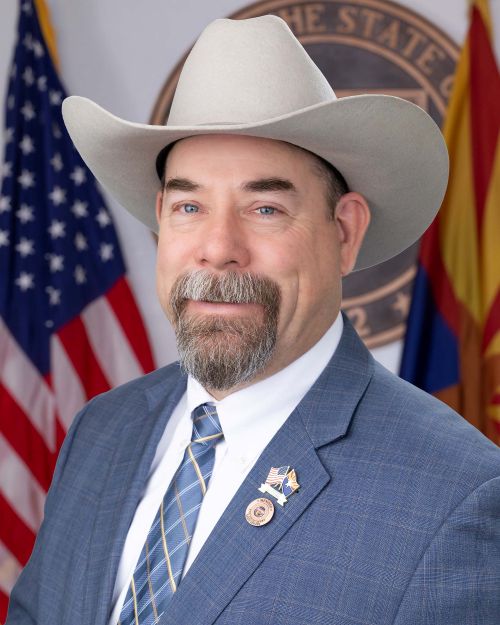
Photo of David Gowan
R Arizona Senate · District 19

Sen. David Gowan

Compare
Total votes
2,872
all sessions
Attendance
99%
29 missed
Higher than 83% of chamber peers
With party
98%
of cast votes
Higher than 80% of chamber peers
Bipartisan score
3%
crosses aisle rarely
Lower than 80% of chamber peers
Sponsored
419
bills & resolutions
Near the chamber average
Committees
3
assignments
419 bills and resolutions

Sponsored bills

Total
419
Primary
191
Co-sponsor
228
This page
419
matching current filters
Primary SB 1500
Introduced · Arizona Senate · Lead sponsor
condominiums; planned communities; assessments

Maddy summarySB 1500 limits annual fee increases for condo and planned community associations in Arizona. For condos (Section 33-1242), associations cannot raise regular fees by more than 3% without 67% owner approval, and must provide itemized budget details, year-over-year expense comparisons, and cost breakdowns for any increase. For planned communities (Section 33-1803), the cap is 23% with the same disclosure requirements. The bill directly affects all unit owners by requiring associations to justify fee hikes transparently before approval. It aims to prevent vague fee increases and ensure owners understand financial decisions impacting their dues.

Introduced Feb 2, 2026 0 co-sponsors
Primary SB 1499
Introduced · Arizona Senate · Lead sponsor
telecommunication providers; rural areas

Maddy summarySB 1499 defines "telecommunications service provider" in Arizona law to include traditional phone companies, broadband providers, and cell carriers. It requires the state department to negotiate contracts with these providers to deliver services in rural or underserved areas. The bill establishes a formal process for the state to secure telecom services but does not specify funding, service standards, or timelines. This definition would directly affect the state department, telecom companies, and residents in rural Arizona communities lacking adequate service. The bill is currently in early legislative review (Senate First Reading).

Introduced Feb 2, 2026 0 co-sponsors
Primary SB 1132
In committee · Arizona Senate · Lead sponsor
appropriation; Arizona state hospital

Maddy summarySB 1132 appropriates state general fund money for the construction of a new wing at the Arizona State Hospital to expand its facilities. The bill directs the Department of Health Services to use these funds during fiscal year 2026-2027 for this specific construction project. This funding directly supports the hospital's infrastructure improvements and its ability to serve patients. The bill is a straightforward funding measure with no policy changes beyond the allocation.

In committee Jan 28, 2026 0 co-sponsors
Co-sponsor HB 2677
Introduced · Arizona House · Co-sponsor
places of worship; unlawful imprisonment

Maddy summaryHB 2677 amends Arizona law to specifically prohibit preventing someone from entering or exiting a place of worship through physical blocking, detention, or force/threats. This directly affects individuals or entities who obstruct access to religious sites, such as security personnel or others blocking entrances. The bill classifies this act as a class 6 felony (unless the victim is safely released before arrest, making it a misdemeanor), adding it as a specific scenario under unlawful imprisonment. It defines "place of worship" per existing law and clarifies that this provision applies to the specific act of hindering religious access.

Introduced Jan 28, 2026 1 co-sponsor
Co-sponsor HB 2424
Introduced · Arizona House · Co-sponsor
precinct committeemen; proxy voting

Maddy summaryHB 2424 would allow Arizona political parties to permit proxy voting at their committee meetings under specific rules. It requires that state committee members grant proxies only to county voters, county committee members only to precinct voters, and in precincts with two or fewer committeemen, a committeeman may appoint a voter from an adjoining precinct to vote at county committee meetings. Proxies would be valid only for the duration of the meeting and must be notarized or witnessed by two people. This bill directly affects political party committee members and qualified voters who might serve as proxies.

Introduced Jan 26, 2026 1 co-sponsor
Primary SB 1269
Introduced · Arizona Senate · Lead sponsor
fire districts; formation; county supervisors

Maddy summarySB 1269 updates Arizona's process for creating fire districts and similar special districts (like community park maintenance or sanitary districts). It requires anyone proposing a new district to prepare a detailed impact statement showing boundaries, property valuations, estimated tax changes for residents, and the expected benefits and drawbacks. The county board of supervisors must hold a public hearing, notify property owners in the proposed area, and decide if the district would promote public health, comfort, convenience, necessity, or welfare. If approved, the proposer must collect signatures from property owners within one year to meet a minimum threshold before the district is formed. This process ensures transparency and community input before new districts are established.

Introduced Jan 22, 2026 0 co-sponsors
Co-sponsor HB 2316
Introduced · Arizona House · Co-sponsor
middle school students; CTE courses

Maddy summaryHB 2316 allows Arizona middle schools (grades 6-8) to offer career technical education (CTE) courses that count toward both 8th-grade promotion and high school graduation. Schools must partner with approved CTE providers like community colleges or state-approved programs, and students must pass courses to earn credit. The bill requires schools to report course offerings and completions annually, with a final report due by 2029, and expires in 2037. It permits CTE districts to fund middle school CTE courses without raising property taxes but prohibits counting middle school students in district enrollment totals.

Introduced Jan 21, 2026 1 co-sponsor
Primary SB 1129
Introduced · Arizona Senate · Lead sponsor
occupational disease; proximate cause; melanoma

Maddy summaryArizona's SB 1129 amends workers' compensation law to create a presumption that melanoma and certain other cancers (like brain, colon, or leukemia) are occupational diseases for peace officers. It directly affects peace officers who developed these cancers after working at least five years in hazardous duty roles (e.g., SWAT or hazardous materials units), provided they had no cancer evidence before employment. The bill presumes the cancer arose from work if the officer was diagnosed while currently employed or within 15 years of retirement (if under age 65), unless tobacco use outside work contributed significantly to respiratory cancers. This changes how claims are evaluated, shifting the burden to employers to prove non-occupational causes for listed cancers.

Introduced Jan 20, 2026 0 co-sponsors
Primary SB 1130
Introduced · Arizona Senate · Lead sponsor
property tax; exemption; widows; widowers

Maddy summarySB 1130 modifies Arizona's property tax exemption rules to provide full tax exemption for widows and widowers of first responders killed in the line of duty. It adjusts veterans' exemptions: those with 100% service-connected disability get full exemption, while others receive a scaled exemption up to $4,188 based on their disability percentage. Eligibility requires income under $34,901 (no children) or $41,870 (with qualifying children), with annual inflation adjustments to these limits. The bill also excludes vehicle taxes from property valuation calculations when determining exemption amounts.

Introduced Jan 20, 2026 0 co-sponsors
Co-sponsor HB 2317
Introduced · Arizona House · Co-sponsor
traffic; vehicle laws; cities; prohibition

Maddy summaryHB 2317 amends Arizona law to prohibit cities and towns from banning "cruising," defined as repetitive driving past the same location without a destination within a specific time period. The bill directly affects local governments by preventing them from enacting or enforcing ordinances that target this type of driving behavior. It updates Section 28-626 of the Arizona Revised Statutes to explicitly state that local authorities "shall not enact or enforce an ordinance... that prohibits cruising." This change ensures uniform traffic laws statewide, allowing cities to create other non-conflicting traffic regulations but not to ban cruising through local ordinances. The bill does not create new penalties or alter other traffic enforcement mechanisms.

Introduced Jan 20, 2026 1 co-sponsor
Showing 71 to 80 of 419 bills
Previous 1 7 8 9 42 Next