

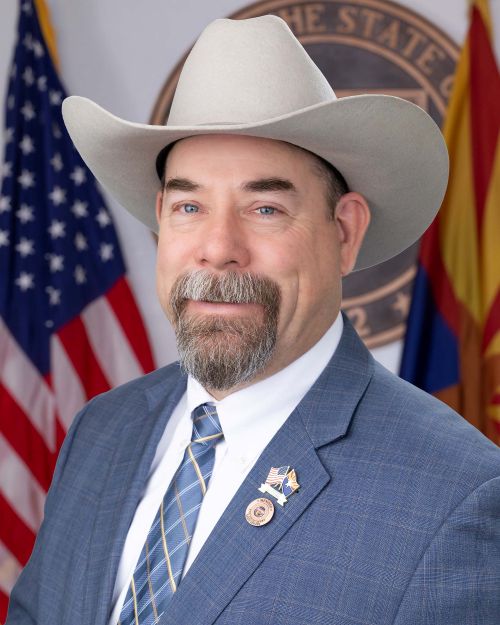
Photo of David Gowan
R Arizona Senate · District 19

Sen. David Gowan

Compare
Total votes
2,872
all sessions
Attendance
99%
29 missed
Higher than 83% of chamber peers
With party
98%
of cast votes
Higher than 80% of chamber peers
Bipartisan score
3%
crosses aisle rarely
Lower than 80% of chamber peers
Sponsored
419
bills & resolutions
Near the chamber average
Committees
3
assignments
419 bills and resolutions

Sponsored bills

Total
419
Primary
191
Co-sponsor
228
This page
419
matching current filters
Co-sponsor HB 2088
Vetoed · Arizona House · Co-sponsor
subsequent AMA; director; removal

Maddy summaryHB 2088 amends Arizona's groundwater management laws to establish procedures for designating new "subsequent active management areas" (SAMAs) and removing them. It allows the director to create SAMAs where groundwater preservation, land subsidence, or water quality issues require action, and to remove SAMAs if these conditions no longer exist. The bill requires public hearings with 30-60 day notice, detailed map and boundary descriptions, and written findings within 30 days of hearings. These changes directly affect landowners and water users in areas meeting the specified groundwater criteria, with all decisions subject to public review and judicial oversight.

Vetoed Apr 15, 2025 1 co-sponsor
Co-sponsor HB 2089
Vetoed · Arizona House · Co-sponsor
subsequent AMA; voters; removal

Maddy summaryHB 2089 allows residents in Arizona groundwater basins designated as "subsequent active management areas" (SAMAs) to petition for removal of that designation after 10 years. It requires 10% of registered voters in the SAMA to file a petition within 180 days before a general election, triggering a review by the groundwater director on whether the designation remains necessary. If the director determines removal is appropriate, a vote is held; otherwise, the designation stays. The bill directly affects residents in SAMAs and was passed by the legislature in April 2025 but vetoed by the governor on April 15.

Vetoed Apr 15, 2025 1 co-sponsor
Co-sponsor HB 2086
Vetoed · Arizona House · Co-sponsor
water improvements program; water hauling

Maddy summaryHB 2086, vetoed by the Governor on April 15, 2025, proposed a county-administered program providing grants to low-income or fixed-income homeowners for specific water improvements. The bill would have allowed grants to deepen existing drinking water wells, install storage tanks for water hauling, or upgrade plumbing for water delivery systems at a residence. County boards would designate an operating entity (like a nonprofit or county department) to set eligibility criteria and manage funds, but prohibited using general county funds for the program. The bill required annual reports on program operations but never took effect due to the gubernatorial veto.

Vetoed Apr 15, 2025 1 co-sponsor
Co-sponsor SB 1495
Passed · Arizona Senate · Co-sponsor
national guard; active duty; requirements

Maddy summaryArizona's SB 1495 requires the state's National Guard to stay within Arizona unless Congress formally declares war or takes specific action under the U.S. Constitution (Article I, Section 8, Clause 15) to call the Guard for specific purposes like enforcing federal law or repelling invasion. The bill defines "active duty combat" as participating in armed conflict, performing hazardous duties related to conflict abroad, or using "instrumentality of war." It mandates the governor to ensure compliance with these requirements before deploying the Guard. This bill directly affects Arizona's National Guard deployment decisions and the governor's authority to release troops. The measure is procedural, focusing on constitutional requirements for Guard mobilization.

Passed Apr 7, 2025 1 co-sponsor
Primary SB 1159
Signed into law · Arizona Senate · Lead sponsor
employment practices; wage claims

Maddy summarySB 1159 amends Arizona law to increase the maximum amount employees can claim for unpaid wages from $5,000 to $12,000 and extends the filing deadline to one year from when wages accrued. The bill allows employees to file written claims with the Arizona Department of Labor for unpaid wages under this threshold, with the department authorized to collect payments and deposit them into a special state fund for disbursement to claimants. It clarifies that employees or the department may pursue remedies like garnishment or judgment to recover unpaid wages. This law, signed by the governor on April 2, 2025, directly affects Arizona workers with unpaid wages below $12,000 who missed the previous filing window.

Signed into law Apr 2, 2025 0 co-sponsors
Co-sponsor HB 2677
Passed · Arizona House · Co-sponsor
middle school students; CTE courses

Maddy summaryHB 2677 allows Arizona middle school students (grades 6-8) to earn career and technical education (CTE) course credits that count toward both 8th-grade promotion and high school graduation. Schools offering these courses must partner with approved CTE providers, such as career districts, state-approved schools, or community colleges. They must report annually to the state on course offerings and student completions, with a final summary due by December 2028. The law applies only through the 2027-2028 school year and expires December 31, 2036.

Passed Apr 1, 2025 1 co-sponsor
Co-sponsor HB 2087
Passed · Arizona House · Co-sponsor
appropriation; groundwater recharge facilities; maintenance

Maddy summaryHB 2087 appropriates $________ from Arizona's state general fund for fiscal year 2025-2026 to clean and restore specific artificial groundwater recharge facilities. It directly affects the state department responsible for water management and communities relying on these facilities in designated groundwater basins that also provide flood control benefits. The bill requires funding only for facilities meeting two criteria: being in a state-designated groundwater management area and offering flood control. The appropriation is exempt from standard rules requiring annual reauthorization. This bill focuses solely on funding mechanisms, not policy changes to water management.

Passed Apr 1, 2025 1 co-sponsor
Co-sponsor HB 2456
Passed · Arizona House · Co-sponsor
appropriation; fire incident management grants..

Maddy summaryHB 2456 appropriates $6.5 million from Arizona's general fund for a fire incident management grant program, directly funding municipal fire departments and fire districts. The bill requires grant recipients to use funds for secure technology systems that standardize incident command (including clear chains of command and shared terminology), enable real-time resource tracking, and allow secure communication and collaboration during emergencies - like sharing maps or managing mass casualty incidents. Grants fully cover the cost of these systems for three years, awarded on a first-come basis, with no more than $250,000 used for program administration. The system must work offline, support federal emergency management standards, and include features like firefighter safety monitoring and smartphone apps for responders.

Passed Apr 1, 2025 1 co-sponsor
Co-sponsor HB 2855
Passed · Arizona House · Co-sponsor
terrorist organizations; drug cartels

Maddy summaryHB 2855 declares that drug cartels operating in Arizona are terrorist organizations under state law. It defines "drug cartel" to include groups involved in human smuggling, drug trafficking, or terrorism, and requires the Arizona Department of Homeland Security to address the threat they pose. The bill explicitly states this definition does not affect individuals' claims for asylum under federal law. This legislation aims to empower state agencies to combat border-related criminal activity, based on voter-approved findings about public safety concerns linked to transnational cartels.

Passed Mar 31, 2025 1 co-sponsor
Primary SB 1153
Signed into law · Arizona Senate · Lead sponsor
write-in candidates; nomination paper filing

Maddy summaryThis bill establishes new requirements for Arizona voters who want to run as write-in candidates for state or local offices. To qualify, write-in candidates must be residents of the district for 120 days before the election, file detailed information (including address, age, and birth date) by specific deadlines (typically 40-60 days before the election), and prove they owe no more than $1,000 in unpaid fines or penalties. Candidates who previously failed to win a primary election or submit sufficient petition signatures are also disqualified. The law applies to all write-in candidates except for presidential races, which require additional documentation naming a vice-presidential running mate and electors.

Signed into law Mar 31, 2025 0 co-sponsors
Showing 131 to 140 of 419 bills
Previous 1 … 13 14 15 … 42 Next