

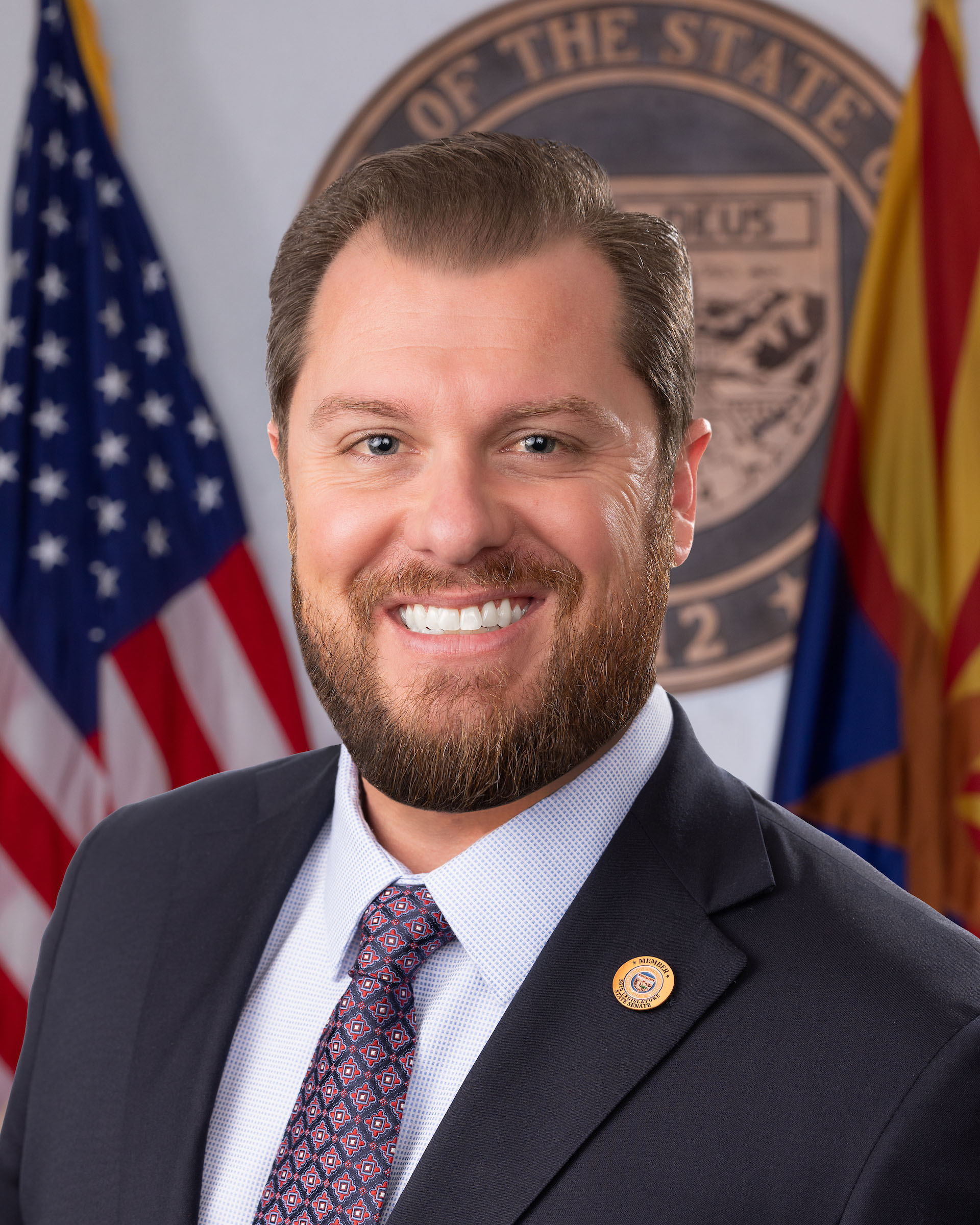
Maddy summarySB 1340 requires the Joint Legislative Audit Committee to conduct a regular audit of Arizona's Department of Law and Attorney General's Office by July 1, 2027. This bill modifies the existing 10-year audit schedule to add these agencies, covering their programs, activities, and funds. The audit will follow established legislative review factors, ensuring oversight of how these offices manage public resources. This procedural bill directly affects the Attorney General's Office and Department of Law, mandating a formal review of their operations.
Sen. Jake Hoffman
Sponsored bills
Maddy summarySB 1111 imposes a fee on businesses (like money transmitters) sending foreign money transfers: $25 for transfers under $500, plus 5% for amounts over $500. The fees collected fund the "Arizona Deportations Fund," which provides $2,500 grants to law enforcement agencies for each individual deported after federal confirmation. The bill also creates a tax credit for businesses that pay this fee, allowing them to offset the cost against state income taxes. This law directly affects businesses handling international money transfers and law enforcement agencies receiving deportation-related grants, with no mention of other affected groups.
Maddy summaryThis concurrent resolution (SCR 1005) encourages Arizona's State Retirement System and Public Safety Personnel Retirement System to study the potential inclusion of Bitcoin and digital asset exchange-traded funds (ETFs) in their investment portfolios. It directs these systems to monitor market developments, consult with SEC-approved digital asset ETF providers, and submit a detailed feasibility report to state officials before the next legislative session. The resolution does not mandate any investment but seeks to evaluate risks, benefits, and safe implementation options for retirement funds. It reflects growing institutional interest in digital assets, noting over 11 approved Bitcoin ETFs and $16 trillion in global assets under management for related firms.
Maddy summaryHB 2703 would have amended Arizona election law to update rules for polling places and early voting. It required counties to adjust precinct boundaries if early voting ballots might reduce in-person turnout at specific locations, allowed voting centers (where voters can cast ballots at any location in the county), and established procedures for emergency voting centers during elections. The bill also updated school polling place requirements, mandated voter notification for polling place changes, and addressed ballot tabulation deadlines for early voting. Passed by the legislature in February 2025, the bill was vetoed by the governor the same month.
Maddy summaryThis bill would have amended Arizona election law to change how counties establish polling places and manage voting locations. It required counties to set precinct boundaries by October 1 before elections, with specific rules for combining precincts or using voting centers where any voter can cast a ballot with ID. The bill also mandated that public schools provide space for polling places unless a principal denies it for safety or space reasons, and created procedures for emergency voting centers during elections. It directly affected county election officials, public schools, and voters across Arizona.
Maddy summarySB 1686 clarifies that the county recorder is the "officer in charge of elections" for Arizona counties, directly affecting county election officials. It updates rules for establishing election precinct boundaries and designating polling places, requiring county recorders to set boundaries by October 1 before elections and follow specific guidelines for combining precincts or using voting centers. The bill also mandates that public schools must provide space for polling places unless principals deny requests with written reasons like lack of space or safety concerns. These changes aim to standardize election administration procedures for county recorders managing polling locations.
Maddy summaryHB 2729 creates a regulated marketplace for selling or leasing groundwater rights within Arizona’s Phoenix, Tucson, and Pinal active management areas. It allows owners of grandfathered groundwater rights to sell or lease portions of those rights (while reserving 35% of their original right), requiring detailed transaction notices to the Department of Water Resources. Buyers receive 65% of the groundwater forgone by sellers, and forgiven water is split 50/50 between aquifer recharge and reserved for future water supply applications. The bill mandates an online public exchange platform for these transactions and exempts conveyed groundwater from replenishment obligations and city water use calculations.
Maddy summarySB 1339 expands the Arizona Auditor General's oversight of community college districts by requiring annual financial audits (including federal compliance checks where applicable) and performance audits. It directly affects community college districts, counties, and school districts by mandating audits to verify proper use of funds (like transportation revenues) and requiring districts to report on implementing audit recommendations within two years. The bill establishes new rules for approving audit contracts, enforcing uniform accounting standards, and reporting failures to comply with audit requirements to legislative committees and the governor. These changes aim to strengthen financial accountability without specifying policy outcomes.
Maddy summarySB 1099 prohibits Arizona state agencies, cities, counties, and their contractors from exposing minors to sexually explicit materials. It also bans using government-owned or managed facilities for filming sexually explicit acts. The bill defines "sexually explicit materials" as content depicting sexual conduct, sexual excitement, or "ultimate sexual acts" (including intercourse, oral sex, or bestiality). Violating this law is classified as a class 5 felony, punishable by up to 2.5 years in prison. The law directly affects government entities, their contractors, and the use of public facilities.
Maddy summarySB 1090 prohibits public schools and libraries in Arizona from using or directing minors to sexually explicit materials. Schools must obtain written parental consent for each material with serious educational value and provide alternative assignments for students without consent. Libraries are similarly barred from facilitating minors' access to such materials. Violations by staff acting with criminal negligence are classified as class 5 felonies. The bill directly affects public school and library staff, students, and minors accessing these resources.